What Size Solar Panel to Charge a Car Battery: A Practical Guide
Learn how to size a solar panel to charge a car battery. This step-by-step guide covers energy needs, sun hours, and safety to help homeowners install an efficient, reliable solar charging setup.


You should size your solar panel for charging a car battery by calculating the battery's energy needs, estimating average daily sun hours, and choosing a charge controller-compatible array that delivers enough energy per day. The result is a panel wattage and array size that meets or exceeds your daily energy target.
Understanding the goal of solar charging for a car battery
If you ask what size solar panel to charge car battery, you’re balancing how much energy the battery stores with how much sun your location receives. A car battery is a 12-volt energy store, and charging it with solar means delivering enough watt-hours over a day to replenish what the battery has used. Your plan depends on the battery’s capacity, daily sun exposure, and the efficiency of your charging equipment. This guide walks you through the math, the setup, and the safeguards so you can size confidently and avoid common mistakes. By the end, you’ll know how to pick a panel, select a controller, and estimate charging time using simple formulas that apply to most passenger vehicles.
The basics: how solar PV turns sunlight into stored energy for a car battery
A solar panel converts sunlight into direct current (DC) electricity. The output depends on panel rating (watts), sunlight quality, temperature, and wiring. A charge controller sits between the panel and the battery to prevent overcharging and to improve efficiency. When sizing, think in terms of energy delivered per day (watt-hours) rather than peak output alone. This helps ensure the battery is recharged safely and consistently across typical weather conditions.
Key factors that influence panel sizing for car charging
Several factors determine the required panel size: daily sun hours at your location, the battery’s usable capacity, the target depth of discharge you’re willing to restore, and the losses from the controller and wiring. Different battery chemistries (lead-acid, AGM, lithium) store energy differently and have distinct charging profiles. Additionally, the efficiency of the charge controller (MPPT vs PWM) and the quality of cabling affect how much energy actually reaches the battery. These variables must be accounted for to avoid under-sizing or over-sizing the system.
A practical sizing method: a formula-driven approach you can apply
To size safely, start with the energy target you want to replenish each day. Let E_target be the daily energy (in watt-hours). Let SunHours be the typical daylight hours with usable sun. Let SystemEfficiency account for controller losses and wiring losses (a conservative placeholder is to assume some percentage of losses). The required panel wattage (P_panel) can be estimated as:
P_panel ≈ E_target / (SunHours × SystemEfficiency)
This equation gives a starting point for selecting a panel and a controller. If your location has fewer sun hours, you’ll want a larger panel or higher-efficiency equipment to compensate. Include a safe margin to cover cloudy days and seasonal changes.
Translating the formula into real-world choices (no exact numbers)
If your battery energy need per day is represented by E_target, and your sun hours are represented by SunHours, you’ll use the formula to approximate a panel size. Then choose a panel within that range and pair it with an MPPT charge controller to maximize usable energy. Plan for wiring losses and controller efficiency, and verify that the total system matches local electrical codes and safety standards. The goal is a balanced system that reliably recharges the battery without overworking components.
Safety, monitoring, and maintenance basics
Always use a proper charge controller, fuses, and a disconnect switch. Regularly inspect connections for corrosion, clean panels as needed, and monitor the battery voltage during charging to ensure it stays within safe limits. Periodic checks help catch issues early and extend battery life. Remember, safety first: keep panels away from water ingress, avoid exposed wiring, and never bypass protection devices.
Tools & Materials
- Solar panel (PV array)(Select wattage range based on sizing method; MPPT recommended for efficiency.)
- Charge controller (MPPT preferred)(Must be compatible with your panel voltage and battery chemistry.)
- 12V car battery or suitable deep-cycle battery(Ensure capacity matches your charging goals and DoD strategy.)
- Conductor wiring and connectors(Use appropriately gauged wire and weatherproof connectors.)
- Fuses/disconnects and mounting hardware(Protect circuits and allow safe shutdown during maintenance.)
- Multimeter or DC testing tool(Measure voltage, current, and verify controller operation.)
- Battery monitor or solar monitoring device(Optional, for ongoing visibility of charge status and health.)
Steps
Estimated time: 2-6 hours
- 1
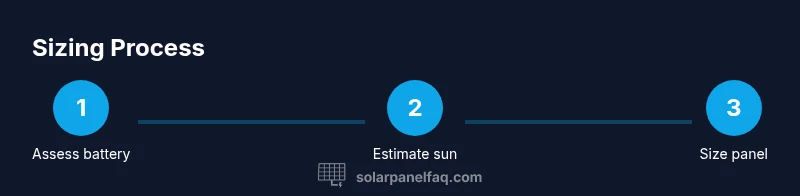
Assess battery capacity and daily charging goal
Identify the battery’s nominal voltage and usable capacity. Decide how much energy you want to restore each day based on usage and safety margins. Document these targets to guide the rest of the sizing.
Tip: Write down your target daily energy in watt-hours to keep calculations consistent. - 2
Estimate your location’s usable sun hours
Research typical daily sun exposure for your area and season. This helps translate panel wattage into real-world energy delivery. Use local solar maps or weather data to inform your estimate.
Tip: Plan for seasonal variability by using a conservative SunHours value. - 3
Choose a panel size range and controller type
Select a panel within the calculated range and pair it with a suitable MPPT controller to maximize energy transfer. Ensure compatibility with your battery chemistry and system voltage.
Tip: MPPT controllers improve efficiency, especially in fluctuating sunlight. - 4
Plan wiring, protection, and safety
Layout the circuit with fuses, proper disconnects, and weatherproof enclosures. Check polarity and ensure cable runs are secure and protected from damage.
Tip: Double-check fusing ratings to match your panel and battery limitations. - 5
Install and perform initial testing
Connect the system in a safe, dry location. Use a multimeter to verify panel voltage, controller voltage, and battery charge state. Look for steady behavior before full operation.
Tip: Test at daylight and under load to confirm performance. - 6
Monitor, adjust, and maintain
Track daily performance, and adjust if you notice consistently under-delivery. Clean panels as needed and inspect for wear or corrosion.
Tip: Set a regular maintenance reminder to extend system life.
Frequently Asked Questions
Can I charge a car battery directly with a solar panel without a controller?
Direct charging from a panel can overcharge or damage a car battery due to fluctuating voltage. A solar charge controller manages the energy, prevents overcharging, and extends battery life. For safety and reliability, use a controller.
Direct solar charging without a controller is risky. Use a charge controller to protect the battery and ensure safe charging.
What size solar panel do I need to charge a typical 12V car battery daily?
Panel size depends on your daily energy target and sun hours. Use the sizing formula to determine the wattage range and select a panel within that range paired with an MPPT controller.
The required panel size depends on your daily energy needs and sun hours; calculate using the sizing formula and pick a panel within that range.
Do I need a solar charge controller if I only want to trickle-charge a car battery?
Even for a trickle charge, a controller helps regulate voltage and protect the battery from overcharging. It ensures safe, long-term charging.
Yes, use a controller to regulate charging and protect the battery.
How long does it take to charge a car battery with solar?
Charging time depends on panel wattage, sun hours, battery capacity, and the controller. It can vary from several hours to multiple days under cloudy conditions.
Charging time varies with sun and panel size; expect several hours to days depending on conditions.
Can lithium car batteries be charged with the same setup as lead-acid?
Lithium batteries have different charging profiles. Ensure the controller supports your battery chemistry and follow manufacturer recommendations.
Check that your controller supports your battery chemistry before charging a lithium pack.
What safety steps should I follow when wiring a solar charging system?
Wear PPE, work in dry conditions, keep wires protected, and verify polarity. Use proper fusing and weatherproof enclosures, and consult local codes.
Always observe safety: dry area, proper fuses, protected wiring, and correct polarity.
Watch Video
Top Takeaways
- Define daily energy needs first
- Use sun hours to size the array realistically
- Choose MPPT for better efficiency
- Protect the system with proper fuses and disconnects
- Monitor performance and adjust as needed