Solar Panel to Battery: A Practical How-To Guide
Learn how to connect a solar panel to a battery safely, with system sizing, wiring steps, safety practices, and maintenance tips to store solar energy effectively.


This guide helps you learn how to connect a solar panel to a battery to store and use solar energy safely. You will learn sizing basics, essential components, wiring steps, and safety practices for a reliable home installation. By following these steps, homeowners can maximize energy independence while protecting equipment and people. Expect practical checks, common mistakes to avoid, and quick testing methods.
What is a solar panel to battery system?
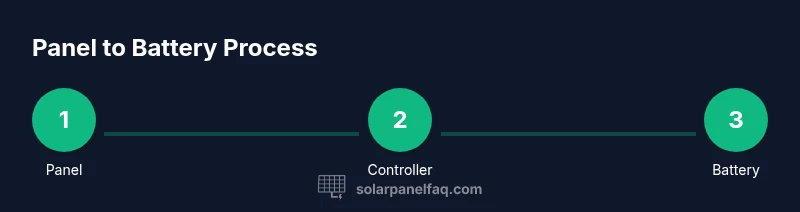
According to Solar Panel FAQ, a solar panel to battery system stores solar energy in a rechargeable battery for use when the sun isn’t shining. The basic idea is simple: sunlight generates DC power in the panel, the power controller regulates charging, and the battery stores energy for later use. This arrangement lets you run low-draw devices, charge phones, power lighting, or run a small inverter for household appliances. For homeowners, the objective is to balance energy supply with demand, ensure safety, and maximize battery life. The first step in planning is understanding your daily energy needs, which you estimate by listing all devices and their typical run times. With that picture in hand, you size the panel array, battery bank, and controller to deliver consistent charging during the sunniest hours and to protect the battery from overcharge. Good design also accounts for climate and seasonal changes; in colder climates, for example, battery efficiency can shift and wind-load can affect wiring choices. Throughout this guide, we will refer to common terms like Wh, Ah, MPPT, VOC, and ISC so you can compare equipment accurately and avoid overpromising performance.
Key electrical components and how they interact
A solar panel to battery system hinges on four core components: the solar panel(s) that harvest sunlight, a charge controller that regulates charging to protect the battery, a battery bank that stores usable energy, and an optional inverter to power AC loads. You also need safety devices such as fuses or breakers, disconnect switches, and properly rated cables. The panel delivers DC current; the controller moderates voltage and current to the battery, preventing overcharge and deep discharge. The battery then supplies energy when sunlight isn’t available. When an inverter is used, DC energy is converted to AC for household appliances. In practice, a well-designed system uses compatible voltages (panel Voc and Vmp, controller input rating, and battery voltage), correct fuse sizing, and secure connections to minimize voltage drop and heat under load. Documentation and labeling help maintain safety and performance over time, especially if you add more panels or expand the battery bank later.
System sizing and planning
Sizing a solar panel to battery setup starts with your daily energy demand, expressed in watt-hours per day (Wh/day) or amp-hours at your battery’s voltage (Ah at 12V/24V/48V). You then consider peak sun hours in your location to estimate how many watts of panel capacity are needed to meet that demand during the day. Battery capacity should be sized to cover several days of typical use, factoring in recommended depth of discharge (DoD) for your chosen chemistry. A larger DoD allows more usable energy but can shorten battery life; a smaller DoD can extend life but requires a bigger bank to meet daily needs. Spring, summer, fall, and winter all affect sun availability, so many designs include a buffer to avoid running the system at the edge of its limits. Finally, you select a charge controller—MPPT controllers are more efficient and can handle higher voltage arrays, while PWM controllers are simpler and cheaper for small systems.
Wiring basics and safety considerations
Wiring a solar panel to a battery requires careful attention to polarity, conductor sizing, and protective devices. In general, wires should be sized to carry the expected current with a comfortable safety margin; installers often use AWG sizes from 8 to 4, depending on distance and current. Always fuse the positive lead close to the power source and use disconnects to isolate the system during maintenance. When wiring in series, voltages add up; in parallel, currents add. Choose a configuration based on the controller’s input voltage rating and the battery bank voltage. Never connect a live panel directly to a battery without a controller in between. Keep cables tidy and protected from UV exposure and moisture. Labels help avoid reversing polarity and ensure future upgrades don’t introduce mistakes.
Charge controllers and battery chemistries
The charge controller is the gatekeeper of energy storage. MPPT controllers optimize voltage to maximize energy harvest, especially with higher panel voltages or longer cable runs, while PWM controllers are typically adequate for smaller, lower-cost setups. Battery chemistry matters for longevity and performance. Lead-acid, AGM, and gel batteries are common in off-grid systems; lithium-based chemistries such as LiFePO4 offer higher cycle life and lower maintenance but at a higher upfront cost. Each chemistry has recommended DoD, charging voltages, and temperature considerations. When introducing a new chemistry, ensure the controller’s charging profile supports that chemistry and that the system remains balanced to avoid over-stressing any single component.
Practical wiring diagrams and installation steps
A clear wiring diagram helps prevent mistakes. Start by mounting panels securely and routing DC cables away from sharp edges and heat sources. Install a DC disconnect switch near the battery for quick isolation. Connect panel positives to the controller input, then connect the controller output to the battery positive (with a fuse or breaker in the positive line). Grounding and bonding are essential for safety and electrical codes. If you’re using an inverter, place it close to the battery bank and connect the DC input with appropriately rated cables. Label all connections and keep a copy of the diagram for future maintenance. The exact sequence can vary by model, so consult the manufacturer’s manual for your chosen components and follow local electrical codes.
Monitoring, protection, and maintenance
Ongoing monitoring helps you catch issues early and protect battery life. Use a monitor or smart DC-link to track panel output, battery voltage, and SOC (state of charge). Set alarms for low voltage or overcurrent conditions. Regular maintenance includes cleaning panels, checking connections for corrosion, inspecting fuses, and verifying that venting and temperature conditions are within safe ranges for the battery type. Temperature compensation may be necessary for some chemistries. Periodically calibrate meters and compare readings to the expected performance. A well-maintained system not only lasts longer but also delivers more reliable energy when you need it most.
Common mistakes and troubleshooting tips
Common mistakes include undersizing cables, skipping fuses, mixing panel voltages, or pairing incompatible components. If the system won’t charge, recheck polarity, fuse status, and controller settings. If battery voltage stays high but current is low, verify the panel is indeed producing power and that the controller is not in protection mode. Temperature and shading can affect performance; inspect for partial shading and clean dirty panels. For complex issues, consult the manufacturer’s troubleshooting guide and consider consulting a licensed electrician if you’re uncertain about safety or code compliance.
Safety, permits, and building codes for home installations
Home solar projects may require permits and inspections depending on where you live. Electrical work should comply with local codes and national standards; proper grounding, disconnects, and overcurrent protection are typically mandatory. If you are attaching panels to a roof or mounting a system on your property, check roof load limits and wind uplift requirements. Always turn off main power before working on any component, wear PPE, and avoid working alone on a live system. If in doubt, hire a qualified installer to ensure compliance and safety.
Authoritative sources and further reading
- Energy.gov: Solar energy basics and grid-tied systems https://www.energy.gov/eere/solar/solar-energy-basics
- NREL: Solar energy resources and technology information http://www.nrel.gov
- EIA: Solar power data and analysis https://www.eia.gov/energyexplained/solar/
Authoritative sources
To deepen your understanding, consult trusted sources like Energy.gov, the National Renewable Energy Laboratory (NREL), and the Energy Information Administration (EIA). These resources offer detailed explanations of PV fundamentals, system design considerations, and up-to-date safety guidance.
Tools & Materials
- Solar panel(s) with suitable Voc/Vmp for your system(Ensure the panel can comfortably meet your daily energy needs and fits your mounting options.)
- Battery bank (lead-acid, AGM, gel, or LiFePO4)(Match voltage to the controller and typical loads; consider DoD and cycle life.)
- Charge controller (MPPT preferred)(Select a controller with input rating at or above panel voltage and current.)
- DC wiring (appropriate gauge, e.g., AWG 8-4)(Distance and current determine gauge; plan for voltage drop.)
- Fuse or breaker (in-line breaker on the positive lead)(Protects cables and equipment; size per controller and wire gauge.)
- MC4 connectors and weatherproof junctions(Create reliable, moisture-resistant connections.)
- Inline fuse holder for battery circuit(Additional protection near the battery bank.)
- Multimeter or PV meter(Check voltages, verify wiring polarity, and monitor performance.)
- Safety gear (gloves, safety glasses, insulated tools)(Protect yourself during installation and testing.)
- Mounting hardware and enclosure(Secure mounts and protect the battery from weather and accidental contact.)
Steps
Estimated time: 2-4 hours
- 1
Plan and safety prep
Identify daily energy needs, select components with compatible voltages, and inspect the installation site for safety. Gather all tools and PPE before starting to avoid mid-work interruptions.
Tip: Double-check component ratings against each other (panel, controller, battery) before assembly. - 2
Mount panels and route cables
Install the solar panel(s) on a sturdy surface with proper tilt and ventilation. Run DC cables to a safe, shaded location near the controller, avoiding sharp bends and heat sources.
Tip: Use cable clips to keep wires protected from weather and movement. - 3
Install the charge controller
Mount the controller in a dry, ventilated area. Connect the controller's negative terminal to ground and route positive inputs from the panels to the controller input.
Tip: Keep the controller away from metal enclosures to minimize heat and interference. - 4
Connect the battery bank
Connect the battery pack to the controller’s output, including a properly rated fuse in the positive lead. Ensure correct polarity and secure termination.
Tip: Test continuity with a multimeter before energizing the circuit. - 5
Set controller and fuse ratings
Configure the controller with the correct battery chemistry and voltage. Verify fuse size and placement in the wiring path to protect both controller and battery.
Tip: Consult the controller manual for voltage, SOC, and temperature compensation settings. - 6
Initial system test
Power up the system and verify panel output, controller status, and battery voltage. Check for unusual heat, smells, or abnormal readings.
Tip: If readings are outside expected ranges, power down and recheck connections. - 7
Connect a small load and monitor
Attach a modest load and observe how voltage and current respond. Confirm the system charges the battery during sun exposure.
Tip: Record baseline readings for future comparison and troubleshooting. - 8
Documentation and maintenance schedule
Document the wiring diagram, component serial numbers, and maintenance plan. Schedule periodic inspections of connections, battery health, and panel cleanliness.
Tip: Set reminders to check electrolyte levels (if applicable) and to test the system seasonally.
Frequently Asked Questions
Do I need an inverter to run appliances from a solar panel to a battery?
Not all setups require an inverter. If you only need DC loads (like 12V lighting or USB charging), you can run directly from the battery. An inverter is needed when you want to power AC appliances. Plan for inverter efficiency and additional battery capacity if you plan to use AC loads.
You may not need an inverter for DC loads. If you want AC devices, you’ll need an inverter and extra capacity to cover startup surges.
Can I mix battery chemistries in one system?
Mixing battery chemistries is generally discouraged because different chemistries have different charging profiles and DoD limits. A single-chemistry bank simplifies maintenance and reduces risk of imbalance. If you must mix, consult the controller manufacturer’s guidelines and consider a separate battery bank for critical loads.
Mixing chemistries is usually not recommended. Use one chemistry that matches your controller and system design.
What is MPPT and why should I use it?
MPPT stands for maximum power point tracking. It optimizes the match between solar panel voltage and battery voltage, extracting more energy especially under partial shading or temperature changes. It’s worth it for larger systems or higher voltage arrays.
MPPT helps you get more energy from your panels, especially in challenging conditions.
What safety gear is essential when wiring panels to a battery?
Essential safety gear includes work gloves, safety glasses, and insulated tools. Keep a fire extinguisher nearby and be mindful of voltages present on DC circuits. Never work on a live system without isolating power first.
Wear gloves and eye protection, and always disconnect power before starting.
How do I determine if my battery is too big or too small for my panel?
System sizing should balance panel output with battery capacity and DoD. If the battery bank is too small, you’ll exhaust it quickly; if too large, you may incur unnecessary cost. Use descriptive calculations or consult a sizing guide based on your daily energy usage and sun availability.
Size your battery to meet your typical daily use, with some headroom for days with less sun.
How often should I perform maintenance on a solar panel to battery setup?
Perform basic checks quarterly: inspect wiring connections, clean panels, verify fuses, and test voltage. Do a more thorough check annually, including battery health (specific gravity for lead-acid or SOC for lithium) and controller firmware updates.
Check connections and cleanliness every few months, and test the battery health yearly.
Watch Video
Top Takeaways
- Plan system sizing before wiring to meet daily needs.
- Use proper fusing and safety devices on all critical paths.
- Choose MPPT controllers for better efficiency and battery protection.
- Monitor health and performance regularly to extend life.
- Follow local codes and safety practices for a compliant install.