How Many Solar Panels to Charge an Electric Car: A Practical Guide
Discover how many solar panels are needed to charge an electric car, with practical calculations, assumptions, and shading/efficiency tips for homeowners.


The basics of charging an EV with solar
Charging an electric car with solar starts with understanding daily energy needs and sun availability. According to Solar Panel FAQ, charging an electric car with solar depends on daily driving and available sun. In many homes, 1 to 3 typical panels can meet daily EV charging needs, but this varies with your car’s efficiency, local climate, and shading. Use this knowledge as a baseline to frame your planning. The goal is to translate the abstract sun hours into a tangible number of panels that can deliver enough energy for your daily miles. A simple way to start is to estimate your daily energy use (in kWh) based on your driving distance and your EV’s efficiency, then compare that with the expected daily output from a single panel under your sun conditions. The question you’re asking—how many solar panels to charge an electric car—becomes a practical planning exercise when you quantify both sides of the equation: energy demand and energy supply.
Estimating your solar needs for EV charging
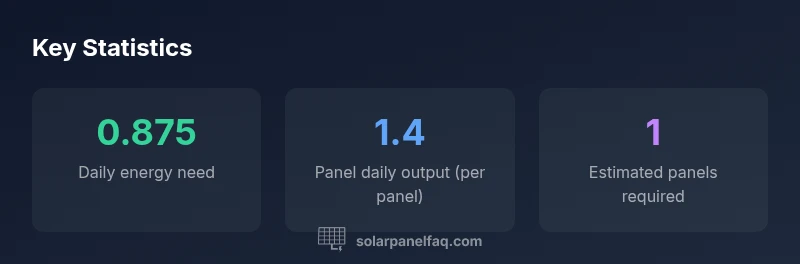
To estimate how many panels you need, begin with your daily energy demand. A common approach is: daily energy need (kWh) = (miles driven per day / 100) × EV efficiency (kWh per 100 miles). Then estimate per-panel daily output: panelOutputPerPanel = (panelWattage / 1000) × sunHoursPerDay. Finally, panelsNeeded = dailyEnergyNeed / max(panelOutputPerPanel, 0.01), rounded to the nearest whole panel. For example, with 25 miles/day, 3.5 kWh/100 mi, 350 W panels, and 4 sun hours, daily need is ~0.875 kWh, per-panel output ~1.4 kWh, so ~0.63 panels, rounded to 1 panel. Your real result will shift with location and weather. This method aligns with the practical approach described by Solar Panel FAQ for homeowners evaluating solar EV charging setups. Always consider rooftop orientation and shading, which can dramatically alter output.
Driving patterns and energy use: scenarios
Household driving patterns vary widely. A commuter who drives 20–30 miles daily at moderate efficiency will have a different daily energy need than a family taking weekend road trips. In sunny climates, the same system might deliver more energy per day, reducing the required panel count, while in northern or overcast regions, more panels or storage can help. The key is to model worst-case versus typical days and account for seasonal changes. For instance, a 25-mile daily routine with average EV efficiency can demand less energy than a 60-mile daily routine, which would push you toward more panels or supplemental storage. This nuance is essential when planning your EV solar setup and when interpreting the quick estimates provided by calculators.
Panel specs, sun hours, and orientation
Solar panel output depends on panel wattage, how many hours of peak sun you receive, and how efficiently your system converts that sun into usable electricity. A typical 350–370 W panel can produce roughly 1.0–1.6 kWh per sunny day, depending on location and tilt. In practice, orientation (south-facing, minimal shading) and tilt angle optimize output. Remember that real-world results are influenced by weather, seasonal daylight, and roof geometry. When you compare options, consider not just panel count but also quality, degradation over time, and warranty terms. These factors determine how many panels you’ll need in the long run to meet your EV charging goals.
Storage, inverters, and grid interaction
If you want to charge at night or during cloudy spells, storage is a powerful addition. Battery storage lets you shift daytime solar production to evening charging, improving reliability and reducing grid dependence. Inverter selection matters too: microinverters or power optimizers can improve performance under partial shade, while string inverters may be cheaper but less tolerant of shading. Solar Panel FAQ analysis shows that system design choices—storage, inverter type, and monitoring—can significantly impact how many panels you ultimately need to meet daily charging needs. Factor these into your planning to avoid over- or under-sizing your array.
Costs, ROI, and practical considerations
A solar EV setup involves upfront hardware costs, installation, and potential incentives. While we avoid exact price quotes here, the general guidance is that economics depend on local incentives, electricity rates, and sun hours. A modest system that meets daytime charging demands can minimize payback time if you live in a high-insolation area and drive moderately. If you anticipate growing energy use (e.g., adding more EVs or increasing driving distance), consider modular designs that allow expansion without costly retrofits. This progressive approach helps balance upfront investment with long-term savings, aligning with the broader lessons from Solar Panel FAQ on costs and savings.
Getting started: a practical checklist
- Define your daily driving distance and EV efficiency. - Map your roof orientation and shading profile. - Use the calculator to estimate panel counts under typical sun. - Consider adding storage if you want nighttime charging. - Check local incentives and permitting requirements for solar. - Plan for expansion if driving or load increases. - Schedule a professional site assessment to confirm feasibility and safety.
Common myths and safety notes
Myth: Solar panels always meet daily EV charging in all climates. Reality: Output varies with sun exposure and weather; many locations require storage or larger arrays. Myth: Rooftop installs are unsafe for homeowners. Reality: A licensed installer is essential for safety and code compliance. Safety note: Work on roof or electrical systems requires proper training and permits to prevent injuries and fire hazards. Always consult a qualified installer before purchasing equipment.