Solar Panels Facts and Figures: A Practical Home Guide
Learn credible solar panels facts and figures for homes: system size, output, efficiency, payback, and how climate and incentives shape your solar journey.


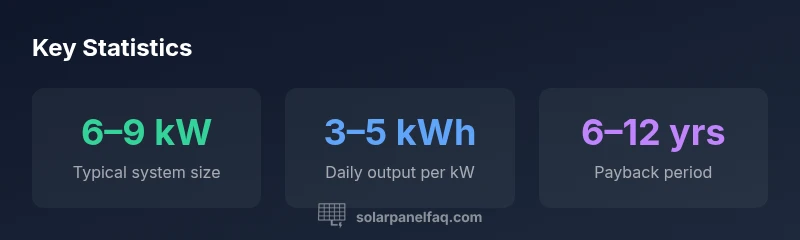
Solar panels facts and figures show that a typical residential PV system generates about 3–5 kWh per day per kilowatt installed under moderate sun, with output affected by location, tilt, shading, and panel efficiency. Payback periods commonly range from 6 to 12 years depending on local electricity prices, incentives, and system size.
What these numbers mean
Understanding solar numbers helps you compare options clearly. System size is measured in kilowatts (kW) and represents peak electrical output under standard conditions; it does not guarantee daily production, which depends on sun exposure, orientation, and losses. Daily production per kW, typically 3–5 kWh in moderate sun, is a practical way to estimate energy generation for your location. Efficiency, usually 15–22%, tells you how much of the sun’s energy becomes electricity; higher efficiency can maximize output in a smaller footprint but may come at a higher cost. Economics tie it all together: payback period and lifetime savings hinge on usage, local electricity prices, incentives, and permitting. When you compare options, standardize on these metrics and consider roof orientation, shading, and system losses to avoid over-optimistic projections.
Location, tilt, and shading matter
The sun’s path and local climate directly influence every figure. A roof facing the sun-rich side and tilted near your latitude generally yields more annual energy. Shading from trees, chimneys, or nearby structures can dramatically reduce output, sometimes more in winter years when sun is lower. Temperature effects also matter: high panel temperatures can reduce voltage and overall efficiency. To mitigate these factors, many installers use shade analyses, microinverters, or power optimizers so every panel contributes as effectively as possible. Real-world performance will vary by region, so demand a site-specific production estimate anchored to your roof’s orientation and potential shading. A thorough assessment helps you set realistic expectations for long-term production and savings.
How to estimate your own production
Step 1: Gather roof orientation and tilt data for your site. Step 2: Look up local sun hours per day and seasonal variation. Step 3: Choose a target system size in kW based on home energy usage and roof space. Step 4: Use a simple production estimator (production per kW × system size) while accounting for losses like soiling, wiring, and mismatch. Step 5: Convert annual production to energy savings using your electricity rate and usage pattern. Step 6: Factor in upfront costs, financing, and incentives to approximate payback. This approach yields a defensible forecast for budgeting and decision-making.
What components influence your numbers
Panels vary by technology and efficiency; monocrystalline modules often offer higher efficiency than polycrystalline, affecting output in a given footprint. Inverters convert DC to AC power and can be string-based, microinverter-based, or a hybrid; microinverters help maximize output if shading or panel mismatch is a concern. Temperature coefficients describe how panel performance changes with heat, while degradation rates describe long-term loss. Racking, wiring, and balance-of-system components add losses and maintenance considerations. When evaluating proposals, compare hardware specifications, warranties, and real-world performance data to estimate long-term reliability and energy yield.
Incentives and payback realities
Incentives reduce the upfront cost and shorten payback; federal, state, and utility programs vary by location. Payback is influenced by energy usage patterns, electricity prices, and the financial structure of the system (purchase, loan, or lease). A favorable incentive environment can dramatically improve the economics of going solar, but incentives change over time and may phase out. Before committing, request a detailed cash-flow analysis that factors in ongoing maintenance, potential degradation, and net metering or export rates. This ensures a realistic view of long-term savings.
Common myths and facts
Myth: Solar panels don’t work in cloudy climates. Fact: They generate energy under diffuse light; output is lower but not zero. Myth: Solar is only for sunny regions. Fact: Solar is viable in many climates with proper system sizing and incentives. Myth: More panels always means more savings. Fact: Savings depend on usage, orientation, and incentives; oversizing panels can raise costs without proportional benefits. Myth: Solar produces instant savings. Fact: Payback occurs over years as energy savings accumulate.
How to compare panels and warranties
Compare efficiency, degradation rate, and warranty length. Check the temperature coefficient to understand performance in heat, and evaluate price per watt to gauge value. Look for product and performance warranties, and verify how many years the warranty covers power output and materials. Degradation is usually gradual; a robust panel warranty protects you against early failure and guarantees minimum output. Always request independent performance data and a consumer-friendly warranty summary.
Finding a qualified installer
Choose a reputable installer with local credentials, proper licenses, and good references. Ask for multiple quotes and verify proposed system performance against your site-specific production estimate. Review the contract terms, permits handling, and timelines; confirm the included equipment and warranty coverage. A site visit and shading analysis are essential before signing. Finally, ensure the installer provides post-installation support and monitoring options so you can track system performance over time.
Overview of common solar panel figures
| Aspect | Typical range | Notes |
|---|---|---|
| System size | 6–9 kW | Common for single-family homes |
| Output per kW | 3–5 kWh/day | Depends on sun exposure |
| Payback period | 6–12 years | Incentives affect length |
| Efficiency | 15–22% | Module tech varies |
Frequently Asked Questions
What does 'kW' mean in solar panels?
kW measures peak power capacity of the panel array. It does not indicate daily energy production.
Kilowatts show peak power capacity; daily production depends on sun exposure and usage.
What is a kilowatt-hour (kWh)?
A kilowatt-hour is a unit of energy equal to using 1,000 watts for one hour.
A kilowatt-hour is energy used or generated.
Do solar panels degrade over time?
Yes, most panels experience gradual efficiency loss over time due to aging and exposure, with manufacturers providing long warranties.
Yes, panels slowly lose some efficiency as they age.
Is bigger system always better?
Not always; bigger increases upfront costs and may yield diminishing returns depending on usage and incentives.
Bigger isn't always better; depends on energy use and incentives.
What incentives affect payback?
Incentives vary by location; federal tax credits, state programs, and utility rebates can shorten payback.
Incentives vary by location and can shorten payback.
How do I compare panels?
Compare efficiency, degradation, warranty, temperature coefficient, and price per watt.
Look at efficiency, warranty, degradation, and price per watt.
“Accurate solar planning hinges on local sun exposure, system size, and incentives; the numbers alone won't unlock savings without proper sizing and an informed installer.”
Top Takeaways
- Estimate typical home output with a 6–9 kW system to gauge performance
- Consider location and shading to refine production estimates
- Use the payback range of 6–12 years as a rough benchmark
- Compare panel efficiency in the 15–22% range for footprint-limited roofs
- Incentives can shorten payback and boost savings