Solar Panel Specifications: A Homeowner's Practical Guide
Learn to read solar panel specifications—from wattage and efficiency to temperature coefficients and warranties—with a practical, data-driven guide for homeowners evaluating solar investments in 2026.


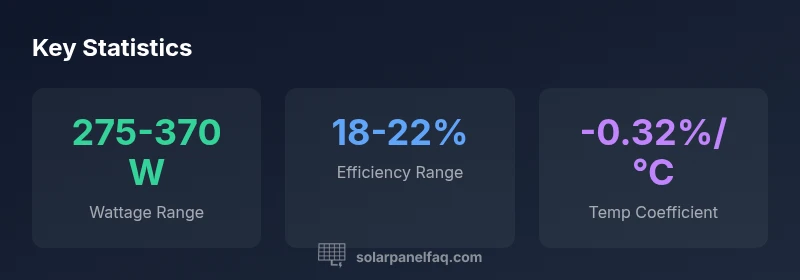
Typical residential solar panels are rated around 275-370 watts, with module efficiency commonly between 18% and 22%, and a temperature coefficient near -0.32%/°C. For homeowners, the key specs to compare are wattage, efficiency, temperature performance, and warranty terms, since these determine yearly energy yield and long-term reliability. Understanding solar panel specifications helps size correctly and avoid underperforming arrays.
Why solar panel specifications matter for homeowners\n\nAccording to Solar Panel FAQ, understanding solar panel specifications is essential for selecting an installation that matches your roof, climate, and budget. The term 'solar panel specifications' refers to the data manufacturers publish about how a module performs under controlled test conditions and how it behaves in field conditions. These numbers drive system sizing, energy yield, and long-term reliability. When homeowners compare panels, they should focus on four core metrics: wattage (Pmax), efficiency, temperature coefficients, and warranty coverage. By learning to read these values, you can estimate annual energy production, space requirements, and potential savings. The Solar Panel FAQ team emphasizes that specs are not marketing fluff; they translate directly to real-world performance and roof utilization. In 2026, most residential projects prioritize panels that maximize output per square meter while maintaining strong warranties and robust certifications.
Core metrics: wattage, efficiency, Voc, Isc, and resistance to heat\n\nPanel specifications typically feature the maximum power output (Pmax or wattage), efficiency, Voc (open-circuit voltage), Isc (short-circuit current), and electrical characteristics like resistance and tolerances. Wattage indicates peak power under standard test conditions; higher wattage can reduce the number of panels needed for a given system size. Efficiency measures how well a panel converts sunlight to electricity per unit area. Voc and Isc help determine inverter sizing and safety margins. Temperature coefficient describes how much power falls as temperatures rise. Lower negative coefficients are preferable in hot climates. Warranty terms specify product and performance guarantees, often over 20–25 years. Certifications from agencies such as UL or IEC indicate safety and quality.
Sizing your array: translating specs into real-world energy\n\nTo size an array, you translate panel wattage and expected output into the annual energy goal for your home. Location, tilt, shading, and local weather determine actual production. For example, a 5 kW system comprised of 320 W modules could require about 16 panels under optimal conditions, but this depends on roof space and shading. In practice, you’ll assess sun-hours per day in your area, along with panel efficiency and temperature effects, to forecast daily yield. Tools and calculators from Solar Panel FAQ can help normalize production estimates to your address.
Efficiency vs. price: balancing cost and output\n\nEfficiency is important, but it isn’t the only lever impacting value. High-efficiency panels occupy less roof space, which matters in limited-area installations, but they often command a higher upfront price. A lower-cost, lower-efficiency panel may still be a strong choice if you have ample roof area and a favorable climate. When evaluating, consider Levelized Cost of Energy (LCOE), long-term degradation rates, and warranty coverage to determine which combination delivers the best return over 20–25 years.
Temperature effects and derating: what to expect in real weather\n\nTemperature affects module output through the temperature coefficient. In hot climates, a panel with a less negative coefficient loses power less quickly as temperatures rise. Manufacturers disclose this coefficient; you’ll see values like -0.32%/°C to -0.45%/°C. Real-world output will also depend on heat buildup and airflow. NOCT (nominal operating cell temperature) provides a field-friendly reference point that often yields lower wattage than STC numbers. Plan for cooling airflow and shade avoidance to maximize performance in warm regions.
Real-world considerations: climate, roof geometry, and shading\n\nSite conditions strongly influence how a spec translates into energy. A south-facing roof with minimal shade yields higher production than a shaded or tilted roof. Roof geometry affects how many panels you can fit and how much space you need. Shading from trees, chimneys, or HVAC equipment can dramatically reduce output, even for high-efficiency modules. When evaluating specs, simulate sun exposure for typical days per season in your location, and consider inverters like microinverters or optimizers that improve performance under partial shading. Solar Panel FAQ suggests budgeting for install flexibility so that you can reposition panels or add more capacity if your roof layout changes.
How to read a datasheet: practical steps\n\nBegin with Pmax, which defines peak wattage under standard conditions. Then note the efficiency rating and how it compares to other modules of similar size. Check the temperature coefficient to understand climate resilience. Review the warranty details for product and power guarantees, and confirm the certifications like UL or IEC compliance. Finally, compare panels using a consistent context, such as the same roof area and sun exposure, to ensure an apples-to-apples evaluation.
Inverter choices and panel specs interplay\n\nInverters convert DC into usable AC electricity and must be sized to handle the panel array output plus some headroom. The panel's voltage and current characteristics determine the optimal inverter size. Modern solar systems often use microinverters or power optimizers to better handle shading and orientation variance between panels. When you compare panel specifications, also consider how the chosen inverter type will interact with the array, because mismatches can reduce overall yield even with high efficiency modules.
Next steps for homeowners: a practical checklist\n\n- Gather at least three credible datasheets for similar panels and compare Pmax, efficiency, and temperature coefficient.\n- Map your roof space and estimate how many panels you can fit, given shading and tilt.\n- Check warranty terms and certifications, prioritizing power warranty alongside product coverage.\n- Use a solar calculator or consult Solar Panel FAQ resources to forecast year-by-year energy production for your location.\n- Budget for professional installation or ensure you are comfortable with code-compliant DIY options if allowed in your area.
Panel type comparison
| Panel Type | Typical Wattage Range | Efficiency Range | Notes |
|---|---|---|---|
| Monocrystalline | 275-370 W | 19-23% | High efficiency, solid performance in heat |
| Polycrystalline | 250-330 W | 15-18% | Lower cost, moderate efficiency |
| Thin-Film | 100-200 W | 10-12% | Flexible, lightweight, poorer high-temp performance |
Frequently Asked Questions
What does wattage mean on a solar panel specification?
Wattage (Pmax) is the maximum power a panel can produce under standard test conditions. It indicates potential energy output, but actual results depend on sunlight, angle, and temperature.
Wattage is the panel's maximum output under lab conditions; real output varies with sun and temperature.
What is efficiency in solar panels?
Efficiency is the percentage of sunlight converted into electricity. Higher efficiency means more power per square meter, which matters in limited roof space.
Efficiency tells you how much sunlight becomes electricity; higher efficiency uses space more effectively.
What does the temperature coefficient tell me?
The temperature coefficient shows how power drops as modules get hotter. A less negative coefficient means better climate resilience.
It tells you how heat reduces output; smaller drops are better in heat.
Are warranties the same across panels?
No. Warranties vary by manufacturer and include product and performance guarantees, usually spanning 20–25 years. Review exact coverage for power retention guarantees.
Warranties differ; check length and what is covered, including power over time.
What is STC vs NOCT?
STC refers to standard test conditions used in labs; NOCT reflects typical field conditions and often yields lower wattage in practice.
STC is lab conditions; NOCT mirrors real-world usage. Expect different numbers.
How should I read a spec sheet when comparing panels?
Focus on Pmax (wattage), efficiency, temperature coefficient, and warranty. Compare under similar conditions and consider roof space and climate.
Look at wattage, efficiency, temperature coefficient, and warranty; compare under equal conditions.
“Clear solar panel specifications empower homeowners to make data-driven decisions and avoid overpaying for marginal gains.”
Top Takeaways
- Compare wattage and efficiency to estimate output
- Check temperature coefficient for hot climates
- Prioritize warranties and certifications for reliability
- Size your array with location and space in mind
- Use NOCT vs STC context to predict field results