How Much Energy Does a Solar Panel Make: A Practical Guide
Learn how much energy a solar panel makes, what factors influence output, and how to estimate daily and yearly production for a residential system. A data-driven guide by Solar Panel FAQ.


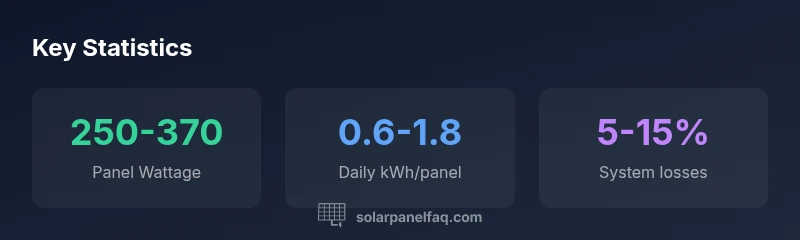
How much energy does a solar panel make? Under standard test conditions, a typical residential panel is 250–370 watts, translating to about 0.6–1.8 kWh per day per panel in fair sun. Real-world results depend on shading, temperature, tilt, and age. According to Solar Panel FAQ Analysis, 2026, these ranges give homeowners a realistic baseline for estimating daily production and planning a solar installation.
Understanding Energy Output: What the Numbers Mean
When people ask how much energy a solar panel makes, they are really asking about two measures: watts (W) for instantaneous output and kilowatt-hours (kWh) for energy over time. A typical residential panel is in the 250–370 W range. That rating, combined with sun exposure, translates into roughly 0.6–1.8 kWh of energy per day per panel in many locations. Of course, real-world results depend on shading, temperature, tilt, and system age. As Solar Panel FAQ Analysis, 2026, notes, these ranges give homeowners a realistic starting point for estimating daily production and planning a solar installation.
Factors Driving Output and Why They Matter
Energy production per panel hinges on a few core variables: the panel’s watt rating, the local solar insolation (sunlight), weather conditions, and the system’s electrical design. Higher wattage panels can provide more energy, but only if the site delivers sufficient sun. Temperature also plays a role: higher ambient temperatures can reduce voltage and overall output in many panel designs. Proper maintenance—keeping panels clean, ensuring no shade from nearby objects, and maintaining inverter health—can preserve a larger share of the rated capacity over time.
Weather, Location, and System Design: The Real-World Picture
Geography and climate determine the daily solar resource. A system in a sunny, southern exposure will typically generate more energy than one in a cloudy or northern locale. Tilt and azimuth adjust how much sun the panel receives during the day, aligning the module with the sun's path across seasons. System design, including string vs microinverters and wiring sizing, also influences the effective energy delivered to your home. These factors collectively explain why two homes with the same panel count can produce different daily energy.
Estimating Daily and Annual Production for Your Home
A practical estimation workflow starts with total DC capacity—the sum of each panel’s watt rating. Multiply this by average peak sun hours for your location and adjust for known losses to estimate gross energy. For example, a 6-panel system at 320 W each totals 1,920 W. With an average of 5 peak sun hours, daily gross energy is about 9.6 kWh, which could translate to roughly 7.5–8.5 kWh after typical losses. Use local sun-hour data and your inverter efficiency to refine this estimate.
Practical Ways to Maximize Output and Efficiency
To maximize output, focus on site optimization and maintenance. Clean panels regularly, prune shade sources, and ensure mounting angles match your latitude. Consider incorporating microinverters or power optimizers to minimize the impact of shading on a few panels. Regular inverter checks, monitoring, and a simple cleaning schedule can yield incremental gains that add up over a year. Small improvements in tilt and orientation, tailored to your roof, can meaningfully raise annual production.
Comparing Panel Output: What to Look For in Specs
When evaluating panels for energy output, prioritize the watt rating (W) and efficiency (%). A higher efficiency panel uses sunlight more effectively, especially in tight roof spaces. Look at the temperature coefficient (%/°C) to understand performance in heat, and check the degradation rate (%/year) to gauge long-term output. Finally, verify warranty terms and certification standards, since durable products with solid warranties often deliver consistent energy over time.
Real-World Scenarios: Case Studies and Takeaways
Scenario A: A sunny, flat roof with southern exposure yields near-nominal output for a 6-panel, 320 W system. In this setup, annual energy may approach the sum of the panels’ ratings multiplied by the sun-hours and adjusted for losses. Scenario B: A shaded urban roof with partial shading across several panels sees a disproportionate drop in energy unless microinverters or bypass diodes are used. Real-world conditions stress the importance of site assessment and design choices.
Typical energy output per panel under varying conditions
| Factor | Typical Range | Impact on Output | Notes |
|---|---|---|---|
| Panel power rating | 250-370 W | Baseline capability | Most common residential panels |
| Estimated daily energy | 0.6-1.8 kWh/day | Sun-hours dependent | Assumes typical 3-6 peak sun hours |
| System losses | 5-15% | Influences net output | Includes wiring, inverter, temperature |
| Orientation/tilt impact | ±10-25% | Angle matters | Optimal tilt maximizes production |
Frequently Asked Questions
What affects solar panel energy output the most?
The most influential factors are the panel rating, sun exposure (peak sun hours), and shading. Temperature and system losses also play a role. Understanding these helps you set realistic expectations for energy production.
The biggest factors are sunlight hours and shading. Temperature and wiring losses also matter, so plan accordingly.
Is more wattage per panel always better?
More wattage per panel generally means higher potential output, but real-world energy depends on available sun and roof space. A higher-watt panel won’t outperform a well-angled system if sun access is limited.
Higher wattage helps if you have the sun to feed it, but sun access and roof space matter too.
Does series vs. parallel wiring change daily energy?
Series vs. parallel configurations affect voltage and current but not the total energy under typical operating conditions. In shaded conditions, microinverters or power optimizers can preserve energy better by minimizing the impact of shading on individual panels.
Wiring changes voltage and current, but energy mostly depends on sun. Optimizers help when some panels are shaded.
Do solar panels produce energy at night?
No, conventional solar panels do not generate energy at night. Some systems use storage (batteries) to draw from stored energy, but daytime production is where most energy comes from.
Panels don’t work at night unless you have a storage system with batteries.
How do shading and dirt affect output?
Shading and dirt significantly reduce output, especially if several panels are affected or if bypass paths are limited. Regular cleaning and strategic placement to minimize shading can restore a large portion of lost energy.
Shade and dirt lower output a lot, so keep panels clean and unshaded when possible.
“Accurate energy forecasts come from understanding both panel specs and local conditions. Small changes in sun, tilt, or cleaning can add up to meaningful gains over a year.”
Top Takeaways
- Estimate output using local sun hours and system size
- Account for shading and temperature losses in planning
- Prioritize panel wattage and efficiency for space-limited roofs
- Regular maintenance can improve year-over-year production