How Much Energy Does a Solar Panel Produce Per Day? A Practical Guide
Discover how daily solar energy production depends on panel size, sun hours, and climate. Learn to estimate output, account for losses, and size a home system with confidence.


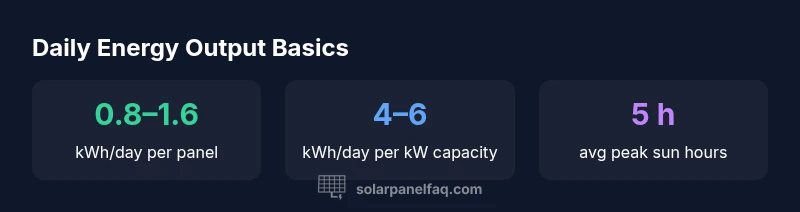
A typical residential solar panel (300–350W) often produces about 0.8–1.6 kWh per day under favorable sun. Output varies with location, shading, tilt, and temperature. In bright climates, a 5 kW system can yield roughly 20–25 kWh daily; in poorer conditions, daily production may fall to 8–12 kWh.
The daily energy question, answered with context
Understanding how much energy a solar panel produces per day helps you plan savings, size equipment, and set expectations. According to Solar Panel FAQ, the daily output is not a fixed number; it's a function of panel rating, sun hours, shading, tilt, temperature, and losses in the system. In practice, you’ll see a range rather than a single value. The rule of thumb is: higher wattage panels and more sun hours translate into more daily energy, but real-world results depend on your location and installation quality.
For a typical residential installation, you can estimate daily production by multiplying the panel's nameplate wattage by the number of peak sun hours in your location and then applying a rough efficiency factor to account for losses. This approach yields a practical starting point for planning, budgeting, and comparing quotes from solar installers.
Key variables that shape daily output
-
Panel wattage: Higher wattage panels produce more energy per hour of sun, all else equal. A 350W panel will generate more daily energy than a 250W panel under identical conditions.
-
Peak sun hours: This metric, usually expressed as full sun equivalent hours per day, varies by latitude, season, and weather. A location with 5 peak sun hours will generate roughly five times the panel’s rated kilowatts in energy per day, minus losses.
-
Tilt and orientation: Panels facing true south in the northern hemisphere (or true north in the southern hemisphere) maximize exposure. Tilt should balance maximizing annual output with seasonal needs.
-
Shading and soiling: Leaves, dirt, snow, and partial shade dramatically reduce daily energy. Even a small shade on part of a panel can lower system output by a noticeable margin.
-
Temperature and losses: Solar cells lose efficiency as temperatures rise. Combine temperature effects with inverter and wiring losses to see total daily output.
Location, climate, and sun hours
Your geography is a major driver of daily production. Arid subtropical regions with clear skies tend to deliver higher sun hours, while northern latitudes and dense urban areas offer more variable results. The “how much energy does a solar panel produce per day” question becomes location-dependent when you consider seasonal changes and weather patterns. In practice, homeowners in sunny climates may observe daily outputs near the panel rating times sun hours, while those in cloudy climates might see a fraction of that. Always use local irradiance data and real-world measurements when evaluating proposals.
The math of estimating daily production
A simple calculation can give you a usable estimate:
-
Step 1: Determine your system size in kilowatts (kW). Example: 5 kW.
-
Step 2: Multiply by average daily peak sun hours for your site. Example: 5 hours/day.
-
Step 3: Apply an overall system efficiency factor to account for losses (often 0.75–0.85). Example: 0.80.
-
Step 4: Multiply: 5 kW × 5 h × 0.80 = 20 kWh/day (roughly).
For a single 350W panel, use 0.350 kW × 5 h × 0.80 ≈ 1.4 kWh/day. Note that this is a rough estimate; actual performance will vary with weather, system age, inverter efficiency, and maintenance.
How to scale from panel to home energy
-
Start with your monthly electricity usage in kWh and convert to daily usage by dividing by 30.
-
Divide daily usage by the average daily sun hours for your area to estimate the needed system size (kW).
-
Account for losses and array orientation; add a small margin for future usage growth.
-
Use PVWatts or a local installer to refine the estimate with site-specific data. These tools factor in shading, temperature, and wiring losses to produce a more precise daily output projection.
Real-world variability and best practices
-
Insist on accurate shading analysis before install; even a tiny tree can reduce daily production.
-
Ensure panels are cleaned and inspected regularly; dirt buildup can reduce output by several percent.
-
Track your system’s performance after installation; compare daily production to the estimator’s predictions to validate assumptions.
-
Understand that “how much energy does a solar panel produce per day” is a moving target; expect seasonal changes and occasional dips during winter.
What you can do next: planning resources and next steps
-
Use official calculators like PVWatts for site-specific estimates.
-
Talk to Solar Panel FAQ for practical guidance on choosing panel sizes and evaluating bids.
-
Consider a monitoring system to track daily production and alert you to potential issues.
-
Review local incentives and utility programs for payback considerations.
-
Remember that a well-sized solar system can hit your daily production goals most days of the year, but never expect perfection.
Daily energy output estimates for common solar setups
| Component | Daily Output (kWh/day) | Notes |
|---|---|---|
| Single 300–350W panel | 0.8–1.5 | Depends on sun hours and panel efficiency |
| Typical 5 kW residential system | 20–25 | Assumes 4–5 sun hours/day and losses |
| Shaded/partial sun | 0.2–0.6 | Severe shading drastically lowers output |
Frequently Asked Questions
How does panel wattage affect daily energy output?
Higher wattage panels generate more energy per hour of sun, increasing daily output. For example, a 350W panel will typically produce more energy than a 250W panel under the same conditions.
Higher wattage panels deliver more energy per hour of sun, so choosing larger panels increases daily output assuming sun exposure stays the same.
Can I expect the same output every day?
No. Daily production varies with weather, season, shading, and temperature. Bright, clear days yield more energy, while cloudy or shaded days yield less.
No—sunny days boost output, while clouds, shading, and heat reduce daily production.
How many solar panels do I need for my home?
Estimate based on your daily usage, available sun hours, and panel efficiency. A calculator or a solar installer can translate your usage into a panel count and total system size.
Count depends on your usage and sun hours; a calculator or installer can convert that into the number of panels.
How does temperature affect solar panel performance?
Solar cells lose efficiency as temperature rises. Higher ambient temps can modestly reduce daily output compared with cooler days, all else equal.
Heat lowers panel efficiency a bit, so hot days can reduce daily energy a touch compared to cool days.
What are peak sun hours and how do they influence daily production?
Peak sun hours approximate the number of hours per day when solar irradiance reaches peak levels. More peak sun hours mean higher potential daily output for the same panel size.
Peak sun hours tell you how much sun your site effectively gets; more hours mean more energy from the same panels.
What tools can I use to estimate daily production for my location?
Use PVWatts (NREL) or a local installer’s calculator. These tools incorporate shading, temperature, orientation, and losses to produce site-specific daily estimates.
PVWatts and local installers can estimate your daily production using your site data.
“Daily energy production from solar panels is highly location-dependent. Understanding sun hours, shading, and temperature is essential for realistic expectations.”
Top Takeaways
- Estimate daily output using panel wattage and sun hours.
- Account for shading and orientation to avoid overestimation.
- Use local sun hours for accuracy and validate with real data.
- Include system losses when planning and budgeting.
- Compare site estimates with a professional calculator for reliability.