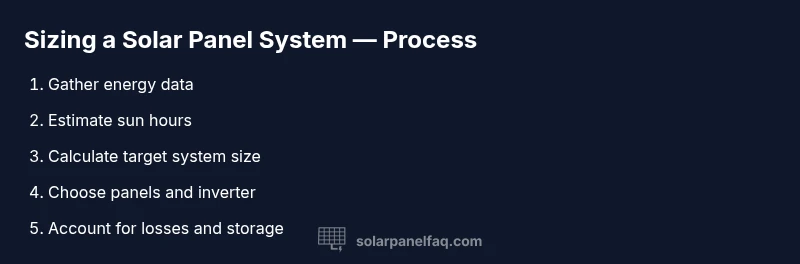
Solar Panel System Sizing: A Practical Step-by-Step Guide
Learn how to size a residential solar panel system for your home, balancing energy use, sun exposure, and equipment choices. This guide covers calculations, margins for losses, storage considerations, and practical examples to help homeowners design an efficient solar setup.


By the end, you’ll be able to size a residential solar panel system that fits your home’s energy use and local sun conditions. This quick guide helps you estimate daily consumption, understand sun hours, and pick a properly matched inverter and panel set, while noting losses and storage options. You’ll leave with a practical sizing plan you can implement or discuss with a pro.
Why Sizing Matters for Solar Panel Systems
According to Solar Panel FAQ, proper sizing matters because it directly affects energy reliability, system performance, and return on investment. Oversizing can mean unnecessary capital outlay, increased equipment weight, and longer payback times, while undersizing leads to unmet energy needs and potential reliance on the grid during peak times. A well-sized system aligns production with usage, climate, and future goals, reducing surprises at the meter. The Solar Panel FAQ team found that homeowners who size thoughtfully typically report smoother energy bills, fewer adjustments, and clearer paths to storage or grid-tied autonomy. The goal is a balance that matches realistic consumption with available sun, while incorporating future growth and safety margins.
In this guide, you’ll learn a structured approach to sizing, with practical steps and concrete calculations you can apply to most single-family homes. We’ll address typical usage patterns, geographic sun variability, and the trade-offs between roof area, panel efficiency, and inverter capacity. The process emphasizes transparency, so you can justify your numbers to installers, lenders, and municipal authorities. Whether you’re planning a new install or evaluating a retrofit, this sizing framework helps you make informed choices without guesswork.
Tools & Materials
- Energy usage data (electricity bill or usage log)(Gather 12 months if possible to account for seasonal variation.)
- Sizing calculator or spreadsheet(Use a reputable online calculator or construct your own sheet with kWh and sun-hour inputs.)
- Access to local sun-hour data(Consult sources like national solar datasets or your installer’s solar resource estimates.)
- Calculator(Basic arithmetic for converting kWh to kW and accounting for losses.)
- Pencil and notepad or digital note app(For jotting down assumptions and checklists.)
- Shade measurement tool (optional)(Useful if you have significant roof shading to map.)
Steps
Estimated time: 3-5 hours
- 1
Gather energy usage data
Collect your electricity bill history and note monthly kWh usage, peak demand, and seasonality. If you have interval data from a smart meter, download the last 12 months. The aim is to establish a reliable average daily consumption and identify high-use periods that may drive sizing decisions.
Tip: Double-check months with unusually high usage (e.g., winter heating or summer AC) to avoid underestimating needs. - 2
Estimate daily energy consumption
Convert monthly usage into a daily figure by dividing total kWh by 30, then refine with seasonal adjustments. You’ll use this daily target to back-calculate the required system size. If you can segment by season, create two scenarios (typical summer and typical winter) to understand variability.
Tip: Use both a high-use and a low-use scenario to frame a sensible sizing range. - 3
Assess available sun hours
Determine the average peak sun hours for your location. This value varies by latitude, roof orientation, shading, and time of year. Use reputable solar resource data to estimate how many hours per day your panels will operate at nominal efficiency.
Tip: If your site has shading, measure or map shade across the year to avoid overestimating output. - 4
Calculate target system size (kW)
Use the formula: System size (kW) = Daily kWh / (Sun hours × derating). Derating accounts for losses (temperature, wiring, inverter efficiency). A common derating range is 0.75–0.85. This step yields a baseline size in kilowatts that you then translate into panel count and inverter rating.
Tip: Start with a conservative derating (0.8–0.85) if you expect long-term shading or temperature extremes. - 5
Size panels and inverter
Choose panel wattage and count to meet the target kW, then select an inverter with a continuous rating equal to or slightly above the system size. Remember inverters are often sized to handle peak DC input with some headroom. Don’t oversize the inverter relative to production expectations, but ensure it covers your measured output.
Tip: Aim for an inverter together with the array that has at least 10–20% headroom for future expansion. - 6
Account for losses and safety margins
Incorporate losses from soiling, temperature, wiring, and aging. Re-run calculations with a higher efficiency assumption (e.g., increase system size by 5–10%) to maintain reliable production over time.
Tip: Consider a sensitivity check: what happens if sun hours drop by 10%? Ensure you still meet daily usage. - 7
Consider storage needs (optional)
If you plan battery storage, size the storage system to meet a subset of daily energy needs during non-sun hours. Battery sizing depends on desired autonomy, discharge depth, and inverter compatibility. Batteries add cost and maintenance; model scenarios to balance benefit against expense.
Tip: Remember that storage adds significant weight, wiring, and safety considerations—factor permit requirements. - 8
Create a sizing plan you can discuss with pros
Document all assumptions, data sources, and calculations. Share your plan with installers for validation and to obtain firm quotes. A transparent sizing plan reduces back-and-forth and speeds up permit reviews.
Tip: Bring your energy bill history, sun-hour data, and your preferred storage stance to the first consultation. - 9
Validate and refine with local codes
Check local permitting, interconnection rules, and electrical codes. Some jurisdictions require specific labeling, roof bracing, or microinverter installations. Have a professional verify the plan before purchase and installation.
Tip: Always use a licensed installer for final system verification and permitting.
Frequently Asked Questions
What is solar panel system sizing?
Solar panel system sizing is the process of determining the number of panels, panel wattage, and inverter capacity needed to meet a home’s energy demand under typical sun conditions. It balances current usage with climate and site constraints, while allowing for future changes.
Sizing is the process of figuring out how many panels and what size inverter you need to meet your typical energy use under normal sun conditions.
Why do sun hours matter for sizing?
Sun hours indicate how long your panels produce near-maximum power each day. More sun hours means you can achieve the same energy production with fewer panels or a smaller inverter, while fewer sun hours requires larger capacity to meet daily usage.
Sun hours matter because they determine how much energy your system can produce each day; more sun hours means you need less hardware to hit your targets.
Can I resize after installation if my needs change?
It’s possible to add more panels or expand storage later, but it can be more costly and complex than sizing correctly the first time. A well-planned system often allows for modular additions or future expansions with compatible inverters.
You can expand later, but it’s usually cheaper to size with future needs in mind from the start if you expect growth.
Should I size for battery storage?
Battery storage sizing depends on how many hours of backup you want and your tolerance for interruptions. Storage adds cost and maintenance, so weigh the value of backup power against the total system cost and roof space.
If you want backup power during outages, size storage to cover essential loads for a chosen period, but be mindful of added costs.
How accurate is system sizing in practice?
Sizing is an informed estimate based on data and models. Real-world factors such as shading, panel aging, and weather can affect actual output. Regular performance monitoring helps ensure you stay on track.
Sizing uses data and models; real-world factors may shift results, so monitor performance after install.
What costs are involved in sizing calculations?
Calculations themselves usually cost little beyond your time and any consultation fees. Major costs come from the equipment (panels, inverter, storage) and installation, not from sizing steps alone.
Sizing steps are inexpensive; the big costs are hardware and installation, so accurate sizing helps avoid waste.
Watch Video
Top Takeaways
- Size around realistic usage, not potential peak demand
- Incorporate sun-hours and losses to avoid surprises
- Use headroom for future energy needs or expansions
- Get professional validation before purchasing
- Include storage only if expected value justifies cost