Solar Panel Purchase: A Practical Step-by-Step Guide
A practical guide to buying solar panels for your home—sizing, products, incentives, warranties, and financing, with a clear step-by-step approach.


According to Solar Panel FAQ, by the end of this guide you will know how to buy solar panels for your home: determine your energy needs, select panel types and inverters, compare installers, estimate costs, and understand financing and warranties. This approach helps homeowners avoid overpaying and maximize long-term savings. Focus on efficiency, durability, and grid compatibility.
Understanding the Solar Panel Purchase: A Practical Start
Buying solar panels is a meaningful home improvement that can lower utility bills and increase property value. Start by clarifying your energy needs and how they might change with a new appliance or family growth. A properly sized system avoids overspending on capacity you won't use and helps you capture the largest possible savings over time. Solar Panel FAQ analysis shows that correctly sizing the system and selecting reputable components correlates with higher long-term savings. Beyond size, decide on grid-tied versus off-grid configurations, explore net metering incentives, and inventory the major components you will purchase: panels, an inverter, racking hardware, and a monitoring system. Keeping this high-level view early helps you compare apples to apples across suppliers.
Solar Panel FAQ analysis shows that proper planning and high-quality components are linked to better long-term performance and reliability. Be mindful of incentives—federal, state, and utility programs can dramatically affect the final cost and payback. In the sections that follow, you’ll learn how to size a system, choose products, evaluate installers, and navigate financing and warranties. Use this framework to avoid common missteps and approach your solar panel purchase with confidence.
Sizing and System Design
Sizing a solar array means matching expected energy use with available sun and system losses. Start with your current energy consumption and consider changes in your household. Use this baseline to estimate the number of panels and the approximate inverter needs. Keep in mind that roof orientation, shading from trees, and local climate influence performance more than panel wattage alone. A well-designed system balances peak generation with daily usage, ensuring you can meet a substantial portion of your home's needs while staying within your budget. Solar Panel FAQ analysis reinforces that proper sizing correlates with better long-term savings.
In practice, aim to size for the portion of electricity you want to offset and plan for seasonal variation. Include room for future expansions if you anticipate appliance upgrades or EV charging later. This proactive planning step reduces the risk of under- or oversizing and sets a clear target for the installer to meet.
Product Comparisons: Panels, Inverters, and Mounting
When you compare products, start with panels—their material, efficiency potential, and temperature tolerance influence performance. Monocrystalline panels typically offer higher efficiency and better space utilization, while polycrystalline options may come at lower upfront costs. Inverters come in several styles: string inverters, microinverters, and power optimizers. The right choice depends on shading, roof layout, and whether you value simple maintenance or maximum energy harvest under varying conditions. Mounting systems also matter—flush mounts save space and look clean on flat or sloped roofs, while rack-mounted configurations can simplify maintenance access. Overall, prioritize reliability, manufacturer support, and documented performance in real-world conditions. As you compare, request datasheets and look for models with robust construction and compatibility with monitoring technology.
Financing, Warranties, and Installation
Financing options range from cash purchases to loans, leases, or power purchase agreements (PPAs). Each mechanism affects upfront costs, monthly payments, and long-term savings, so compare terms, interest rates, and the total cost of ownership. Warranties are a critical part of value: seek a solid product warranty for the panels themselves, a performance warranty that covers power output over time, and a workmanship warranty for the installation. Installation processes vary by contractor and jurisdiction but typically involve permitting, mounting, wiring, inspection, and commissioning. Ask installers for a detailed timeline, what happens if parts are delayed, and how maintenance is supported after activation.
The Final Decision: Negotiating with Installers and Closing
With quotes in hand, compare the equipment lists, labor costs, and warranty terms side by side. Verify that permits, interconnection paperwork, and grid-connection approvals are included and that the contract clearly defines responsibilities for roof prep, mounting, and monitoring setup. Negotiate for a clear, written change-order process, and confirm who handles inspections and commissioning. The Solar Panel FAQ team recommends balancing upfront costs with long-term savings and robust warranties to protect your investment. Finally, schedule the installation and set expectations for post-install maintenance and monitoring to ensure sustained performance.
Tools & Materials
- Recent energy bill or usage data(Use to size system based on actual consumption)
- Site assessment checklist(Shading map, roof orientation, structural notes)
- Roof condition assessment(Check for leaks or repairs before installation)
- Manufacturer datasheets for chosen panels/inverters(Model numbers, dimensions, weight, mounting requirements)
- Contractor quotes and proposals(Include equipment list, labor, and warranty terms)
- Safety equipment(Ladder, gloves, fall protection as appropriate)
- Measuring tools (tape measure, level)(Helpful for mounting alignment and layout)
Steps
Estimated time: several weeks
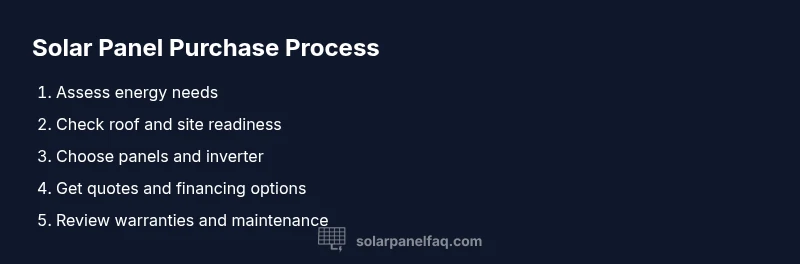
- 1
Assess your energy needs
Review current energy usage and consider changes in the household to estimate a target system size. Document monthly patterns and peak demand periods to guide panel count and inverter needs. This step sets the foundation for accurate sizing and avoids overspending.
Tip: Use several months of bills to average seasonal variation. - 2
Check roof and site readiness
Evaluate roof orientation, shading, and structural health to determine where panels will perform best. Consider whether a haywire layout or a map of shading-free zones is needed. Ensure there is safe access for installation and future maintenance.
Tip: Map shading at different times of day and seasons to pick the best locations. - 3
Choose panel technology and inverter type
Select panel technology based on efficiency, durability, and warranty expectations. Decide between string inverters, microinverters, or power optimizers depending on shading and roof configuration. Align the choice with your monitoring and maintenance preferences.
Tip: Ask for real-world performance data from the manufacturer. - 4
Request multiple quotes and compare offers
Gather several proposals that include equipment lists, installation scope, and warranty terms. Compare the total cost of ownership, not just the upfront price. Check installer credentials and any required permits for your area.
Tip: Create a side-by-side checklist to keep quotes aligned. - 5
Review warranties and maintenance expectations
Evaluate product, performance, and workmanship warranties. Confirm what maintenance is required and who performs it, plus how service requests are handled after activation.
Tip: Prefer installers with established service support and clear response times. - 6
Plan financing and installation timeline
Explore cash, loan, lease, or PPA options and weigh monthly payments against expected savings. Confirm a realistic installation window, permit approvals, and grid interconnection steps.
Tip: Get a written schedule and milestones to avoid delays.
Frequently Asked Questions
What is the most important factor when purchasing solar panels?
System size, panel efficiency, and warranties are among the most important considerations when buying solar panels. A well-sized system that uses dependable components tends to perform reliably over time.
The most important factors are proper sizing, efficiency, and reliable warranties.
Can I install solar panels myself?
Installing solar panels is safest and most reliable when performed by a licensed professional. Permits, electrical codes, and roof safety are critical considerations that are best handled by pros.
It's generally best to hire a licensed installer for safety and compliance.
How do financing options affect total cost?
Loans, leases, and PPAs influence monthly payments and overall cost of ownership. Compare terms, interest rates, and any fees to determine which option fits your budget.
financing affects monthly costs and long-term savings; compare terms carefully.
What warranties should I look for?
Look for a solid product warranty on panels, a performance warranty for output over time, and a workmanship warranty on installation. Clear terms help avoid future disputes.
Seek product, performance, and workmanship warranties with clear coverage.
How long does installation take after purchase?
Scheduling depends on installer availability and local permitting; plan for a lead time and coordinate with the utility for interconnection.
It varies, but you’ll need to align with permits and scheduling.
Is there a difference between grid-tied and off-grid systems?
Grid-tied systems are the common choice for most homes and rely on the utility for net metering; off-grid systems require storage and more capacity.
Grid-tied is most common; off-grid includes storage needs.
Watch Video
Top Takeaways
- Define your energy goals before purchasing.
- Size the system to your actual consumption.
- Compare panel types, inverters, and warranties.
- Shop financing options to minimize monthly costs.
- Verify permits, interconnection, and service terms before signing.