Size of Solar Panel: Dimensions, Footprint, and System Design
A detailed guide on the size of solar panel, its footprint and dimensions, and how panel size influences roof layout, energy output, and system design for homeowners.


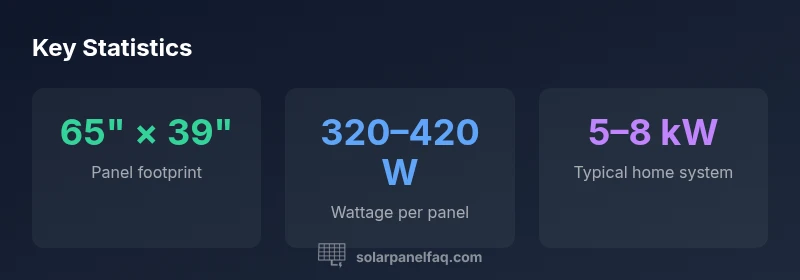
The size of a standard residential solar panel is about 65 inches by 39 inches (1.65 m by 0.99 m), which equals roughly 1.6–1.8 m² of active area and about 17–21 ft² per module. This footprint directly affects roof layout, mounting spacing, and wiring, and helps determine how many modules you need to reach a target system size.
Understanding the size of solar panel
The size of a solar panel matters well beyond its watts. In residential projects, the panel footprint determines how many modules can be installed on a roof, how they are oriented, and how space is allocated for rails, spacing, and ventilation. While a larger wattage panel may seem advantageous, it does not automatically mean more space efficiency if the footprint is substantial. Homeowners should evaluate the size of solar panel in tandem with system goals, roof area, and potential future upgrades. This section uses a practical lens to connect physical dimensions with real-world installation outcomes, and it anchors discussions in typical residential formats while noting that commercial and off-grid scenarios often use different dimensions.
When planning, map the available roof area, then translate that area into module footprints. The footprint dictates the maximum number of modules per row and the total rows, which ultimately determines usable roof area and the aesthetic fit. Accurate measurements reduce the risk of gaps or shade issues that limit performance. The Solar Panel FAQ team emphasizes grounding decisions in the actual size of solar panel, not just the advertised wattage, to avoid space constraints later.
How panel size translates to roof layout and shading considerations
Roof layout is a geometric problem: you must fit modules within the roof plane, account for racking width, and leave clearance for ventilation and maintenance. Larger panel footprints demand more adjacent clearance and can complicate alignment with roof edges or vents. Conversely, compact footprints enable denser layouts and potentially more modules on a given plane, increasing total system capacity without expanding roof area. Shading impact is also a function of spacing; if modules are packed too tightly, minor shading on one module can cascade to neighboring modules. The size of solar panel is a practical design parameter that helps installers optimize tilt, orientation, and row spacing to maximize energy harvest over the year.
Standard sizes by technology and cell count
Most residential panels today come in 60- or 72-cell formats. The physical dimensions are commonly around 65 inches by 39 inches for many standard 60- and 72-cell modules, though exact measurements vary by model. The choice between 60-cell and 72-cell, and between monocrystalline vs polycrystalline, influences both footprint and electrical characteristics. Higher wattage often accompanies slightly larger footprints or tighter cell arrays, but many manufacturers optimize designs to balance footprint with efficiency. When evaluating panel size, compare the exact dimensions and weight, not just the watt rating, to ensure a proper fit on your roof structure and mounting hardware.
Translating panel size to system capacity and layout
System capacity is the sum of the wattage of all installed panels. If you plan an 8 kW system and use panels in the 320–420 W range, you may need around 19–25 panels, depending on the final chosen model and any derating factors. The footprint plays a critical role in determining whether a denser, higher-wattage panel can reduce the total number of modules without compromising spacing requirements. Always work with a qualified installer who can model the layout, taking into account angle, azimuth, and shading patterns specific to your roof.
Space planning: roof space, mounting, and airflow
Beyond footprint, consider roof orientation, ventilation, and seasonal shading. Panels require air gap for cooling; too-tight spacing can increase operating temperatures and degrade performance slightly. Roof orientation and tilt influence system output as much as panel size does, so a compact footprint that fits well on a south-facing slope with minimal shading can outperform a larger footprint that forces suboptimal placement. The right balance between panel size, spacing, and roof geometry yields the best long-term return.
Practical steps to estimate panel fit on your roof
- Measure usable roof area in square feet or square meters; exclude vents, chimneys, and edges that complicate mounting. 2) Obtain exact footprint dimensions from prospective panels (width × height). 3) Calculate how many modules can fit per row and how many rows are needed for your target system size. 4) Factor in railing width, clearance for cleaning, and electrical clearance at the edges. 5) Work with your installer to run a shading analysis and confirm the final layout before permitting.
Case studies: real-world roof scenarios
In a typical single-family home with a 2,000–2,500 square foot footprint and an east–west roof orientation, a 6–8 kW system often uses 18–26 panels depending on the chosen wattage. A home with a smaller roof (~1,800 ft² usable area) might fit 12–18 panels if using high-wattage 340–360 W modules. Case studies show that precise measurement and layout optimization can save thousands of dollars by reducing the number of modules without sacrificing total output. The size of solar panel is central to these outcomes because it dictates how efficiently roof space is used.
Key dimensions and specs for common solar panels
| Aspect | Typical value | Notes |
|---|---|---|
| Panel footprint | 65" × 39" | Standard residential module size |
| Wattage per panel | 320–420 W | Depends on model and efficiency |
| Module efficiency | 18–22% | Higher efficiency often means better space use |
| Common system size | 5–8 kW | Typical for many homes in moderate climates |
Frequently Asked Questions
What is the typical size of a residential solar panel?
Most residential solar panels measure about 65 inches by 39 inches (1.65 m by 0.99 m). The exact footprint varies by model and cell count, but the 60- and 72-cell formats are the most common. This footprint translates directly into how many panels fit on a roof.
Most home panels are around 65 by 39 inches; the number you can fit depends on your roof.
How does panel size relate to system output?
Panel size determines the number of modules you can install, which affects total system capacity. Wattage per panel adds up to your home’s kilowatt target; higher efficiency panels can reduce footprint without sacrificing output, but the overall system size is the sum of all panel wattages.
Smaller footprints can still produce power if wattage is high; layout optimization matters.
Can larger panels fit on a small roof?
Larger wattage panels may be larger in footprint or similar in size; the constraint is the footprint. On small roofs, higher-efficiency panels or optimized tilts can maximize capacity, but you may still face limits from shade and orientation.
A small roof may fit fewer panels even if wattage is high due to footprint.
Are there different sizes for different panel types?
Yes. Monocrystalline and polycrystalline panels come in multiple sizes and cell counts (e.g., 60- and 72-cell formats). The size affects footprint, weight, and wiring, as well as cost per watt. Check manufacturer specs for exact dimensions.
Different panel types come in different sizes; check exact dimensions from the manufacturer.
What is the impact of panel size on installation cost?
Panel size influences system density, mount count, wiring runs, and racking length. Larger panels can reduce module count, but total cost depends on wattage, efficiency, and balance-of-system components. Work with an installer to estimate total cost.
Panel size affects mounts and cables, impacting installation cost.
How should I measure my roof to estimate panel fit?
Measure usable roof area, account for shading and orientation, and use the panel footprint to estimate fit along each row and total rows required for your target system size.
Measure usable roof space and divide by panel footprint to estimate fit.
“Panel size is a practical design parameter that shapes roof layout and long-term energy yield. Understanding footprint helps you maximize space and minimize costs.”
Top Takeaways
- Identify the exact panel footprint before layout planning
- Higher-wattage modules can reduce count but may alter footprint
- Roof orientation and shading are as important as panel size
- Use precise dimensions from the manufacturer for accurate planning
- Consult a qualified installer for a layout that maximizes space and output