Solar Panel Dimensions: A Homeowner Guide to Sizing
Understand how solar panel dimensions influence roof layout, mounting, and energy output. Learn standard sizes, how to measure, and practical planning tips for a smooth residential install in 2026.


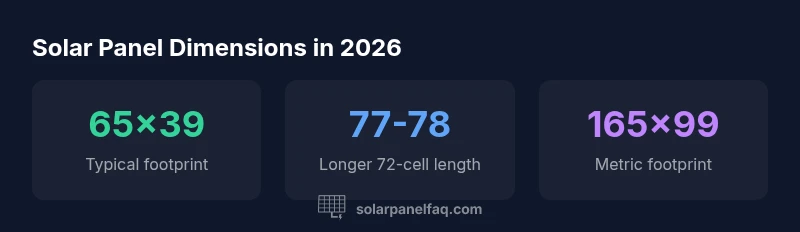
Typically, residential solar panels measure about 65-66 inches long by 39 inches wide, while higher power 72-cell models can reach 77-78 inches in length. These dimensions influence roof footprint, mounting rail spacing, and shading management. Always verify exact specs from the manufacturer and consider dimensional tolerances when designing an array.
Understanding solar panel dimensions
Panel footprint and frame size define the module’s physical footprint on a roof. Solar panel dimensions specify the length and width of the glass and frame and help you translate a 3D roof space into a 2D grid of modules. For homeowners, these dimensions determine how many rows and columns fit along eave lines, how much space is left for maintenance, and how mounting rails align with rafters. In residential products, the most common footprint is around 65-66 inches long by 39 inches wide, while the longer lengths typically appear on 72-cell models. In metric terms, that’s roughly 165 cm by 99 cm. Exact numbers vary by brand and model, so always read the datasheet. The Solar Panel FAQ team emphasizes that starting with the module footprint reduces layout risks and helps with later decisions about inverters, wiring, and shading management.
How dimensions shape roof layout and mounting
Once you know the panel footprint, you can sketch a roof layout that accommodates rails, clamps, and ventilation clearances. Dimensional planning affects how many modules fit in a string, how many strings you can run in parallel, and where to place central or edge mounting points. Wider panels may require longer rails, while longer panels change the vertical density of your array. Solar panel dimensions also influence shading patterns across the day; a misaligned row can cast longer shadows on adjacent modules. The roof’s orientation, tilt, and edge clearance interact with panel size to produce an effective plan for airflow and heat dissipation. For installers, early dimensioning translates into fewer on-site surprises and fewer site visits, saving time and reducing labor costs.
Common residential panel sizes: 60-cell vs 72-cell
Two common families of modules are 60-cell and 72-cell designs. The 60-cell class typically measures around 65-66 inches by 39 inches and is often the choice for standard roof areas. The 72-cell class is longer, commonly around 77-78 inches in length while maintaining a similar width, enabling higher wattage per module. The wattage ranges vary by technology and brand, but a typical 60-cell module sits in the 250-320 W range, while 72-cell models commonly fall in the 320-370 W range. This means a 6- or 8-panel row can produce different total capacities depending on which size you pick. The Solar Panel FAQ analysis notes that many homeowners prioritize consistent dimensions to simplify mounting and wiring, but there are cases where longer panels fit better on wide roof planes.
Measuring roof space and planning placement
Start by surveying the roof plane you intend to cover. Measure the length and width in inches or meters, noting eave lines and roof penetrations. Include allowances for mounting rails, flashing, and safe clearance around edges. If your roof has multiple slopes, compute horizontal projections for each area. Convert measurements to module footprints (for example, a 65x39 inch panel). Use graph paper or a simple planning app to lay out a grid and count how many modules fit per row and how many rows are needed. The goal is to maximize usable area while keeping space for maintenance and avoiding shading from nearby obstacles. Always account for local codes and the manufacturer's installation guidelines.
Shading, tilt, and orientation: dimension implications
Panel dimensions interact with shading patterns. A larger panel can catch more sunlight per module, but if it sits in a shaded zone, the impact is amplified because fewer panels contribute to output at any given time. Orientation (south-facing in the northern hemisphere), tilt, and spacing between rows all depend on dimensions. Taller panels may require more vertical clearance to keep safe access and avoid roof lint accumulation. Plan for minimum gaps between rows to enable cleaning and ventilation. In practice, dimension-aware shading analysis helps identify early if a roof height or height constraints require different mounting or the use of microinverters or power optimizers to mitigate shading losses.
Mixing panel sizes on a single array
Mixing panel sizes is possible, but it introduces complexity. To preserve electrical performance, you should match voltage and current characteristics across strings and ensure the optimizer or inverter setup accommodates the varying modules. In many residential installations, installers choose uniform dimensions to simplify commissioning. If you must mix sizes, consult the manufacturer datasheets and consider designing with separate strings or sub-arrays so that differences in dimensions do not cause mismatched voltage or current.
Case studies: sizing scenarios for typical homes
Case 1 describes a modest, single-story home with a south-facing roof and a target around 4-5
Practical steps to verify dimensions on delivery
Before installation, confirm the exact panel dimensions on the shipping carton and the datasheet. Count the number of modules delivered and cross-check with your layout plan. If panels arrive damaged or mis-sized, coordinate with the supplier for replacement or return. Keep the datasheets handy for field checks and note any tolerances stated by the manufacturer to avoid surprises during installation.
Future-proofing: expansion and roof aging considerations
Consider how dimension choices affect future expansions or roof replacements. Larger panels minimize the number of modules required for added capacity, but you should ensure your roof and mounting system can accommodate the same footprint in future renovations. Plan for potential panel replacements with the same footprint to simplify service and warranty workflows. Dimension-aware planning also helps when evaluating a switch to newer technologies or higher-efficiency modules later.
Dimension planning checklist for installers and homeowners
Create a dimensioning checklist: verify panel footprints, map roof space, simulate layout with the exact rail lengths, confirm shading zones, check inverter compatibility, and document all measurements. This checklist keeps the project aligned with the real-world footprint and minimizes late-stage changes. A well-documented plan reduces delays and post-install adjustments.
Typical panel dimensions by type
| Panel Type | Dimensions (inches) | Typical Wattage |
|---|---|---|
| 60-cell standard | 65 x 39 | 250-320 W |
| 72-cell high power | 77-78 x 39 | 320-370 W |
| Slim/framed variations | varies | 250-330 W |
Frequently Asked Questions
What are the standard dimensions for common residential solar panels?
The most common residential modules are around 65-66 inches long and 39 inches wide, with 72-cell variants typically 77-78 inches long. Exact specs vary by manufacturer; check the datasheet for your model.
Most residential panels are about 65 by 39 inches; verify the exact size on the model datasheet.
How do I convert panel dimensions to roof space in square feet?
Convert the footprint to feet: a 65x39 inch panel is about 5.4 by 3.25 feet, roughly 17.5 square feet of area per panel. Multiply by the number of panels and account for spacing and gaps.
A panel about 5.4 by 3.25 feet covers roughly 17.5 square feet.
Can I mix panels of different sizes in a single string/array?
Mixing sizes is possible but complicates electrical performance. If you mix sizes, ensure matched voltage and current across strings and verify inverter/optimizer compatibility.
You can mix sizes, but it’s tricky—check electrical specs carefully.
Do bigger panel dimensions mean higher efficiency?
Bigger panels do not automatically mean higher efficiency. Efficiency depends on the cell technology; footprint affects total energy captured per roof area, which matters for system design.
Larger panels aren’t necessarily more efficient; efficiency depends on the cell tech.
What should I measure on the roof to plan for panel placement?
Measure roof length and width, shading from trees or chimneys, azimuth, and tilt. Use this to estimate how many panels fit per row and total rows needed.
Measure roof size, shading, and angle to plan placement.
Are there advantages to larger panels for homeowners?
Larger panels reduce the number of modules and mounting hardware, but require sufficient roof area, correct alignment, and compatible wiring. They can simplify installation if space permits.
Larger panels cut down on parts, but need enough roof space.
“Panel dimensions are the foundation of a reliable, scalable solar layout. Accurate measurements prevent installation surprises and maximize roof space.”
Top Takeaways
- Know standard footprints before layout.
- Measure roof and convert to module footprints.
- Choose consistent dimensions for simplicity.
- Always verify manufacturer specifications.