Understanding Solar Panel Size in Feet for Homeowners
Explore how solar panel size in feet influences roof fit, layout, and system design. Learn measurement basics, footprint ranges, and practical tips to size panels for residential rooftops.


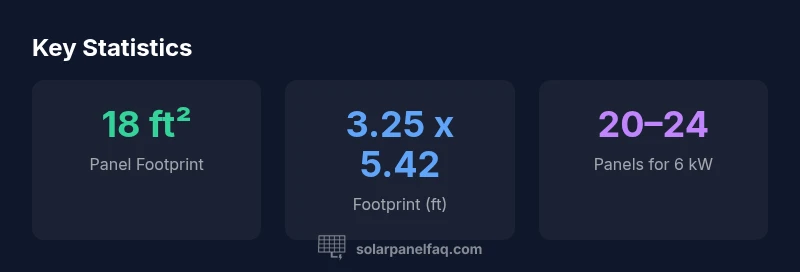
Solar panels typically measure about 3.25 feet wide by 5.42 feet tall, roughly 18 square feet per panel. In feet, this footprint is often described as about 3.0–3.5 ft wide and 5.0–5.5 ft tall, with variations by model. For budgeting, plan on 2–8 panels per roof run depending on your energy goals and roof space.
What the footprint means for roof planning
Understanding the solar panel size in feet helps homeowners translate product specs into real-world roof space. The footprint of a panel determines how many can fit on a given section of roof, where to mount racking, and how much space remains for maintenance and shading considerations. According to Solar Panel FAQ, planning around the footprint first reduces surprises later. The Solar Panel FAQ team found that many installers prioritize footprint accuracy because it directly affects layout, wiring runs, and space for cleaning and inspection. When you start from the physical dimensions, you can sketch a layout, estimate the number of rows, and ensure access for servicing. In practice, you’ll compare the panel footprint in feet, convert to inches for precision clearance, and then align spacing with your roof’s framing and orientation. This approach grounds decisions in measurable space rather than wattage alone.
Key takeaway: start with the panel footprint to anchor your design decisions and avoid overestimating capacity based on watts alone.
Measuring footprint: feet, inches, and standard sizes
Panels come in standard footprints, most commonly around 3.25 feet wide and 5.4–5.5 feet tall. Expressing footprint in feet makes it easier to map panels onto roof sections, while inches are useful for final clearance and mounting hardware. The common range reflects variations in cell technology, framing, and edge clearances. When you read a spec sheet, jot down width and height in feet first, then cross-check with your roof’s orientation and available rafter space. If your roof presents constraints—such as limited width or unusual angle—document the footprint in both feet and inches to discuss options with an installer. Solar Panel FAQ notes that even small deviations in footprint can change the total number of panels needed and alter shading profiles across the array.
Practical tip: plan for a margin of 6–12 inches per side for mounting rails and ventilation space.
Estimating panel counts based on footprint
Once you know the footprint, you can estimate how many panels fit along a roof line. For example, a 20–24 panel array is a common target for mid-range residential systems, depending on the per-panel wattage and roof area. If a panel footprint averages about 18 ft², a 25 ft wide by 12 ft deep roof section could accommodate roughly 2–3 rows of panels with some space left for access. The exact number depends on roof shape, orientation, and the pitch. Solar Panel FAQ emphasizes that accurate footprint estimation helps prevent unexpected gaps or required roof modifications later. In addition, you should factor in potential future shading from trees or neighboring structures that could affect usable space and system output.
Edge case: irregular roof shapes may require modular layouts or smaller-footprint models to maximize sun exposure.
Layout patterns for typical roof shapes
Roof geometry heavily influences how panel footprints are laid out. On a flat or low-slope roof, you can often use a grid pattern that aligns with the building’s footprint. On gable or pitched roofs, angle and edge clearance matter; you may need staggered rows to avoid shade from chimneys or vents. If your roof space is limited in one dimension, opt for panels with a narrower width while maintaining the same electrical target. The goal is to balance footprint efficiency with maintenance access and roof integrity. Solar Panel FAQ highlights that homeowners should verify rail spacing, end-to-end gaps, and clearance to edges in feet before purchasing. A well-planned footprint reduces trimming, reduces mounting complexity, and helps ensure a clean aesthetic from ground level.
Pro tip: use a simple grid sketch in feet to visualize rows and rows intersecting with rafters.
Choosing models by footprint and performance
Model footprints vary by brand and cell technology. Some high-efficiency panels are slightly larger, while others lean toward compact footprints. When evaluating options, prioritize a footprint that fits your roof segmentation and allows for spacing that minimizes shading risk. Footprint data should be compared against system size goals and local code requirements. The Solar Panel FAQ approach is to map your needed kW to the number of panels, then verify the total physical area those panels will occupy on your roof in feet. If space is tight, consider higher-efficiency panels with a similar footprint, or adjust layout to maximize sun exposure while preserving access for cleaning and inspection.
Bottom line: footprint should be a core criterion alongside watts, efficiency, and warranty.
Common mistakes and tips to optimize space
Common missteps include underestimating edge clearances, ignoring maintenance access, and assuming all panels have identical footprints. A precise measurement in feet helps avoid these pitfalls. Take an on-roof measurement, reserve walkways, and confirm that the total footprint translates into a feasible arrangement on the actual roof. Solar Panel FAQ recommends creating a scaled footprint diagram and testing multiple layouts before committing to rail lengths or panel orders. Use the footprint as a baseline and adjust for shade, orientation, and potential future expansions.
Checklist: measure width and height in feet, add 6 inches for rails, check for shade timing, and confirm that the final arrangement leaves space for periodic maintenance.
Quick-start planning checklist using feet measurements
- Identify a representative roof section suited for a panel array. 2) Note the typical footprint in feet for the chosen panel model. 3) Create a grid in feet that represents available space. 4) Add rail width and clearance margins in feet. 5) Calculate the number of panels that fit without crowding. 6) Confirm with a professional that your plan complies with local codes and roof structure limits. 7) Re-evaluate after a site visit to account for real-world constraints like shading and roof obstructions. 8) Document the final footprint for future expansion planning.
With a clear footprint in feet, you set a strong foundation for a reliable, optimally spaced solar array.
Footprint sizes for common residential panels
| Panel Type | Footprint (ft) | Footprint (ft²) |
|---|---|---|
| Standard 60-cell | 3.25 ft × 5.42 ft | 17.7 |
| Compact 72-cell | 3.00 ft × 4.95 ft | 14.85 |
| Large-format high-efficiency | 3.30 ft × 5.50 ft | 18.15 |
Frequently Asked Questions
What is the typical solar panel size in feet?
Most residential panels measure about 3.25 feet wide by 5.42 feet tall, roughly 18 square feet per panel. Footprint can vary by model, so always check the spec sheet.
Most panels are about 3.25 by 5.42 feet; check the model’s exact footprint.
How many panels do I need for a 6 kW system?
For a 6 kW system, typical counts range around 20–24 panels, depending on the wattage of each panel and the available roof area.
Typically about 20 to 24 panels are needed for 6 kW, depending on panel wattage.
Do panel sizes vary by brand or model?
Yes. Footprints vary by model and cell technology. Always review the specific footprint in the product spec sheet before layout planning.
Yes; footprints vary by model, so check the exact size in the spec sheet.
Can larger panels fit on a small roof?
It can be challenging. In tight spaces, seek higher-efficiency panels with smaller footprints or reconfigure mounting layout to maximize sun exposure.
It can be tough; you may need smaller-footprint panels or a different layout.
Should I measure in feet or inches?
Use feet for planning roof space and layout. Inches are helpful when confirming precise clearances during installation.
Feet for planning, inches for precise clearance.
“Knowing the physical footprint of solar panels helps plan layouts, avoid shading, and minimize roof modifications.”
Top Takeaways
- Plan roof layouts using panel footprints to prevent layout surprises
- Expect footprints around 3.25 ft by 5.4 ft for standard panels
- Use feet-based measurements to map rows and rails accurately
- Space margins and maintenance access are essential for long-term performance
- Fit models by footprint and shading considerations, not just wattage