What Are the Dimensions of a Solar Panel?
Discover typical solar panel dimensions for common configurations (60- and 72-cell), how size affects roof fit and mounting, and how to measure your space for installation.


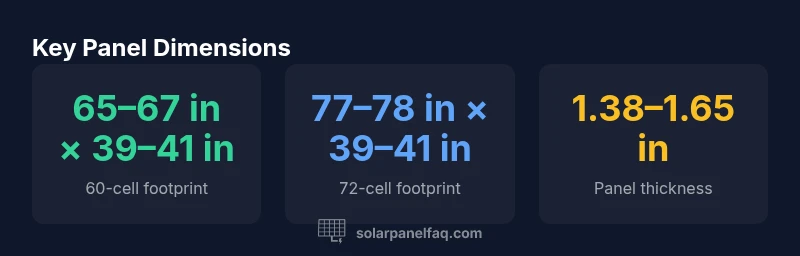
The most common residential solar panels measure about 65–67 inches long by 39–41 inches wide for 60-cell modules, and about 77–78 inches long by 39–41 inches wide for 72-cell modules (roughly 1650–1700 mm × 990–1040 mm and 1956–1981 mm × 990–1040 mm, respectively). Exact sizes vary by model and manufacturer, and frame/rail design can add a few millimeters to the footprint.
What the term 'dimensions' covers for solar panels
When homeowners ask what the dimensions of a solar panel are, they are usually seeking three basic measurements: length, width, and sometimes thickness. In residential installations, the length and width define how many panels fit along a roof run and how much shading area you’ll have on a given orientation. Thickness and frame profile influence how panels sit on mounting rails and how much usable clearance exists near edges, vents, or skylights. In official product literature, dimensions are given as two numbers (length × width) for the face of the panel, with a third measurement (thickness) noted separately. For most buyers, “dimension” means the surface footprint—the rectangle that must clear roof structures and fit within the racking system. Throughout this article we’ll translate those numbers into practical space planning and installation decisions.
Note: The exact footprint can vary by model and manufacturer; always verify the datasheet before purchasing or ordering rails.
Typical sizes by cell count: 60-cell vs 72-cell modules
The vast majority of residential panels sold today fall into two common families: 60-cell modules and 72-cell modules. A typical 60-cell panel measures around 65–67 inches long and 39–41 inches wide, which is about 1650–1700 mm by 990–1040 mm. For many installations this footprint translates to about 1.8 to 2.0 square meters of panel area, not including framing. 72-cell panels are longer, usually about 77–78 inches in length with the same 39–41 inch width, or roughly 1956–1981 mm by 990–1040 mm. The precise numbers vary by brand and the mounting frame, but the overall ratio remains roughly 1.6:1 (length to width).
If you are replacing a failed panel or expanding an array, you’ll often see the two sizes side by side in spec sheets; always verify the exact dimensions on the manufacturer’s datasheet. These measurements directly affect how many panels fit along a roof edge or in a fixed racking plan.
How orientation and framing influence fit
Orientation and frame design influence the effective footprint. While the face of a panel is roughly 65 by 39 inches for a typical 60-cell, the outer frame can add a few extra inches to length and width. Some manufacturers also slightly alter the dimension by using a different backsheet or by trimming the frame edge; these adjustments can change fit by a few millimeters to a half inch. When planning on a pitched roof, you must consider between-row spacing (gap between adjacent panels) and rail length; a longer panel reduces flexibility for tight roof bays but can maximize power in wide installations. For ground-mounted arrays, the dimension choice also affects the layout of the mounting grid, the number of rows, and the overall shading pattern. In practice, always consult the exact datasheet for the model you intend to buy and confirm compatibility with your mounting hardware before purchasing.
Measuring space on your roof: a practical step-by-step
- Map your roof area and determine the maximum length and width available for solar modules.
- Choose your preferred panel family (60-cell vs 72-cell) and note the nominal footprint from the datasheet.
- Account for mounting rails, edge clearance, and any overhangs near vents or skylights.
- Add a small tolerance for installation tolerances and potential misalignment during installation.
- Sketch conceivable layouts on graph paper or a digital tool, and try multiple strings to optimize shading and output.
- Confirm with your installer that rail lengths and module spacing fit the roof geometry and racking system.
- Verify the final fit with a physical template if possible before ordering panels.
These steps help ensure the chosen panel dimensions align with roof geometry and mounting constraints, avoiding costly rework later.
Variations by manufacturer and generation
Manufacturers vary panel dimensions slightly due to frame design, backsheet materials, and corner cut-outs for wiring. Even within the same cell count family, you may encounter footprints that differ by a few millimeters. When planning an upgrade or replacement, always compare the exact footprint from the datasheet rather than relying on the general rules of thumb. Tolerances are typically small, but even a few millimeters can matter in tight roof bays or when you’re trying to maximize the number of modules on a limited surface. The practical takeaway is: treat the spec sheet as your primary guide, and coordinate with your installer to confirm rail compatibility and spacing.
Layout optimization: strings, shading, and space planning
A well-planned layout uses consistent panel dimensions to simplify wiring and string design. If you mix panel sizes, you must recalculate string configurations, bypass diodes, and potential shading impacts. In general, maintaining uniform panels across a string minimizes complexity and maximizes performance. For complex roof geometries (hip roofs, dormers, or irregular edges), work with an installer to create modular strings that fit within the available footprint while maintaining electrical safety clearances. Remember, the dimension choices affect not only the physical fit but also electrical performance and maintenance access around the array.
Standards, safety, and choosing the right size
Industry standards and safety guidelines influence how panels are sized and installed. Look for panels that comply with IEC 61215 or UL 1703/2703 family standards, and check that mounting hardware is rated for the panel thickness and weight. The dimension selection should align with your roof structure’s load capacity and local codes. When in doubt, rely on a qualified solar installer to verify that the panel footprint, rail length, and spacing meet both performance goals and safety requirements. This reduces risk and helps ensure a durable, high-performing solar installation.
Authoritative sources and credible references
For further verification, consult trusted sources such as the National Renewable Energy Laboratory (NREL), the U.S. Department of Energy, and the International Electrotechnical Commission (IEC). Reading the manufacturer datasheets is essential to confirm exact footprints and mounting details. See the references listed in the article’s sources section for direct links to standards and technical guidelines.
Common residential solar panel dimensions by cell count
| Panel Type | Typical Dimensions (in) | Typical Dimensions (mm) |
|---|---|---|
| 60-cell | 65-67 in × 39-41 in | 1650-1700 mm × 990-1040 mm |
| 72-cell | 77-78 in × 39-41 in | 1956-1981 mm × 990-1040 mm |
Frequently Asked Questions
What are the typical dimensions of a standard 60-cell solar panel?
A typical 60-cell panel is about 65–67 inches long and 39–41 inches wide, with exact numbers varying by brand. Check the manufacturer’s datasheet for precise footprint to ensure your mounting rails and rail spacing will fit.
Most 60-cell panels measure around 65 to 67 inches by 39 to 41 inches; always verify the exact size on the datasheet.
Do dimensions vary between manufacturers?
Yes. The length, width, and even thickness can vary slightly between models and frame designs. Always rely on the official datasheet for the exact footprint before planning a layout.
Yes, footprints vary by model; check the datasheet for the exact size.
How can I measure space for a roof installation?
Measure the available roof area, note the roof orientation, and select a panel family (60- or 72-cell). Create a mock layout on paper or a design tool, factoring in rail length and edge clearance.
Measure your roof, pick a panel size, and plan a layout with rails and clearances.
Are there low-profile or thinner panels?
Most residential panels share similar thickness ranges, typically around 1.38–1.65 inches. Some special designs may be thinner, but it’s best to confirm with the manufacturer.
There are not standard ultra-thin panels for home installs; thickness varies, check the datasheet.
Can I mix panel sizes in the same installation?
Mixing sizes is possible but increases design complexity and may affect shading and electrical balance. Consult with an installer to optimize layout and performance.
Mixing sizes is doable but tricky; best to plan a uniform layout with your installer.
What standards govern panel dimensions and mounting?
Panel dimensions and mounting are guided by standards like IEC 61215 and relevant UL/ETL listings. Always ensure both the module and the mounting hardware comply with local codes.
Standards like IEC 61215 guide dimensions and mounting; make sure your kit meets local codes.
“Panel dimensions are a fundamental driver of installation fit and system layout. While most residential panels share a standard footprint, small differences between models can affect how many modules you can place on a roof.”
Top Takeaways
- Measure both length and width before purchasing.
- 60-cell and 72-cell panels use distinct footprints.
- Check manufacturer datasheets for exact dimensions.
- Consider mounting rails and edge clearance in your plan.