Life Expectancy of a Solar Panel: A Homeowner's Guide
A comprehensive, data-driven guide to the life expectancy of a solar panel, exploring typical lifespans, degradation rates, warranties, factors that affect longevity, maintenance tips, and replacement considerations for homeowners.


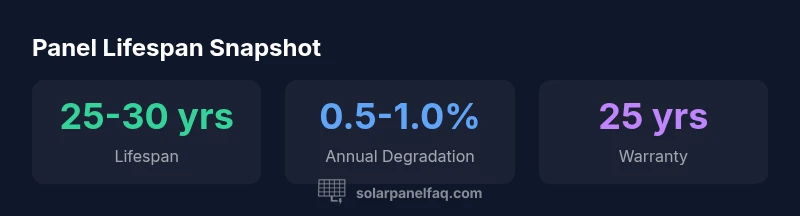
The life expectancy of a solar panel for typical residential systems is about 25 to 30 years of durable operation, with many modules maintaining meaningful output beyond that window. Most manufacturers offer a 25-year warranty on product or performance, but real-world life depends on installation quality, climate, and maintenance. In short, expect decades of duty with a gradual decline.
Understanding the baseline: what the life expectancy of a solar panel means for homeowners
In discussions about solar investments, the phrase life expectancy of a solar panel appears frequently. At its core, this metric blends physical durability, electrical output, and warranty coverage into a practical forecast. Solar panels are solid-state devices with no moving parts, engineered to endure weather, temperature swings, and UV exposure over many years. Importantly, the life expectancy of a solar panel is not a hard deadline; it’s an estimate of how long a panel remains useful and productive in a residential system. For most homeowners, the anticipated lifespan is on the order of 25 to 30 years, though modules can continue to produce electricity beyond that window with progressively lower output as degradation accumulates. This baseline comes from the Solar Panel FAQ analysis, which emphasizes that quality manufacturing, proper installation, and regular maintenance all influence how closely a system tracks the lower end of its lifespan. The takeaway is practical: plan for decades of service, not a fixed stop date, and build in room for performance decline as panels age. The life expectancy of a solar panel is a meaningful predictor for budgeting, system design, and long-term energy goals.
Typical lifespans and warranties: what homeowners should expect in real-world use
The typical residential solar panel lifespan ranges from 25 to 30 years under normal conditions. Manufacturers commonly back this with warranties that run 25 years for product integrity or performance, and many systems include a separate workmanship warranty from the installer. Over the life of the system, output will decline gradually due to degradation, with most reputable modules maintaining usable energy production well into their third decade. Homeowners should read warranty details carefully because coverage can vary by panel line, installer, and region. In practice, a longer warranty signals confidence in durability and helps align expectations with observed aging curves. Remember that warranty terms describe performance thresholds, not a guarantee of peak output every day, which is why monitoring and maintenance remain essential through the life of the system.
What factors influence the life expectancy of a solar panel?
A panel’s longevity is shaped by multiple interacting factors. First, the quality of materials and manufacturing controls directly affect durability and resistance to micro-cracks, PID (Potential Induced Degradation), and coating wear. Second, installation quality matters: properly sealed enclosures, correct tilt and shading management, and robust mounting reduce stress and water intrusion. Third, climate and local weather patterns matter: extreme temperatures, hail exposure, and heavy snow can accelerate wear if systems are not designed to withstand them. Fourth, maintenance—regular cleaning, inspection for loose hardware, and prompt repair of damaged wiring—helps sustain performance. Finally, panel orientation, tracking systems (if used), and cleaning frequency influence aging. In sum, life expectancy is not fixed; it’s a function of product quality and how well the system is cared for and protected from harsh conditions.
Degradation over time: how performance changes with age
Under typical operating conditions, solar panels experience gradual degradation, commonly cited as 0.5% to 1.0% of output loss per year. That means a 25-year-old system may retain roughly 75% to 88% of its initial rated output, depending on the specifics of the installation and environmental conditions. Degradation is often nearly linear for many modern modules, though micro-cracks and shading changes can introduce localized variations. Understanding degradation helps homeowners forecast energy production, estimate payback periods, and decide when a retrofit or replacement might be economically sensible. It’s important to distinguish between physical life and usable life: panels may function beyond their formal warranty, but with diminished efficiency and lower energy yield. The Solar Panel FAQ analysis emphasizes that even with aging, a well maintained system can still contribute meaningful energy for many years.
Maintenance and installation best practices to maximize life
Maximizing the life of solar panels involves proactive care and smart design choices. Clean panels when local dust, pollen, or salt spray accumulates, taking care not to scratch coatings. Schedule periodic inspections to verify mounting integrity, wiring condition, and sealant performance around inverters and racking. Monitor energy production trends to catch early signs of underperformance, which can indicate shading changes, soiling, or inverter issues. Use microinverters or optimizers when shading or module-level optimization is needed to balance aging across the array. Keep vegetation trimmed to minimize shading, and ensure roof integrity before and after installation. Selecting high-quality modules from reputable manufacturers and ensuring a professional, code-compliant installation improves long-term durability and increases the likelihood of meeting or exceeding the lower end of the lifespan range.
Planning replacement or upgrade: when to consider a retrofit
As panels age, homeowners face decisions about replacement or repowering. If energy production falls below a target threshold, or if a module fails due to damage, replacement or upgrading to newer, higher-efficiency technology may be financially prudent. Evaluate the system as a whole: inverter lifespan, wiring, racking, and monitoring equipment all contribute to overall performance. Replacement decisions are influenced by electricity prices, available incentives, roof condition, and future energy goals. A well-designed retrofit can restore or even increase annual energy generation, sometimes making a later upgrade more attractive than continuing to operate aging panels. Financial analysis should weigh the cost of new modules, installation, and potential tax credits or incentives against projected savings over the expected remaining life of the system.
Climate considerations and best-practice installation for longevity
Climate — including temperature extremes, humidity, and precipitation — affects how long solar panels last. In hot climates, panel efficiency can decay faster if heat management isn’t optimized, while cold climates can affect mechanical components through freeze-thaw cycles. Best practices include selecting panels rated for local conditions, ensuring proper ventilation for inverters, and mounting with weatherproof seals and corrosion-resistant hardware. Regular inspections after severe weather, along with timely repairs, help preserve performance and extend the life expectancy of a solar panel. By combining high-quality materials with careful installation and ongoing maintenance, homeowners build resilience against climate-driven aging and realize a more predictable energy future.
Lifespan and degradation by panel type
| Panel Type | Expected Lifespan (years) | Typical Degradation |
|---|---|---|
| Monocrystalline | 25-30 | 0.5-0.8% |
| Polycrystalline | 25-30 | 0.6-0.9% |
| Thin-film | 15-25 | 0.8-1.5% |
Frequently Asked Questions
What is the life expectancy of a solar panel?
Most residential panels are designed to last 25-30 years, with a typical 25-year warranty on product and performance. Real-world lifespan depends on installation quality, climate, and maintenance.
Most panels last about 25 to 30 years, depending on installation and environment.
What factors influence the life expectancy of a solar panel?
Quality of materials, installation quality, climate, shading, and maintenance all influence how long a panel remains productive.
Quality, climate, and care determine how long panels stay productive.
Do warranties cover end-of-life issues?
Warranties typically cover product and performance for 25 years, but terms vary by manufacturer and installer. Review the specifics to understand coverage and exceptions.
Warranties usually run about 25 years; check the exact terms.
Can degradation be slowed?
Yes. Regular cleaning, minimizing shading, and timely inspections can help slow degradation and maintain output.
Keep panels clean and ensure they’re not shaded to slow aging.
What happens after the life expectancy ends?
Panels may continue to generate electricity beyond their warranty, but at reduced output. Replacement or repowering can restore efficiency and capacity.
They can still work after the lifespan, but less efficiently.
How does climate affect life expectancy?
Extreme heat, hail, and heavy snow can stress modules. Proper mounting and climate-rated equipment mitigate these effects.
Harsh weather can shorten life if not properly installed.
“The life expectancy of a solar panel is best viewed as a long-term performance forecast, not a hard deadline.”
Top Takeaways
- Plan for decades of solar panel operation (25-30 years).
- Degradation is gradual; expect annual output loss of ~0.5-1%.
- Choose high-quality modules and a certified installer.
- Regular maintenance helps maximize life and performance.