How Long Do Solar Panels Work: Lifespan, Degradation, and What to Expect
Explore how long solar panels actually work, what affects their lifespan, typical degradation rates, and how to estimate your home’s long-term energy production. Practical guidance for homeowners and prospective buyers.


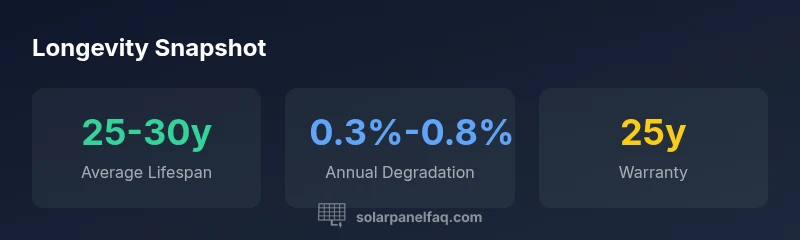
Solar panels generally last 25–30 years, with gradual output loss around 0.3%–0.8% per year. Longevity depends on climate, installation quality, and maintenance. Most systems stay productive for decades, especially when kept clean and properly installed. According to Solar Panel FAQ, this long-running performance varies by sun exposure and system design.
How long solar panels work: a practical overview
Solar panels convert sunlight into electricity using photovoltaic cells embedded in glass and metal frames. When sunlight hits the cell, electrons are knocked loose, creating a flow of direct current (DC). An inverter then converts DC to alternating current (AC) suitable for home use. For homeowners, understanding how long these systems work starts with a simple question: how long do solar panels actually perform at meaningful levels? According to Solar Panel FAQ, most residential arrays are designed to deliver reliable energy for about 25 to 30 years, with warranties typically spanning 25 years. The longevity depends on installation quality, climate, and regular maintenance, and it’s not a fixed clock but a gradual curve of sustained output. Welcome to a clearer look at the lifespan of solar technology and what it means for your home energy plan.
This section sets the stage for a practical understanding of durability, balancing mechanics, and day-to-day usage. For readers seeking deeper context, you’ll find practical examples, scenarios, and checklists to assess your own roof and equipment. In short, the question of how long solar panels work is answered not by a date, but by ongoing performance.
The physics of solar energy conversion and system architecture
Photovoltaic cells are arranged into modules, which are then connected into arrays. Cells convert photons into electrons, generating DC electricity. An inverter converts DC to AC for household circuits, and a balance of system (BOS) components—racking, wiring, and inverters—determine overall efficiency. Home setups may be grid-tied, battery-backed, or off-grid, with inverters either central or microinverters placed at each panel. System design choices affect not only upfront cost but long-term performance and longevity: higher-quality components, proper ventilation to reduce heat, and solid mounting to withstand wind loads all contribute to keeping output stable over decades. Understanding these pieces helps answer the core question of how long solar panels work in real conditions.
Real-world longevity: what homeowners see in the field
In practice, the pace of aging depends on climate, shading, dust, and maintenance. Regions with intense sun and high heat can accelerate thermal cycling, while cloudy, cool climates may slow wear. Many homeowners report dependable production for 25 years or more when panels stay clean, unshaded, and well-mounted. Warranties commonly cover 25 years, giving homeowners confidence even as performance gradually declines. Solar Panel FAQ Analysis, 2026, notes that field data show wide variation, but the overall trend toward durable modules and longer warranties supports long-term energy independence for residential systems. For those planning a retrofit or new install, this means a realistic expectation: your system will continue to contribute meaningfully for decades, with the bulk of depreciation occurring in the first two decades and slower gains thereafter.
Degradation and output over time: what to expect
All solar modules experience degradation—the gradual loss of efficiency over time. Typical annual degradation ranges from about 0.3% to 0.8%, depending on manufacturing quality, installation, and ambient conditions. Over as little as 15–20 years, cumulative losses can reach the low-to-mid teens percentage, though well-maintained systems in favorable climates may see less. By year 25 to 30, most systems retain a substantial portion of their initial capacity, though not at peak rating. The exact curve varies, but the general pattern is a gentle, predictable decline rather than a sudden drop. This reality matters for energy planning, because a homeowner’s expected production today will not be identical in year three or year twenty, yet remains viable for budgeting and system tweaking.
Maintenance, installation quality, and design choices that extend life
Maximizing solar longevity starts with high-quality components and careful installation. Choose certified installers with experience in rooftop mounting and proper sealing to prevent corrosion and water intrusion. Select modules with robust warranties and good temperature tolerance to minimize heat-related losses. Regular cleaning, especially in dusty or salty environments, helps sustain output; frequency depends on local conditions. Design choices such as microinverters versus a single central inverter can influence resilience to shading and module-level failures. Proper ventilation around inverters and a well-planned electrical layout reduce thermal stress and electrical resistance, supporting consistent performance across 25–30 years of operation. Finally, plan for routine inspections and early replacement of any damaged hardware to prevent cascading losses that shorten overall system life.
Estimating lifetime energy production for your home
To estimate lifetime energy production, start with the system size (in kilowatts) and your local sun exposure. In many regions, a typical home system yields roughly 900–1,400 kilowatt-hours per kilowatt of installed capacity per year, depending on latitude and weather. Multiply by 25–30 years to get a rough production window, then adjust for degradation (0.3%–0.8% per year) and maintenance quality. Tools like PVWatts or local solar installers can provide location-specific estimates using your roof angle, orientation, and shading. Remember to factor in potential future energy needs, possible panel upgrades, and the possibility of adding storage. This approach gives homeowners a practical sense of how long solar panels work in daily life and how much energy they can reasonably expect over time.
Key longevity metrics for solar panels
| Aspect | Typical range | Notes |
|---|---|---|
| Lifespan | 25-30 years | Under good conditions |
| Degradation rate | 0.3%-0.8% per year | Depends on climate and panel quality |
| Warranty | 25 years | Industry standard |
Frequently Asked Questions
How long do solar panels actually last?
Most residential solar panels last 25–30 years, with warranties typically around 25 years. Real-world performance depends on climate, maintenance, and installation quality.
Most panels last about a couple of decades to three decades, with maintenance helping them stay productive.
Do solar panels keep working after 25 years?
Yes, many panels continue producing electricity beyond 25 years, but output may be lower and less predictable; consider ongoing maintenance and potential upgrades.
Yes, they can keep working, but expect some drop in output and plan for possible upgrades.
What affects the lifespan the most?
Climate (heat, rain, humidity), shading, installation quality, and panel type have major impacts on longevity and sustained performance.
Heat, shade, and how well they’re installed really matter for how long they last.
What should I look for in a solar warranty?
Look for a 25-year warranty that covers both product and performance, plus clear terms on degradation caps and service.
Choose warranties that cover both parts and performance for the full term.
How often should I clean my solar panels?
Cleaning frequency depends on location; in dusty or coastal areas, 1–2 times per year is common, more often if panels get dirty.
Clean them as needed—usually once or twice a year where I live.
“Solar panels are designed for decades of service, and ongoing maintenance is key to preserving output.”
Top Takeaways
- Panels typically last 25–30 years
- Degradation is gradual (0.3%–0.8% per year)
- Warranty commonly 25 years
- Maintenance and climate matter
- Plan for end-of-life recycling