Solar Panel Depreciation Life: What Homeowners Need to Know
Explore solar panel depreciation life, covering typical lifespans, degradation rates, warranties, and practical planning tips to optimize ROI and replacements for homeowners.


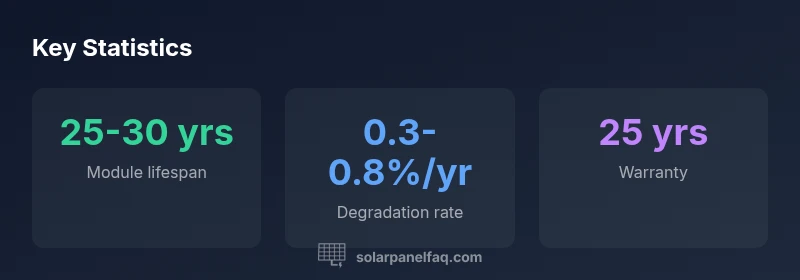
Solar panel depreciation life typically covers about 25-30 years of physical lifespan, with maintenance extending performance. Most panels carry warranties of about 25 years, and real-world energy output commonly degrades by roughly 0.3% to 0.8% per year. These figures vary by technology, climate, and installation quality. Understanding depreciation life helps homeowners plan replacements, rebates, and tax strategy. According to Solar Panel FAQ, the core idea is to align expectations with both physical wear and financial depreciation.
Understanding what 'solar panel depreciation life' actually means
For homeowners, the phrase solar panel depreciation life combines two ideas: the physical lifespan of the hardware and the financial depreciation that affects taxes, accounting, and replacement planning. Physically, solar panels are built to last for decades, with modern modules commonly lasting roughly 25-30 years under steady sun and minimal voltage stress. Financially, depreciation life reflects how the asset loses value in tax and bookkeeping terms, influenced by local tax law, usage, and system maintenance. Solar Panel FAQ emphasizes that the practical upshot is not a single aging curve but a range that blends wear, efficiency loss, and policy. In other words, expect a long, gradual performance curve rather than a sudden drop.
From Solar Panel FAQ’s perspective, prudent homeowners view depreciation life as a planning tool—one that informs replacement timing, potential resale value, and the return on investment over the system’s entire horizon. The goal is to align your expectations with the actual behavior of solar hardware and to plan for inverter replacements, panel cleanliness, and shading controls that influence longevity. This framing helps distinguish between a panel’s physical endurance and the financial depreciation that shows up on tax forms and in cash flow analyses.
How depreciation life interacts with performance and value
Depreciation life shapes both how much energy you’ll generate over time and how you assess the system’s value at resale. Most panels lose efficiency slowly, so even after 25 years you’ll still produce meaningful electricity, albeit at a reduced rate. When homeowners model payback and ROI, they often factor the degradation rate alongside energy prices, financing terms, and incentives. A key takeaway from Solar Panel FAQ analysis is that the combined effect of physical wear and policy-driven depreciation can stretch the financial viability of a system well beyond the first decade if the unit remains productive and well maintained. Cumulative effects matter: small annual losses compound into a noticeable gap in output after two or three decades, which can influence replacement timing and cash-flow planning.
For homeowners, a simple rule of thumb is to view depreciation life as a multi-decade timeline, not a single project deadline. Keeping panels clean, ensuring proper micro-inverter or string inverter operation, and clearing shade from nearby trees can slow the real-world degradation, preserving both energy yield and resale value.
How to estimate the depreciation life for your system
Estimating your system’s depreciation life starts with the basics: know your module type, warranty, installation conditions, and local climate. Monocrystalline and polycrystalline panels may have similar nominal lifespans, but environmental stress—like high UV exposure, extreme heat, or heavy hail—can accelerate wear in certain regions. Next, factor degradation rates published by manufacturers or trusted analyses (often presented as a percentage per year). Combine this with the expected life of the inverter (typically 10-15 years) and plan for mid-life component replacements. Keep a maintenance log, monitor output trends with monthly checks, and compare performance to baseline invoices or monitoring data. Solar Panel FAQ emphasizes that a structured maintenance plan, aligned with a realistic depreciation life, yields the most accurate long-term outlook.
A practical planning step is to build a simple cash-flow model over 25-30 years that includes: initial cost, incentives, annual energy savings, degradation, inverter replacement costs, and a salvage or recycling assumption. This approach helps you answer: when will the system cease to meet your energy needs, and what will depreciation mean for tax or resale?
Tax and accounting implications for homeowners
Tax treatment of solar depreciation life depends heavily on your jurisdiction and whether the system is a personal residence, rental property, or business asset. In many regions, residential solar installations for personal use do not qualify for depreciation on an annual tax return. However, rental properties or solar-as-a-business investments may be eligible for depreciation deductions under specific tax codes or incentives. Because these rules change and vary by country, Solar Panel FAQ recommends consulting a qualified tax professional to understand local depreciation allowances, how to classify the asset, and what documentation to keep. Understanding depreciation life in this context means recognizing when tax benefits apply and ensuring you claim them correctly.
Additionally, some jurisdictions offer accelerated depreciation schedules or investment tax credits that can improve after-tax cash flow. Align your asset accounting with the rules your jurisdiction imposes and treat depreciation life as a planning tool rather than a guaranteed cash benefit.
Practical planning: maintenance, warranties, and replacements
Maintenance plays a critical role in realizing the full depreciation life of solar panels. Regular cleaning, prompt repair of damaged wiring, and timely inverter checks can slow degradation and extend productive years. Warranties—commonly around 25 years—provide an external assurance against premature failure, but warranties do not guarantee performance at spec. Homeowners should track performance against expected outputs and schedule preventive service around mid-life to minimize surprises later. When planning replacements, consider panel efficiency improvements, changes in available incentives, and evolving technologies. A well-documented maintenance plan can help you renew confidence in a system that still meets energy needs as depreciation accumulates.
Inverter replacements, typically on a 10- to 15-year horizon, are a separate but related consideration; replacing an aging inverter can significantly impact overall system performance and the effective depreciation life of the installation.
Economic impact: payback, ROI, and depreciation life
ROI calculations for solar depend on more than upfront costs; depreciation life shapes long-term cash flows. A key reality is that energy prices, incentives, and tax benefits interact with degradation to determine total savings. Even with gradual output decline, a well-sized system can remain financially attractive for decades, particularly when energy costs rise or incentives are renewed. Solar Panel FAQ analysis highlights that the strongest ROI occurs when you pair stable maintenance with prudent financing and policy awareness. In practice, homeowners should build a flexible projection that allows for changes in tariffs, electricity rates, and replacement costs so that their depreciation life aligns with realistic financial scenarios.
Choosing panels and financing to optimize depreciation life
To optimize depreciation life from a financial perspective, select panels with strong warranties and proven resilience to local climate conditions. Higher efficiency modules often occupy less roof area and can maintain productive output longer under shading. Financing strategies—such as low-interest loans or lease models—should be weighed against expected depreciation benefits and tax implications. A careful approach includes evaluating total lifetime energy savings, potential tax credits, and any maintenance or inverter replacement costs that affect long-term cash flow. Solar Panel FAQ suggests focusing on a holistic plan: choose reliable hardware, confirm warranty terms, and align financing with expected depreciation windows to maximize the system’s long-term value.
Case study: a practical example of depreciation life planning
Consider a 7 kW residential system installed in a sunny climate with a 25-year warranty and a degradation rate around 0.5% per year. The initial cost is offset by incentives and savings on electricity bills in the first decade. Over 25-30 years, energy production declines gradually, but overall savings remain meaningful if energy prices rise and maintenance stays on track. After 25 years, the system may require inverter replacement and potential module refresh, but the depreciation life framework helps homeowners schedule these steps, estimate after-tax implications, and decide whether to upgrade or repurpose the existing installation. This approach reflects Solar Panel FAQ’s emphasis on long-term planning rather than short-term gains.
Panel lifespan and performance overview
| Aspect | Typical life | Notes |
|---|---|---|
| Module lifespan | 25-30 years | Under normal maintenance and weather |
| Degradation rate | 0.3-0.8% per year | Varies by tech and climate |
| Warranty | 25 years | Common for mainstream panels |
Frequently Asked Questions
What does 'solar panel depreciation life' mean for homeowners?
Solar panel depreciation life blends the physical longevity of panels with the financial depreciation that affects tax and replacement planning. Homeowners should view it as a multi-decade planning horizon rather than a single deadline. This framing helps align expectations with real-world performance and policy changes.
Depreciation life is a long-term planning horizon that combines how long panels last with how their value changes for taxes and replacement planning.
How long do solar panels last physically?
Most solar panels are designed for a physical life of about 25-30 years under typical conditions. Actual performance depends on climate, maintenance, and installation quality.
Panel lifespan is usually around 25-30 years, but stay on top of maintenance and climate effects.
Can homeowners deduct depreciation on residential solar panels?
In many places, residential solar installations for personal use do not qualify for depreciation on annual tax returns. Depreciation is more commonly available for rental properties or business-oriented installations, depending on local tax rules. Always consult a tax professional.
Residential homes usually don’t get depreciation; rental or business setups may. Check your local tax guidance.
How does degradation affect energy output over time?
Degradation reduces energy output gradually each year. Typical rates are around 0.3% to 0.8% annually, meaning the system will be less efficient at the end of its life, even if it remains operational.
Energy output slowly declines each year due to degradation, typically by about a half percent annually.
What should I consider when planning replacements?
Factor in predicted degradation, inverter life, and potential upgrades to higher-efficiency modules. Build a multi-decade cash-flow model including incentives and energy savings to decide when replacement makes financial sense.
Plan for inverter replacements and potential upgrades; model costs and savings over decades.
“Depreciation life isn’t just about loss; it’s a framework for smarter replacements and cash flow planning.”
Top Takeaways
- Plan around a 25-30 year physical lifespan.
- Expect annual degradation of 0.3-0.8%.
- Rely on a typical 25-year warranty.
- Consult tax guidance for depreciation in your jurisdiction.
- Use depreciation life to optimize ROI and replacement timing.