How Many Hours Can a Solar Panel Last? A Lifespan Guide
Explore how long solar panels last in hours, with lifespans in years, sun-hours, degradation, warranties, and practical maintenance tips for homeowners.


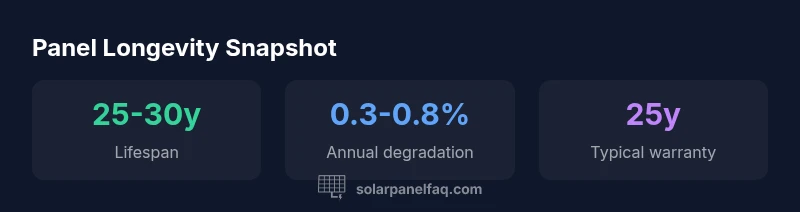
Solar panels don’t have a fixed hour tally. Most residential modules are designed to last about 25-30 years under typical conditions, which translates to roughly 40,000–60,000 sun-hours over their lifetime. Real-world results depend on climate, maintenance, and panel quality.
What does a solar panel's 'hours' actually mean?
Solar panels are rated by lifespan, not by a fixed number of hours. The concept of hours only makes sense when you translate sun exposure into energy output. A solar array continues to produce electricity as long as the cells remain functional and within warranty. In practice, manufacturers expect performance for about 25-30 years under normal conditions. The actual hours your system operates depend on your local climate and daily sun exposure. If you live in a sunny region with consistent irradiance, your panels will accumulate more sun-hours over the same calendar period than in a cloudier area, even if the rated lifespan is the same.
This perspective helps homeowners plan for long-term performance rather than chasing a precise hour-count. You’re not counting hours of service; you’re estimating remaining life in years and total sun-hours the system can harness during that span.
Typical lifespans in years and conversion to sun-hours
Most residential solar panels are designed for a lifespan of approximately 25-30 years. To translate that into sun-hours, start with expected daily sun exposure. A conservative assumption of four to five sun-hours per day results in about 1,460 to 1,825 sun-hours per year. Multiply by 25 to 30 years and you reach roughly 36,500 to 54,750 sun-hours over the system’s lifetime. These figures are useful for budgeting, for estimating cumulative energy production, and for comparing panel warranties. Keep in mind that weather patterns, roof orientation, shading, and system maintenance can shift these numbers up or down.
In practical terms, plan around a long horizon – decades – with a clear sense of how much sun your site receives and how that translates to total energy rather than an arbitrary hour-count.
How to convert years into sun-hours and why it matters
Converting years to sun-hours starts with local insolation data and expected daily sun-hours. If your area averages 4-5 sun-hours per day, you can estimate annual sun-hours by multiplying by 365. Over a 25-year period, this yields roughly 36,500 sun-hours; over 30 years, about 54,750 sun-hours. This conversion matters because it frames expected energy production and helps assess long-term maintenance needs. Energy output declines with degradation, so a panel that lasts 25 years but loses significant output sooner may be less valuable than a longer-lasting unit with slower degradation. Use sun-hour estimates alongside degradation rates to project lifetime energy production, not just physical age.
Solar Panel FAQ recommends pairing lifespan estimates with location-specific data to form realistic expectations.
Factors that affect longevity: environment, temperature, shading, and panel quality
Longevity depends on a mix of environmental and hardware factors. High temperatures accelerate degradation in some PV materials, while heavy dust, sand, or coastal salt spray can cause abrasion and reduce efficiency. Persistent shade from trees or nearby structures reduces the effective life by constantly stressing the modules. The quality of the panel itself—cell technology, encapsulation, and frame corrosion resistance—directly impacts how well it ages. Installation quality and wiring integrity also matter; loose connections or mismatches can increase losses and degrade performance faster. Net effect: even identical panels can behave very differently in different homes. To maximize life, prioritize reputable brands, ensure proper ventilation and cooling, minimize shading, and perform regular inspections.
Understanding these variables empowers homeowners to estimate how long a system will effectively serve their needs.
Degradation rates and what they imply for output
PV degradation rates describe how quickly a panel loses efficiency each year. Common ranges fall between 0.3% and 0.8% annually, meaning an initially rated 100% output could drop to roughly 70-90% after 25-30 years, depending on the exact rate and operating conditions. Degradation is typically gradual and predictable, allowing energy yield to be projected with reasonable accuracy. The practical takeaway is that the oldest modules might supply less energy than new ones, even if they physically continue to function. When evaluating a system, ask for the degradation curve in the panel’s datasheet and compare it against warranties. A lower degradation rate generally translates to more consistent energy production over time.
This is a crucial factor for homeowners who rely on solar energy for long-term cost savings.
The role of warranties and performance guarantees
Warranties offer a safety net for long-term performance. The most common are product warranties (covering defects) and performance warranties (covering minimum output over time). In residential PV, a typical warranty spans 25 years, with a guaranteed level of performance that declines gradually due to degradation. When you compare options, examine both the duration and the specific performance guarantees. Some panels promise 80% output at 25 years; others may guarantee a more gradual decline. Also verify what constitutes a claim, whether labor is included, and the process for replacement. Warranties are not a crystal ball, but they do set expectations for reliability and residual value after many years of use.
A robust warranty combined with solid installation provides the greatest assurance for homeowners planning for long-term solar energy.
Climate-specific scenarios: hot/dusty vs cool/wet environments
Climate plays a pivotal role in panel longevity. Hot and dusty regions can accelerate wear and reduce efficiency more quickly than cooler, low-dust climates. In desert environments, dust buildup requires more frequent cleaning, and intense heat can stress cells. Conversely, cooler, humid climates may experience slower degradation but potential moisture-related issues if seals are not well designed. In both scenarios, regular maintenance helps preserve performance. For homeowners in extreme climates, selecting panels with robust temperature coefficients, anti-reflective coatings suited to dusty environments, and reliable junction boxes is prudent. The key is to tailor maintenance and monitoring to local conditions while following manufacturer guidelines.
Understanding climate effects helps set realistic lifetime expectations and maintenance schedules.
Maintenance practices to extend life
Maintenance is a practical lever to extend a panel’s useful life. Regular cleaning to remove dust and debris improves energy yield and reduces thermal stress. Periodic inspections of mounting hardware, racking, and wiring prevent corrosion and mechanical wear. Address microcracks promptly through professional inspection, as they can propagate and degrade performance. Ensure proper ventilation around roof-mounted systems to prevent overheating. Tracking performance data over time also helps detect anomalies early. In summary, proactive cleaning, inspection, and prompt repairs can slow degradation and help you reach the upper end of the lifespan range. A well-maintained system often delivers higher energy output for a longer period, maximizing return on investment.
How to evaluate longevity when buying a system
When evaluating a solar system, look beyond upfront cost and consider long-term energy production and reliability. Compare panel efficiency, degradation rates, and warranty terms. Check the inverter’s expected life and whether a replacement is included. Assess installation quality, roof compatibility, and mounting durability for weather resistance. Ask for performance data in the datasheet, including the linear degradation curve and expected final output at year twenty-five. Finally, consider the installer’s track record and post-installation service options. A comprehensive evaluation that combines technical specs with local climate considerations will yield a more accurate forecast of how many hours a system can effectively last over decades.
Estimated longevity metrics for residential solar panels
| Aspect | Typical Range | Notes |
|---|---|---|
| Lifespan (years) | 25-30 | Common range for residential panels |
| Total sun-hours (lifetime) | 37,000-55,000 | Assumes 4-5 sun-hours per day over 25-30 years |
| Annual degradation | 0.3-0.8% per year | Average efficiency loss each year |
| Warranty period | 25 years | Standard for many panels |
Frequently Asked Questions
Do solar panels degrade over time?
Yes, solar panels slowly degrade, losing a small percentage of output each year, typically around 0.3-0.8% annually. This degradation is gradual, and warranties cover performance for 25 years.
Yes. Panels gradually degrade each year, usually by a small percentage, and warranties cover long-term performance.
How many hours of sun does a solar panel need to last?
Panels don't wear out by hours of sun; longevity is tied to years of operation, climate, and panel quality. The sun-hours translate to total energy produced, not a fixed hour limit.
Sun hours relate to energy produced, not a fixed lifespan in hours.
Does climate affect panel lifespan?
Yes. Hot, dusty, or humid climates can accelerate degradation, while milder conditions support slower aging. Proper cooling, cleaning, and ventilation help mitigate climate effects.
Climate matters. Hot or dusty conditions can shorten lifespan; maintenance helps mitigate it.
What should I look for in a warranty?
Look for both product and performance warranties, typically 25 years, with clear degradation guarantees. Check coverage scope, service terms, and whether labor is included.
Seek product and performance warranties with clear terms and service details.
Can maintenance extend panel life?
Yes. Regular cleaning, prompt repairs, and avoiding shading help sustain output and prolong life. Periodic professional inspections can catch issues early.
Regular maintenance helps panels last longer and stay efficient.
“A solar panel's life is a long-term investment; expect decades of service with gradual output decline.”
Top Takeaways
- Understand that hours are not fixed; lifespan matters more than hour-count
- Expect decades of usefulness, not a single hour milestone
- Degradation rate affects future energy output and ROI
- Warranties set expectations for long-term performance
- Maintenance and climate dramatically influence real-world longevity