How to Make Solar Panels from Scratch: A Practical Guide
Learn the realities of DIY solar panel projects, safety must-haves, and smarter alternatives. This educational guide explains why full-from-scratch manufacturing is rarely practical for homeowners and outlines safe paths, with step-by-step workflow, testing, and regulatory considerations.


Why DIY solar panels from scratch isn’t practical for most homeowners
Building a solar panel from raw materials is far more complex than it appears in hobby circles. The core of any solar panel is a functioning photovoltaic cell, which requires precise processing, purity controls, and protected environments. Attempting to manufacture or assemble such cells at home raises safety concerns (high voltage, glass shards, soldering fumes) and code complications that most homeowners cannot meet without professional oversight. For readers asking how to make solar panels from scratch, the reality is that the most reliable learning paths start with safe, lower-risk experiments and move toward commercially manufactured modules. Solar Panel FAQ’s team emphasizes that real energy production must meet electrical codes, insulation standards, and grid interconnection rules; DIY from-scratch panels rarely achieve this without substantial lab infrastructure and licensing.
If you’re researching how to make solar panels from scratch, look for safer, educational alternatives first. This approach aligns with the Solar Panel FAQ analysis, which highlights how legal and safety considerations shape homeowner projects. The goal is to learn, test, and understand solar concepts without compromising family safety or local regulations.
wordCountRange":null},
What goes into a solar panel (cells, encapsulation, frame) and why scale matters
A modern solar panel comprises several interdependent layers: photovoltaic cells, encapsulation (commonly EVA), a front glass sheet, a backsheet, and a rigid frame. The manufacturing precision required for cell interconnections, corrosion-resistant bus bars, and moisture sealing is extraordinary. While the idea of manufacturing every layer from scratch might tempt DIY enthusiasts, the reality is that at-home fabrication often leads to unreliable performance and weather-related failures. If your aim is to understand the fundamentals behind how to make solar panels from scratch, start with a study of how cells convert light, how encapsulation protects cells, and why the panel’s seal matters for longevity. Solar Panel FAQ’s team notes that safety and quality control are the main barriers to home fabrication, and that even small mistakes can reduce efficiency and safety in operation.
A practical takeaway is recognizing that scale matters. Appliance-grade or grid-ready modules are built under strict quality assurance protocols, environmental controls, and test standards that are impossible to replicate in a kitchen workshop. If you want hands-on experience, consider educational kits or hands-on courses that demonstrate the physics of PV without exposing you to hazardous conditions. In Solar Panel FAQ’s view, understanding these components helps you decide whether to pursue a kit, a pre-assembled module, or a professionally installed system—rather than attempting a “from scratch” build.
For readers curious about the terminology around this topic, see Solar Panel FAQ’s recommended primer on PV basics and the differences between cells, modules, and arrays. These insights are part of an educational journey, not a blueprint for home manufacturing.
wordCountRange":null} ,
Safer alternatives for homeowners: kits, pre-built modules, and professional installation
If your curiosity centers on how to learn and experiment rather than to deploy a full system, there are practical, safe options that still teach important concepts. DIY solar panel kits, which include pre-wired cell strings, connectors, enclosing frames, and tested junctions, let you observe how wiring, connections, and sealing influence performance without handling raw cells or chemicals. For those seeking real-world energy output, purchasing high-quality, pre-built modules from reputable brands and arranging professional installation is often the safest route. This approach aligns with the Solar Panel FAQ guidance that emphasizes compliance with electrical codes, fire safety standards, and proper permitting. Solar Panel FAQ analysis shows a strong preference for learning through kits and simulations before attempting any home-scale installation, reducing risk while maximizing educational value.
Another safe path is to pursue off-grid, small-appliance experiments that run on solar power for educational purposes. These projects limit exposure to high voltages and allow you to observe how weather, shadow, and orientation affect performance. By taking this route, you still gain meaningful hands-on experience with PV systems without crossing into the complexities of grid-tied or large-scale installations. The important message from Solar Panel FAQ is that you can gain a deep understanding of solar science while staying within safe, permissible boundaries.
Lastly, many homeowners choose to consult licensed electricians or solar installers for a site assessment and to obtain a formal estimate. This professional route provides access to verified equipment, safety warranties, and code-compliant interconnection options. If your goal is to learn rather than to deploy immediately, consider enrolling in a workshop or online course that covers PV fundamentals, safety, and the regulations that govern solar installations.
wordCountRange":null} ,
A safe, educational DIY workflow using off-the-shelf components
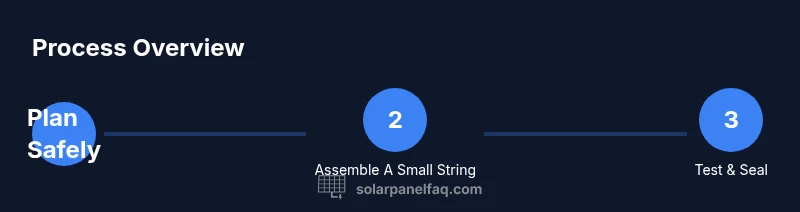
For learners who want a tangible, safe project, here is a high-level workflow based on off-the-shelf components. This approach avoids creating cells from scratch and focuses on understanding system behavior using tested parts.
- Plan and safety: Establish a clearly defined scope, select a small, testable design, and assemble safety gear. This step reduces risk and helps you manage expectations about what you can learn from a DIY project. Why: safe planning prevents accidents and weather-related damage, which are common with improvised setups.
- Choose a design: Decide on a single, small module or panel using pre-tested cells or modules. This keeps electrical risks manageable and provides real-world learning insights about series/parallel wiring. Why: understanding wiring configurations helps you predict voltage and current behavior under sun conditions.
- Assemble a test string: Use commercially manufactured cells or pre-wired strings, connect them with appropriate bus bars and diodes, and verify insulation, isolation, and continuity with a multimeter. Why: hands-on wiring teaches practical electrical skills without requiring cell fabrication.
- Mount and seal: Place the assembly in a weatherproof frame with a protective glass front and a backsheet; apply sealant to prevent moisture ingress. Why: proper sealing is critical to panel longevity and safety in outdoor use.
- Wire a safe junction: Attach a junction box with clean cable routing, over-current protection, and a visible label. Why: correct protection and documentation reduce risk during use and future maintenance.
- Test under sun: Expose the assembly to outdoor light, measure open-circuit voltage and current with a portable meter, and compare results to expectations. Why: real-world testing confirms safety and reveals inefficiencies from misalignment or shading. EstimatedTime: 4-8 hours
tip":"Always keep DC power isolated when wiring; use insulated tools and wear eye protection. Do not attempt to connect a DIY panel to the grid without a licensed electrician and proper permits."}],
tipsList
tips