How to Check a Solar Panel with a Multimeter
Learn how to safely check solar panels using a multimeter. This guide covers Voc, Isc, load testing, and interpretation to verify health and performance of your solar system.


This quick answer shows how to check a solar panel with a multimeter to confirm health and performance under sunlight. You’ll measure open-circuit voltage (Voc) and short-circuit current (Isc) using a DC voltmeter and a safe load. Record readings, then compare them to the panel’s nameplate ratings to spot issues early. Ensure connections are secure and avoid touching live leads.
Understanding the test: what you're measuring and why
Checking a solar panel with a multimeter is a practical way to confirm health and performance trends between inspections. By measuring open-circuit voltage (Voc) you see the panel’s voltage when no current is drawn, and by assessing short-circuit current (Isc) you gauge how much current the panel can deliver under sunlight when connected to a near-zero resistance load. These two readings, when compared to the panel’s nameplate values, can reveal shading, damaged cells, loose connections, or diode issues. According to Solar Panel FAQ, consistent Voc and Isc readings indicate a healthy panel, while significant deviations often point to a problem in the module or its wiring. Use these checks as part of regular maintenance rather than a one-off test. LSI keywords to keep in mind include DC voltage testing, current measurements, load testing, and sun-exposure effects on readings.
Safety first: essential precautions before you begin
Before you touch any panel or meter, ensure you follow basic safety practices. Work in bright, direct sunlight with dry surfaces and dry hands. Wear insulated gloves and eye protection, and keep metal tools away from live terminals. Do not attempt tests if the panel or wiring looks damaged, if connectors are corroded, or if the system is wired into other equipment. If you are unsure, pause testing and consult a qualified technician. The sun can rapidly energize panel circuits, so plan measurements in sequence and keep your hands away from exposed conductors.
Tools and environment you need before you begin
You will conduct measurements using a digital multimeter (DC voltage and current capable), test leads, and a safe load or resistor to measure Isc under load. Set up in direct, unobstructed sunlight with a clear view of the panel terminals. Have the panel’s nameplate data handy for comparison, and keep a log to record Voc and Isc readings over time. The goal is to observe readings that align with the panel’s rated values within a reasonable tolerance, while noting any drift that could indicate issues.
Step-by-step: measure open-circuit voltage (Voc)
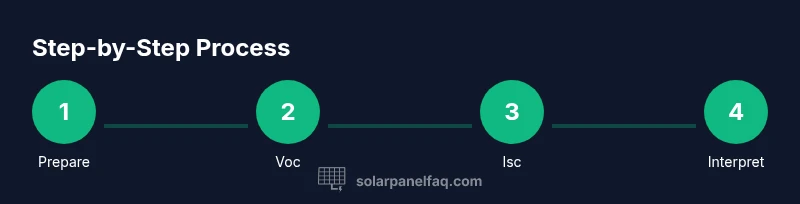
- Set your digital multimeter to DC voltage, selecting a range that comfortably covers the panel’s expected Voc. 2) Disconnect any load so the circuit is open and place the meter probes directly on the positive and negative terminals. 3) Read and record the Voc, ensuring the panel is in full sun and that connections are secure. 4) Re-check after a minute or two to confirm stability. Pro tip: keep the leads away from the panel housing to avoid heat buildup. Keeping Voc stable under sun is a strong sign of healthy cells.
Step-by-step: measure short-circuit current (Isc) and current under load
- Switch the multimeter to current mode and connect it in series with a safe load (a resistor or dedicated solar test load). 2) Ensure the load is suitable for the panel’s current capacity to avoid overheating or damage. 3) With the panel in bright sun, observe and record the current (Isc) flowing through the circuit. 4) Compare the measured Isc to the nameplate rating; a reasonable tolerance is expected, but large discrepancies suggest issues such as shading or damaged cells. Pro tip: if your meter has a 10 A range, verify that you are within range before measurement to prevent fuse damage.
Step-by-step: interpret results and consider next steps
- Compare Voc and Isc against the manufacturer’s nameplate values, noting any consistent drift across multiple tests. 2) If Voc is significantly lower than expected, check shading, dirty lenses, or loose connections. 3) If Isc is far below the rating under full sun, inspect for damaged cells, cracked glass, or faulty bypass diodes. 4) If readings are inconsistent among series-connected panels, recheck wiring and shading patterns and test panels individually to locate the offender. Solar Panel FAQ Team emphasizes recording readings for trend analysis and using them to decide whether a professional inspection is warranted.
Common mistakes and safe troubleshooting tips
- Avoid testing in wet conditions or with wet hands; moisture increases the risk of short circuits. - Do not short-circuit panels deliberately without a proper load; a direct short can cause damage. - Ensure that all connections are clean and tight before testing to prevent false readings. - If readings don’t match, re-check the test setup and test under identical sun conditions for consistency. This repeated testing helps confirm genuine issues vs. measurement errors.
Tools & Materials
- Digital multimeter (DC voltage/current capable)(Prefer a meter that can measure up to 100 V DC and 10 A with proper fusing.)
- Alligator clip leads(Red/black leads for secure, hands-free connections.)
- Safe load resistor or solar test load(Low-ohm resistor rated for panel output; ensure wattage is adequate.)
- Insulated gloves and eye protection(Personal protective equipment for safe handling in sun.)
- Panel nameplate/spec sheet(Have Voc and Isc ratings on hand for comparison.)
Steps
Estimated time: 60-90 minutes
- 1
Prepare the setup and safety checks
Inspect the panel and wiring for visible damage. Choose a dry, sunny location with direct sun exposure. Gather your meter, leads, and a safe load. Verify the area is free of standing water and that you will work with dry hands and dry surfaces.
Tip: Double-check that you are following local electrical safety guidelines. - 2
Configure the multimeter for Voc testing
Power off any connected circuits and set the meter to DC voltage, selecting a range that can accommodate the panel’s expected Voc. Attach the red probe to the positive terminal and the black probe to the negative terminal, ensuring a solid contact.
Tip: Use a high-range setting to avoid overloading the meter if the exact voltage is unknown. - 3
Measure Voc (open-circuit voltage)
With the panel in full sun and no load attached, read the voltage across the terminals. Record the value and repeat after a short interval to confirm stability.
Tip: Voc should remain stable under consistent sun; fluctuations may indicate connection issues. - 4
Set up for Isc testing with a safe load
Switch the meter to current mode and place a safe load in series with the panel. Ensure the load’s resistance is appropriate for the panel’s current rating. Connect the meter in series and monitor the current.
Tip: Never place the meter directly across the panel in current mode without a load. - 5
Measure Isc under load
Read and record the current (Isc) under sunlight while the load is connected. Compare to the nameplate current rating and note any significant deviation.
Tip: If the current is much lower than expected, recheck connections and ensure the load is truly in series. - 6
Document results and assess health
Summarize Voc and Isc readings, note consistency, and identify potential issues like shading or damaged cells. Decide whether to re-test later or seek professional help if results are outside the expected range.
Tip: Document date, sun conditions, and panel orientation to track performance over time.
Frequently Asked Questions
What readings should I expect from a healthy solar panel?
A healthy panel should show Voc close to the nameplate value with minor tolerance and an Isc that approaches the rated short-circuit current under bright sun. Significant deviations warrant re-checking connections or considering panel health.
A healthy panel will show Voc near the nameplate value and Isc close to the rated current under strong sun; large deviations may indicate issues.
Can I test Isc without a load?
No. Isc requires a current path through a safe load. Testing without a load can cause a direct short, which risks damage to the panel and meter. Always include a proper load or use a current clamp if available.
Isc testing needs a safe load or a current clamp; never test Isc with no load.
What could cause Voc to be low on a sunny day?
Possible causes include loose connections, shading on part of the panel, damaged diodes, or cracked cells. Re-check wiring and inspect for any physical damage before deciding on further action.
Low Voc can be due to loose connections, shading, or damage. Inspect wiring and the panel for issues.
Why do readings vary between panels in a string?
Panels in a series string can drift due to shading, orientation, or manufacturing tolerances. Test each panel individually to locate underperformers and adjust placement or wiring to optimize performance.
If panels in a string differ, test them individually to find the underperformer and adjust as needed.
Should I test panels during winter or cloudy days?
Testing under non-ideal sunlight can produce misleading results. For baseline health, perform tests in bright sun; use caution and note sun conditions when comparing readings.
Best to test in bright sun; cloudy days can skew results, so note sun conditions when interpreting readings.
Do I need to disconnect from a live system before testing?
If you are testing a panel isolated from the rest of the system, you can test at the panel level. Do not disconnect wiring inside an active array without proper procedures and safety equipment. When in doubt, consult a professional.
Only test panels in a controlled way; if unsure about the system, consult a professional.
Watch Video
Top Takeaways
- Verify Voc and Isc readings against nameplate values.
- Test under full sun with proper loads for safety.
- Record results to track panel health over time.
- Re-check measurements if readings are unexpected.
- Consult a professional if readings show significant degradation.