How Many Watts Does a Solar Panel Make? A Practical Guide
Explore how many watts a solar panel produces, what affects output, and how to estimate home system performance with practical ranges and examples.


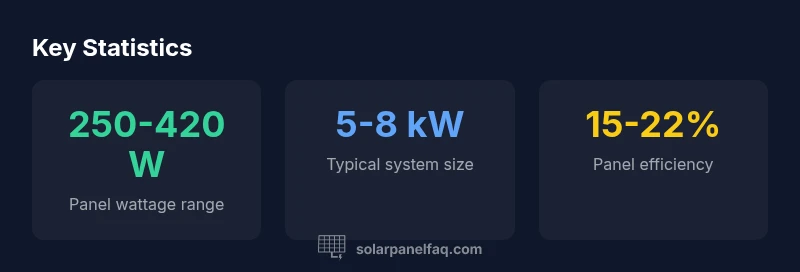
The typical residential solar panel is rated in the 250–420 watt range under standard test conditions, but actual output varies with sun exposure, temperature, and shading. In practice, you use wattage as a ceiling for planning, then translate that into daily energy (kWh) based on local sun hours and system losses. This upfront wattage helps size your roof layout, inverter, and battery needs, while real production depends on conditions and usage patterns.
How many watts does a solar panel make in practical terms
Understanding the wattage rating helps homeowners plan a solar installation, but it is only part of the story. The phrase how many watts does a solar panel make captures the idea that a panel’s peak power comes from its DC rating under ideal laboratory conditions. In the real world, sunlight intensity, shading, temperature, and orientation all shape actual energy production. Today’s typical residential panels sit in a broad range of about 250 to 420 watts per module. This rating is a ceiling—the maximum clean DC power the panel can produce in perfect STC conditions. When you size a system, you translate that wattage ceiling into expected daily energy production (kWh) by factoring in sun hours, array tilt, and inverter efficiency. For Solar Panel FAQ readers, wattage is a starting point for planning rather than a guaranteed daily output; the goal is to match system size to energy needs and roof space while accounting for losses.
In practice, a homeowner assessing how many watts a solar panel makes should also consider the panel’s real-world performance data from installers and monitored systems in similar climates. Wattage alone does not tell the full story of yearly production, peak sunshine days, or seasonal variation. This is why we emphasize approaching watts as a planning variable, then validating with local sun hours and historical production data. The result is a more accurate expectation of how much energy a rooftop solar array can deliver across seasons.
Why panel ratings are given as watts under standard test conditions (STC)
Panel ratings are established under standardized test conditions to create a uniform basis for comparison. STC specifies a solar spectrum, cell temperature of 25°C, and irradiance of 1000 watts per square meter. Those controlled conditions mean a 350-watt panel is capable of delivering up to 350 watts in theory. Real-world conditions diverge—sunlight angles shift, temperatures rise, or panels may be shaded. The practical takeaway is that STC wattage gives a useful baseline, but you should adjust expectations for your locale. Manufacturers also publish temperature coefficients and tolerance ranges to help you estimate how much power may drop on hot days or under slight manufacturing variance. For homeowners, the STC rating is a starting point for system design, while field data confirms performance.
Real-world output vs nominal wattage
A panel’s nominal wattage assumes optimal lab conditions. In real life, you lose power through several factors: temperature increases, shading from trees or chimneys, soiling on the glass, and electrical losses in wiring and inverters. The temperature coefficient indicates how much watts decrease per degree Celsius above standard conditions; each panel has its own coefficient. Even with a high-wattage panel, a hot rooftop on a summer afternoon may produce less than half of the STC rating in extreme cases. Conversely, cool, clear days with plenty of sun can push output closer to the rating. The key for homeowners is to model expected annual production using average sun hours for the location and account for system losses (often around 10–25% depending on equipment and maintenance).
To translate watts into meaningful energy, multiply the system’s total wattage by the average daily sun hours and adjust for losses. For example, a 6 kW system in a location with 5 peak sun hours per day, minus losses, could yield roughly 20–25 kWh per day in optimal conditions across seasons. Actual results will vary with weather, orientation, and shading.
How geography and climate influence wattage
Geography and climate are major drivers of how many watts a solar panel can produce in a given day. Regions with long, sunny summers and low cloud cover provide more peak sun hours, increasing daily energy output for a fixed system size. Conversely, locations with frequent clouds, higher latitudes, or steep winter clouds see fewer peak sun hours, reducing daily production. Tilt angle and roof orientation amplify or mitigate these effects: a south-facing roof in the Northern Hemisphere with a tilt close to latitude tends to produce more consistently than a poorly aligned roof. Seasonal patterns—long days in summer and shorter daylight in winter—shape annual energy, even when panel wattage remains constant. For homeowners evaluating wattage, it’s essential to look at local meteorological data and solar irradiance maps, not just the panel’s label.
Solar Panel FAQ’s guidance is to use a location’s typical sun hours to estimate yearly energy, incorporating losses from shading, soiling, and system components. If you live in a high-irradiance region, you may realize more of the rated wattage across a year; in temperate or cloudy climates, the same panel will provide less annual energy but can still significantly offset usage with proper sizing.
Estimating system output for your home
Estimating how many watts your home system will produce starts with your target energy use and roof space. A common approach is to estimate daily energy needs in kWh, then translate that into a required system size. A typical rule of thumb is 3–5 sun hours per day per kilowatt of installed capacity in many U.S. locations; adjust for local conditions. Calculating system losses is also essential, as wiring, inverters, and temperature collectively reduce output. A 5 kW system under good sun and moderate losses might produce roughly 15–20 kWh per day in many places, but this is location-dependent. When planning, consider both winter and summer seasons to avoid under- or over-sizing. The goal is to achieve your energy targets while staying within roof space and budget constraints.
In practice, homeowners should leverage a solar calculator or consult a local installer to refine the wattage-to-energy projection. By inputting roof area, shading profile, and local sun hours, you can determine how many panels are needed to meet a specific daily or monthly energy goal. Remember that the wattage rating is the ceiling; the real-world energy depends on climate, orientation, and maintenance.
Choosing the right wattage for your roof
Selecting the right wattage per panel starts with roof area and structural capacity. If space is limited, higher-wattage panels (around 350–420 W) can maximize production per panel, reducing the number of modules needed. For larger roofs with abundant space, mid-range options (300–370 W) often balance cost and performance. Weight and mounting hardware also factor into installation costs and roof load considerations. Battery storage and inverter sizing can influence the final system configuration as well. A professional assessment helps identify whether higher-wattage panels or more efficient, slightly lower-wattage options best suit your budget and energy goals. The best approach combines clear energy targets, structural feasibility, and reliable system losses estimates.
In all cases, ensure compatibility with the chosen inverter topology (string vs microinverters) and verify that your electrical panel can receive the expected backfeed current and voltage. A proper design avoids overheating, shading bottlenecks, or voltage drop issues that would otherwise erode watts produced.
Inverter and balance-of-system: what else affects watts produced
The inverter and balance-of-system (BOS) components play a critical role in translating panel watts into usable AC electricity. Inverter efficiency, wiring losses, and MPPT (maximum power point tracking) performance influence how many watts reach your home grid or battery. A high-efficiency inverter minimizes conversion losses, but variations in temperature and load can still reduce real output. Microinverters and power optimizers can mitigate shading and orientation issues, effectively preserving more watts under uneven conditions. Another factor is the aging of components; performance degrades gradually over time, which means a system’s output may drift downward as modules and inverters approach the end of their rated lifespans. Regular cleaning, inspection, and preventative maintenance help maintain wattage output near the rated levels.
Understanding these elements helps you forecast true daily energy production, not just peak wattage on a lab bench. A well-meshed design with properly sized inverters and minimal BOS losses will keep a higher share of the panel’s potential watts available for daily use.
Quick-start steps to maximize watts in your system
- Audit energy use to set a realistic target for solar production.
- Assess roof space and orientation, prioritizing south-facing exposure in the Northern Hemisphere.
- Choose panels with higher wattage ratings where roof space is limited.
- Consider advanced inverter options (microinverters or optimizers) to reduce shading losses.
- Plan for regular cleaning and maintenance to minimize dirt and debris losses.
- Use an energy monitoring system to track real production vs. expected watts and adjust usage patterns.
- Work with a qualified installer to optimize tilt, shading management, and wiring for peak performance.
Common myths about solar panel wattage debunked
Myth: Higher wattage panels always produce more energy. Truth: Wattage is just the ceiling; actual output depends on sun, temperature, and losses. Myth: Wattage alone determines system cost. Truth: Installation geometry, mounting hardware, and inverter choice influence cost per watt. Myth: Solar panels fail quickly if wattage drops. Truth: Most panels maintain high output across decades with minimal degradation; regular maintenance helps preserve performance. Distinguishing between rated capacity and real-world energy helps homeowners avoid overestimating gains and ensures a practical, data-driven approach to solar investments.
Wattage ranges by panel type
| Aspect | Typical wattage range | Notes |
|---|---|---|
| Monocrystalline panel | 320-420 | Higher efficiency; premium option |
| Polycrystalline panel | 250-320 | Cost-effective alternative |
| Current standard residential panel | 300-380 | Common choice for new installs |
Frequently Asked Questions
What is the meaning of wattage rating on a solar panel?
The wattage rating indicates the maximum DC power a panel can produce under standard test conditions. Real-world output varies with sun exposure, temperature, and shade, so use it as a planning ceiling rather than a guaranteed daily figure.
The wattage rating is the panel's maximum power under ideal conditions; real output depends on sun, temperature, and shading.
Does higher wattage mean more electricity produced every day?
Higher wattage has more potential to generate energy, but actual daily production depends on sun hours, tilt, shading, and inverter efficiency. A higher-wattage panel can be more productive in good conditions, but losses still apply.
Higher wattage means more potential power, but real daily energy depends on sun and system losses.
How many watts do I need for a typical home?
That depends on your energy usage. A home audit and a target daily kWh help determine a system size, often in the 5–8 kW range for many residences. Local sun hours and budget influence the final design.
It varies by your energy use; many homes aim for a 5–8 kW system, adjusted for sun and budget.
What else affects actual watts produced besides the panel rating?
Shade, orientation, tilt, temperature, inverter efficiency, and soiling all affect real output. Microinverters or power optimizers can help mitigate some shade and orientation losses.
Shade, tilt, temperature, and the inverter all impact how many watts you actually get.
Can I estimate how many panels I need based on watts?
Yes. Divide your daily energy target by the expected daily energy per watt and factor in losses; a calculator or installer can provide a precise estimate for your location.
Yes. Use your energy goal and local sun data to estimate panels with a calculator or installer.
“Wattage ratings provide a useful starting point for system design, but homeowners should model annual production using local sun hours and typical losses to set realistic expectations.”
Top Takeaways
- Estimate watts as a planning ceiling, not guaranteed daily output
- Close-in watts depend on sun hours, orientation, and losses
- Match system size to energy goals and roof space
- Use local sun data to project annual energy, not just peak watts
- Inverter and BOS choices substantially affect real output