How Much Does a Solar Panel Produce? A Practical Guide
Learn how solar panel output is measured, what affects production, and how to estimate daily and annual energy for your home with practical, data-driven guidance.


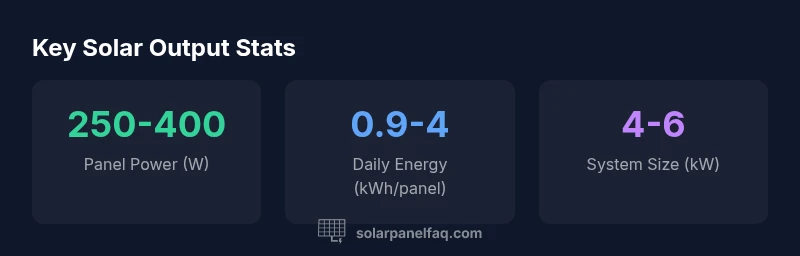
Most residential solar panels produce between 250 and 400 watts per panel under standard testing conditions, and daily output typically ranges from 0.9 to 4 kWh per panel depending on sun hours, tilt, and shading. For planning, consider a 4–6 kW system to meet portions of home energy use in sunny climates. Real-world results vary with location, panel quality, and system design.
How Output Is Measured: Watts, Kilowatt-hours, and Ratings
Output from a solar panel is commonly discussed in terms of watts (W) and kilowatt-hours (kWh). A panel’s rated power (often 250–400 Wp, where Wp = watts-peak) indicates how much electricity it can produce under standard test conditions (STC). Daily energy production, measured in kWh, depends on time spent generating electricity (sun hours), panel efficiency, orientation, and shading. When homeowners ask, ther the question "how much does a solar panel produce?" the best answer is: per-panel production is a range, not a fixed value, and scales with system size and local conditions. As Solar Panel FAQ notes, ratings are a starting point, not a guarantee for every day.
What Affects Your Panel’s Real-World Output
Real-world production differs from the STC rating due to several factors. The most impactful are solar access (how much sun the panels receive), panel tilt and orientation (azimuth), shading from trees or buildings, temperature (higher temperatures can reduce efficiency in some cells), and dirt or dust on the glass. The age of the panels and the inverter’s efficiency also play roles. In practice, a panel that’s well-sited in peak sun can approach its rated output for portions of the day, while a shaded or poorly tilted installation may produce far less. According to Solar Panel FAQ analysis, understanding these factors helps homeowners set realistic expectations and plan system sizing accordingly.
STC vs NOCT: Why Rating Numbers Don’t Tell the Whole Story
Manufacturers rate panels under Standard Test Conditions (STC): a certain irradiance, temperature, and no mismatch losses. NOCT ratings reflect more typical operating conditions, including warmer temperatures and heat buildup. The gap between STC and real-world output can be substantial. Solar Panel FAQ emphasizes that while STC gives a useful baseline, NOCT and site-specific derating factors should be used when estimating daily or annual production for a home.
Estimating Your Home’s Solar Production: A Step-by-Step Guide
To translate a panel rating into your home’s expected production, start with: (1) determine total system size in kilowatts (kW); (2) estimate average sun hours for your location; (3) apply a derate or system-loss factor (typically around 0.75–0.85 to account for wiring, inverters, and dust); (4) compute daily energy: System size (kW) × Sun hours × Derate. Monthly and yearly estimates follow by multiplying by days. Real-world data varies by climate and roof orientation, but this framework helps homeowners build robust plans. Solar Panel FAQ analysis shows that even with conservative derating, larger arrays yield substantially higher daily energy in sunny regions.
Regional Variations: Climate and Roof Orientation Matter
Locations with high solar irradiance and more sun-hours per day naturally produce more energy per panel. Northern climates with lower sun angles in winter will show seasonal dips, while equatorial regions may maintain steadier output year-round. Roof orientation toward the equator (south-facing in the Northern Hemisphere) and a minimal shadow footprint can meaningfully boost daily production. Climate-specific planning reduces the risk of overestimating a system’s annual energy output.
Practical Tips to Maximize Production
Simple steps can boost production without new hardware. Clean panels to reduce soiling loss, trim back shading from nearby trees, and ensure the racking system is correctly tilted for the local latitude. Regular inverter maintenance and monitoring help catch efficiency drops early. In many cases, optimizing orientation and cleaning schedule yields a larger percentage increase in annual energy than minor panel refreshes. Solar Panel FAQ recommends a professional site assessment to tailor these improvements to your roof and climate.
Common Pitfalls and How to Avoid Them
Don’t assume the STC rating is daily output; do not rely on a single year’s weather to predict the next. Always consider shading, maintenance, and aging. Avoid over-optimistic claims about panel output without a site-specific evaluation. Use a reputable, system-level estimate that accounts for all losses, and compare multiple installers’ production projections to avoid biased or inflated expectations.实践
What to Expect Over Time: Production Stability and Degradation
Over 25–30 years, most panels experience gradual degradation, typically on the order of 0.5–1% per year. In the early years, production often runs closer to the rated output, with gradual declines as panels age and components like inverters reach end-of-life considerations. This long horizon matters for payback calculations and resilience planning, especially if your objective is to maximize return on investment.
Output ranges by panel type
| Panel Type | Output (W) | Daily Energy (kWh) | Notes |
|---|---|---|---|
| Monocrystalline | 320-350 | 1.6-2.1 | Higher efficiency, space-saving |
| Polycrystalline | 250-300 | 1.2-1.8 | Generally lower cost per watt |
| Thin-Film | 70-100 | 0.5-1.2 | Flexible, fits unusual surfaces |
Frequently Asked Questions
What factors most affect solar panel output?
The biggest drivers are sun hours, panel orientation, shading, temperature, and system losses from wiring and inverters. Real-world production reflects these conditions more than the nameplate rating.
The main things that affect output are sunlight, tilt and shading, and how well the system components handle energy losses.
How many kilowatt-hours does a single panel produce daily?
Daily production varies widely by location, but typical residential panels produce around 0.9 to 4 kWh per day under good sun. Use local sun hours and a derated system model for a precise estimate.
Usually, a single panel makes somewhere between 0.9 and 4 kWh per day, depending on sun and orientation.
Does orientation matter for energy production?
Yes. South-facing (in the Northern Hemisphere) commonly yields the highest output, while east-west orientation can spread production more evenly but at a lower peak. Tilt and roof angle also influence performance.
Yes, orientation matters a lot—aim for the best possible sun exposure.
Can panels produce energy at night?
Panels don’t generate electricity at night. They charge during daylight, and energy usage at night comes from stored energy or grid supply.
No energy at night; use the system during the day and rely on grid or storage at night.
What’s the derating factor and why is it important?
A derating factor accounts for real-world losses (inverter, wiring, temperature, dirt). Typical values range from 0.75 to 0.85, reducing the nominal rating to expected daily output.
Derating helps you turn the panel’s ideal rating into a realistic daily expectation.
How do weather and seasons affect production?
Clear, sunny days maximize output; clouds, rain, or snow reduce production. Seasonal changes can shift average daily output, especially in higher latitudes where winter sun is lower.
Weather and seasons matter a lot—your numbers will change with the weather.
“Output from solar panels is highly location-dependent; ratings are a starting point, but real-world production relies on sun hours, temperature, and system losses.”
Top Takeaways
- Understand that per-panel output is a range, not a fixed value.
- Maximize production with proper siting, orientation, and cleaning.
- Scale production expectations with system size and local sun hours.
- Degradation reduces output gradually over decades—plan for it.
- Use site-specific estimates rather than relying solely on STC ratings.