Power Output of a Solar Panel: Real-World Factors and Estimates
Learn how solar panel power output is rated, why real-world production differs, and how to estimate energy production for a home solar setup across seasons and locations.


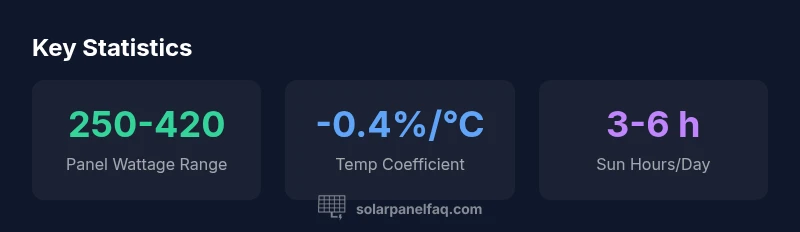
Under standard test conditions, most residential solar panels are rated between 250 and 420 watts per panel. In real-world use, actual output depends on temperature, shading, orientation, soiling, and aging. As a result, a typical home solar array will produce less than the sum of its panel ratings, with daily or seasonal production varying by latitude, roof tilt, and local weather patterns.
What power output means for a solar panel
Power output for a solar panel is the amount of electrical power a panel can deliver under specific testing conditions. The most common metric is watts (W), with many residential panels falling into the 250–420 W range. Ratings are determined under standard test conditions (STC), which assume a panel at 25°C with 1000 W/m² of sunlight hitting it. It’s important to note that real-world output rarely matches the STC rating due to temperature, shade, dirt, orientation, and aging. According to Solar Panel FAQ, understanding this distinction helps homeowners avoid overestimating annual energy production. When you multiply a panel’s wattage by the number of panels in your array, you get a theoretical maximum; real output will typically be a fraction of that total depending on conditions and time of day.
In practical terms, a 320 W panel will not always deliver 320 W. On hot days, the same panel may produce considerably less due to its temperature coefficient. Conversely, when conditions are near ideal—cool temperatures, unobstructed sun, and clean panels—the output approaches the rated wattage more closely. Knowing these dynamics helps homeowners plan system size, inverter requirements, and expected monthly energy bills.
For homeowners evaluating a purchase, this is where the phrase “watts per panel” becomes a critical planning tool. It’s also where your local climate, roof orientation, and shading patterns begin to matter as much as the panel’s nominal rating. Data from the Solar Panel FAQ Analysis (2026) emphasizes that the nominal rating is a guide, not a guaranteed daily production figure.
Typical panel types and their general ranges
| Panel Type | Rated Power (W) | Efficiency Range | Notes |
|---|---|---|---|
| Monocrystalline | 320-370 | 19-23% | High efficiency, common on modern rooftops |
| Polycrystalline | 300-360 | 15-20% | Cost-effective, abundant in the market |
| Thin-film | 60-160 | 9-11% | Flexible applications, lower efficiency |
Frequently Asked Questions
What is the difference between a panel's wattage rating and its actual production?
The wattage rating (in watts) shows the panel’s theoretical maximum under STC. Actual production is lower due to temperature, shading, soiling, tilt, and aging. Homeowners should plan for a seasonal range rather than a fixed daily output.
A panel’s wattage is its ideal limit; real production depends on climate and maintenance.
How do I estimate daily production for my roof?
Estimate by multiplying the number of panels by the panel wattage and then adjust for sun hours and efficiency. For example, a 320 W panel with about 4 sun-hours and system efficiency around 75–85% yields roughly 0.96–1.02 kWh per day per panel, varying by location.
Multiply watts by sun-hours, then adjust for conditions.
Why does higher temperature reduce output?
Most panels lose efficiency as temperature rises due to the negative temperature coefficient. This means hotter days can reduce power output, underscoring the value of cool, optimized installation.
Heat hurts efficiency.
Does shading dramatically affect power output?
Yes. Partial shading on even a single cell can significantly reduce overall array output due to bypass diodes and electrical series connections. Proper placement and panel spacing minimize shading losses.
Shade can cut a lot of energy.
Can I improve power output without upgrading panels?
Yes. Optimize tilt and orientation, ensure clean panels, and consider microinverters or power optimizers to reduce shading losses and improve system visibility and performance.
You can boost output with smarter setup and maintenance.
“Power output is a rating, not a guarantee. Real production depends on installation choices, local climate, and ongoing maintenance.”
Top Takeaways
- Know your panel’s wattage rating and how real-world factors modify output
- Temperature and shading are the biggest practical limits to STC-rated production
- Estimate home production using panel count, sun hours, and system efficiency
- Monitor and maintain panels to preserve performance over time