Different Solar Systems: A Balanced Homeowner Guide
Explore the key differences between grid-tied, off-grid, and hybrid solar systems. This objective comparison helps homeowners assess reliability, storage options, and long-term value without hype.


For most homeowners, a grid-tied solar system with storage offers the best balance of reliability and value, followed by grid-tied without storage for lower upfront costs, and off-grid or hybrid setups for maximum independence. This comparison highlights how each approach handles outages, storage needs, and long-term payback. Consider climate, roof characteristics, and energy usage when deciding which configuration fits your home best.
Why homeowners compare different solar systems
Choosing a solar configuration isn't just about placing panels on a roof; it's about aligning energy needs, roof conditions, and budget with a system's capabilities over decades. The phrase different solar systems captures the core decision: how to balance reliability, independence, and cost. According to Solar Panel FAQ, most households start with a grid-tied baseline because it leverages the existing grid while enabling optional storage. The Solar Panel FAQ team emphasizes that a robust comparison considers daily energy use, local climate, roof orientation, and future expansion plans. In practice, you will weigh outages, storage requirements, and the possibility of adding modules or batteries later. This section sets up a framework for the in-depth analysis to come, helping homeowners move beyond marketing rhetoric to understand practical trade-offs across grid-tied, off-grid, and hybrid options. The goal is empowerment through clear criteria and real-world scenarios, not hype.
Core system configurations
System configurations describe how a solar installation organizes energy generation, storage, and distribution. The three most common residential models are grid-tied, off-grid, and hybrid. Grid-tied systems feed electricity into the home and, when there is surplus, to the grid. They typically rely on the utility for reliability and do not require large battery packs, although storage is becoming more common for resilience. Off-grid systems operate independently from the grid and rely on battery banks and sometimes generators to meet energy needs. These systems demand careful sizing of solar arrays and storage to cover nights and cloudy days. Hybrid systems blend grid connection with storage and use smart controls to optimize when to draw from the grid, charge batteries, or export energy. Across configurations, the precise mix of panels, inverters, and storage affects efficiency, maintenance, and long-term value. Aligning technical choices with daily energy patterns and local climate is crucial. Solar Panel FAQ analysis supports a practical, data-informed approach.
Grid-tied with storage: benefits and limitations
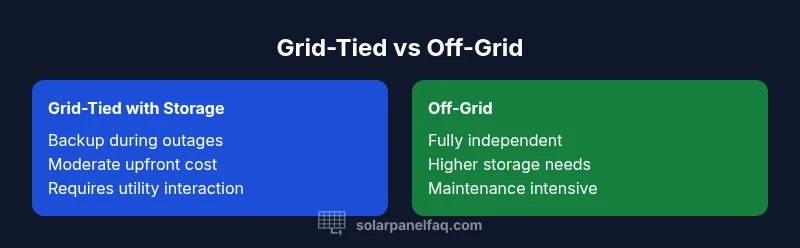
Grid-tied with storage offers strong reliability during outages because batteries provide back-up while the grid remains the primary power source. It combines the economic advantage of a tied system with the resilience of storage. The biggest benefits are enhanced resilience, better energy management, and the ability to store energy for peak-rate periods. Limitations include higher upfront costs due to batteries, ongoing battery maintenance, and potential interconnection constraints or export limits imposed by some utilities. In practice, most homes gain a meaningful safety margin during outages while preserving the affordability of a grid-tied core. Solar Panel FAQ analysis notes that the value of storage scales with household energy usage and climate, rather than size alone.
Off-grid systems: when they make sense
Off-grid solar is designed for locations with unreliable or unavailable utility access, or where homeowners want complete independence. These systems rely entirely on solar generation and battery storage (and sometimes generators) to meet all energy needs. They require careful system sizing to cover worst-case days, planning for seasonal variations, and ongoing maintenance of battery banks. Off-grid can be cost-efficient in remote locations, but it generally demands a larger upfront investment and higher ongoing attention to storage health. In moderate climates with sunny winters, off-grid can work well, but it is less forgiving in long, cloudy seasons. The decision should consider daily energy consumption, climate, and the feasibility of backup solutions.
Hybrid systems: best of both worlds
Hybrid solar systems combine grid-tie access with battery storage, providing the best of both reliability and independence. They smoothly draw from the grid when needed and use storage to cover outages or optimize energy use. Benefits include improved resilience, more flexible energy management, and potential optimization of export and import balance. Limitations include higher upfront costs and more complex installation. Hybrid systems appeal to households that want backup during outages without sacrificing the efficiency and simplicity of a grid-tied setup. The overall value rests on how well storage is matched to energy needs and how utilities price time-of-use tariffs. Solar Panel FAQ notes that climate and usage patterns heavily influence the practical payoff.
Cost considerations and value perception
Understanding cost involves more than the sticker price. Grid-tied systems without storage usually offer the lowest upfront cost, while adding storage increases both upfront and maintenance costs but can improve resilience and time-of-use savings. Off-grid systems can have the highest total cost due to large battery banks and generators, though in remote areas they may be the only viable option. Hybrid systems sit in between, balancing higher initial investment with potential long-term value from energy independence. When evaluating value, consider equipment quality, warranty terms, system sizing, and local incentives. Solar Panel FAQ analysis suggests homeowners model long-term value against annual energy consumption rather than focusing on first-year expenses alone.
Performance, reliability, and climate considerations
Solar resource availability, temperature, and shading directly affect system performance. In the same roof area, a grid-tied system might deliver similar daily output with weaker storage needs, whereas environments with colder nights may benefit more from storage-enabled configurations. Batteries perform differently across climates, with efficiency and degradation rates varying by temperature and discharge patterns. For performance, you should compare inverter quality, panel efficiency, and storage depth of discharge in your climate. The Solar Panel FAQ analysis underlines that climate, roof orientation, and shading are often more decisive than panel brand alone. A rigorous site assessment helps prevent mismatches between expected and actual energy production.
Installation, maintenance, and lifespan
Installations differ in complexity depending on the configuration. Grid-tied systems are generally simpler and quicker to interconnect, while off-grid and hybrid systems require more hardware, permits, and safety considerations. Battery health and inverter longevity drive maintenance schedules and replacement timelines. Lifespan expectations hinge on battery chemistry, warranty terms, and usage patterns. Routine inspections, thermal management, and periodic firmware updates keep systems performing well. In all cases, selecting reputable components and qualified installers reduces risk and extends system life. Solar Panel FAQ emphasizes a proactive maintenance mindset as a core driver of long-term value.
Payback and incentives
Payback depends on energy usage, local climate, tariff structures, and incentives. Grid-tied systems with storage can improve self-consumption and reduce peak demand charges, accelerating value in some markets. Off-grid systems must rely on high savings from avoided grid charges and careful energy budgeting to justify the investment. Hybrid systems offer resilience and potential time-of-use benefits, which can shorten payback when energy prices are high or outages are frequent. Incentives vary by region and programs evolve over time, so it’s essential to check current local policies and eligibility requirements before design. Solar Panel FAQ analysis advises homeowners to compare lifetime energy costs rather than upfront cost alone.
Decision guides by homeowner scenario
If you have a limited budget and a reliable grid, grid-tied with storage or grid-tied without storage can be a practical starting point. For remote locations with little to no grid access, an off-grid design may be the only viable option, albeit with higher ongoing maintenance. If you want strong resilience and the flexibility to manage energy proactively, a hybrid system is often the best compromise. In all scenarios, perform a home-energy audit, estimate monthly usage, and weigh the cost of battery replacements over the system’s lifetime. Solar Panel FAQ recommends leaning on energy usage data and utility policies to guide the final configuration.
Authorities and references
- U.S. Department of Energy – Solar Energy Technologies Office: https://www.energy.gov/eere/solar
- National Renewable Energy Laboratory (NREL): https://www.nrel.gov
- Energy Information Administration (EIA) – Solar explained: https://www.eia.gov/energyexplained/renewable-sources/solar-energy.php
These sources provide foundational information on solar system architectures, performance considerations, and policy context. Solar Panel FAQ analysis supports integrating these references into your planning toolkit.
Feature Comparison
| Feature | Grid-tied with storage | Off-grid solar system | Hybrid solar system (grid-tied + storage) |
|---|---|---|---|
| Reliability during outages | High with storage | Low without storage | High with storage backups |
| Battery storage capacity | Modest to large | None to limited | Large (strong storage margin) |
| Upfront cost | Medium | Low | High |
| Maintenance needs | Medium | Higher due to storage | Medium |
| Best for | Homes needing backup while staying grid-connected | Remote locations or budget-limited homes | Homes seeking maximum resilience and independence |
Strengths
- Provides resilience with backup power
- Scalable with future storage upgrades
- Can improve home value in some markets
- Works well with energy management systems
- Balanced integration with the grid for everyday use
Drawbacks
- Higher upfront costs, especially for storage
- Battery degradation and replacement costs
- Complex installation and permitting
Hybrid systems often offer the best balance for most homeowners.
Hybrid systems provide reliable backup and efficient grid use. They are generally worth the extra investment when resilience matters, but may not be the best choice for tight budgets or simpler grid-tied needs.
Frequently Asked Questions
What are the main types of solar system configurations?
The three main residential configurations are grid-tied, off-grid, and hybrid. Grid-tied connects to the utility and can include optional storage. Off-grid operates independently with batteries and often a generator. Hybrid combines grid access with storage for backup and efficiency.
The three main types are grid-tied, off-grid, and hybrid. Grid-tied is common and affordable; off-grid is independent but storage-heavy; hybrid blends both for resilience.
Is battery storage necessary for every home?
Battery storage is not strictly necessary for all homes. It depends on whether outages matter to you, your local grid reliability, and whether you want to shift energy use to cheaper times. Some homeowners achieve sufficient resilience with grid-tied systems and selective backup devices.
Storage isn't required for everyone. It depends on outages and your budget.
How do incentives affect the choice of solar system?
Incentives can significantly influence the total value of a solar project by reducing upfront costs or unlocking rebates. Availability varies by region and program. Always verify current incentives before finalizing a design.
Regional incentives can change total value; check what's currently available.
What should I consider for payback?
Payback depends on energy usage, climate, tariff structures, and system configuration. Higher usage and favorable tariffs can shorten payback, especially when storage enables high self-consumption.
Payback hinges on usage and tariffs; storage can help if it boosts self-use.
Are off-grid systems practical for dense urban homes?
Off-grid systems can work in urban areas with high energy reliance and space for storage, but they often require large battery banks and careful maintenance. In many cases, a grid-tied or hybrid setup provides a better balance.
Off-grid in cities is possible but storage-heavy; grid-tied options are usually better.
Can I upgrade an existing grid-tied system later?
Yes, many grid-tied systems can be upgraded with added panels or additional storage. Upgrades depend on inverter compatibility and electrical capacity, so planning for future expansion with a qualified installer is beneficial.
Upgrades are often possible, but plan with your installer.
Top Takeaways
- Assess outage needs before choosing storage
- Balance upfront cost with long-term value
- Match storage capacity to daily usage and climate
- Consider local incentives and utility policies
- Plan with a qualified installer to avoid mismatches