On Grid vs Off Grid Solar System: A Side-by-Side Analysis
A thorough, objective comparison of on grid and off grid solar system configurations for homeowners, covering components, sizing, costs, maintenance, and best-use scenarios.


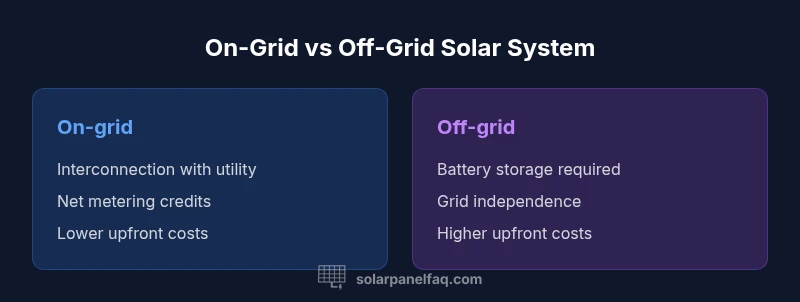
According to Solar Panel FAQ, choosing between on grid and off grid solar system hinges on grid access, daily energy use, and storage goals. An on-grid (grid-tied) setup leverages the utility for power supply and bill reductions via net metering, while an off-grid system relies on batteries and storage to operate independently. For most urban homes, grid-tied configurations offer balance and simplicity; off-grid works best for remote locations or where outages are frequent. This quick snapshot points you toward the option that aligns with location, usage patterns, and resilience priorities.
Understanding on grid and off grid solar system
The phrase on grid and off grid solar system describes two foundational ways homes generate and manage electricity from solar panels. In an on-grid (grid-tied) configuration, solar panels feed energy to the home and can push excess power back to the utility grid. The grid acts as a virtual battery, and you may earn credits through net metering where available. In an off-grid setup, energy is stored in batteries for use when the sun isn’t shining, requiring careful sizing and a reliable storage strategy. The distinction matters not only for how power is produced, but for how bills are managed and what happens during an outage. According to Solar Panel FAQ, the choice should be grounded in local grid policies, home energy needs, and resilience goals. Practically, many urban homes favor grid-tied systems for their lower maintenance profile and access to the grid, while remote cabins or areas with unreliable power tend toward off-grid installations. The Solar Panel FAQ team emphasizes that both approaches can scale with demand, but the right path depends on load patterns, climate, and long-term priorities. Start with a clear picture of daily habits and backup requirements to guide your decision.
Core components and system topology
A solid understanding of the main parts helps clarify how on-grid and off-grid solar systems differ in practice. An on-grid system typically includes solar PV panels, an inverter, and a utility connection. A bidirectional meter tracks energy flow, and a battery bank is optional for storage or peak shifting. Off-grid systems add a battery bank, a charge controller, and an oversized inverter to ensure a steady supply during extended sunless periods. Battery chemistry (such as lead-acid or lithium) and inverter sizing influence cost, performance, and maintenance frequency. The Solar Panel FAQ team notes that wiring, grounding, and safety practices are fundamental in both configurations, but battery management and readiness for outages are the key differentiators. Hybrid approaches exist, but they introduce additional complexity and cost. At every step, a careful assessment of space, climate, and usage helps determine which topology best fits the home.
Grid-tied (on grid) configurations and net metering
In on-grid configurations, solar power flows to the home and back to the grid depending on demand, with net metering programs often providing credits for surplus energy. This approach minimizes the need for large storage systems and reduces upfront equipment costs. However, reliability depends on grid stability, utility policies, and local incentives. For many homeowners, this setup maximizes return on investment by aligning generation with daily usage and leveraging the grid as a shared resource. The Solar Panel FAQ team highlights that net metering economics vary by region, so understanding local rates and policies is essential before committing. A key advantage is simpler maintenance compared with off-grid systems, along with easier scalability through modular solar and inverter upgrades over time. While grid-tied systems excel in populated areas, they depend on continuous grid access for resilience.
Off-grid configurations: storage and reliability
Off-grid solar systems are built around independent operation and energy storage. A battery bank, charge controller, and robust inverter are core components, enabling nighttime usage and resilience during outages. Storage sizing must cover the worst-case daily load, plus a buffer for cloudy days. Battery choice influences cost, lifespan, and charging behavior; lithium-based options generally offer higher cycle life and deeper discharges than traditional lead-acid types, but come with higher upfront costs. Because there is no utility backstop, off-grid setups demand careful energy budgeting, regular maintenance, and a backup generator or other generation source for extended periods of low sun. The Solar Panel FAQ team notes that independence comes with complexity and ongoing management, so be prepared for more hands-on planning and potential service requirements.
Sizing, energy needs, and load analysis
Sizing is the bridge between a homeowner’s energy reality and the technology that serves it. Start with a household energy audit: identify daily and seasonal loads, peak demand, and critical circuits. For on-grid systems, sizing focuses on meeting daytime load and matching export opportunities with net metering credits. For off-grid systems, calculate the daily energy requirement including storage for night-time and low-sun days, then select a battery bank and inverter capable of sustaining core loads under worst-case scenarios. It’s essential to model seasonal variations, especially in climates with long winter nights or cloudy seasons. The Solar Panel FAQ emphasizes documenting realistic usage patterns and planning for growth (e.g., future appliance upgrades or addition of electric vehicle charging). A well-sized system reduces wasted energy and prolongs equipment life, improving overall value.
Costs, incentives, and long-term value
Costs for on-grid and off-grid solar systems vary with location, hardware choices, and installation specifics. An on-grid setup generally has lower upfront costs due to smaller or no battery storage and simpler interconnection requirements, while off-grid systems incur higher costs for batteries, controllers, and robust inverters. Local incentives, rebates, and tax credits can influence the financial case, but these programs differ widely by region. The Solar Panel FAQ notes that evaluating total cost of ownership over time—accounting for maintenance, battery replacements, and potential grid outages—provides a clearer picture than upfront price alone. Consider also the environmental and resilience benefits when weighing long-term value and alignment with personal goals.
Maintenance, warranties, and lifecycle planning
Maintenance demands differ meaningfully between on-grid and off-grid systems. Grid-tied installations typically require less ongoing maintenance, with periodic inverter checks and cleaning as needed. Battery maintenance and replacement become central in off-grid configurations, affecting both cost and downtime. Warranties for panels and inverters are common across both setups, but battery warranties and lifecycle estimates vary by chemistry and usage. Proactive monitoring, proper ventilation for battery banks, and regular safety checks reduce risk and extend system life. The Solar Panel FAQ team recommends documenting warranty terms, anticipated replacements, and service windows to avoid surprises when components reach end-of-life.
Decision framework: choosing between on grid and off grid solar system
Choosing between on grid and off grid solar system involves a structured decision process. Start with grid availability and policy context: if net metering and reliable utility service exist, on-grid often delivers faster payback and simpler maintenance. If your property experiences frequent outages, remote location, or a desire for energy independence, off-grid may be warranted, provided you can accommodate storage and backup generation. A phased approach can help: begin with a grid-tied system and add storage later if resilience becomes a priority, or design an off-grid system with a hybrid backup tied to conventional power. The Solar Panel FAQ emphasizes tailoring the plan to location, energy habits, and risk tolerance, then validating with a professional site assessment.
Authoritative sources and further reading
For deeper context, consult authoritative sources that explain solar energy basics, interconnection rules, and storage technology:
- https://www.energy.gov/eere/solar/articles/solar-photovoltaic-systems-net-metering
- https://www.nrel.gov/grid/solar-resource-valuation.html
- https://www.energy.gov/eere/solar/articles/what-solar-net-metering
These resources provide foundational guidance on grid interconnection, policy considerations, and storage options to complement homeowner planning.
Comparison
| Feature | On-grid solar system | Off-grid solar system |
|---|---|---|
| Interconnection & grid dependence | Grid-connected with net metering; relies on utility | Independent; requires storage and backup power |
| Storage | Optional or none; battery use increases flexibility but not required | Battery storage is central; designed for autonomy |
| Energy independence | Depends on grid reliability; high independence not guaranteed | High independence; energy supply secured on-site |
| Maintenance | Lower ongoing maintenance; occasional inverter check | Higher maintenance due to battery cycling and safety concerns |
| Upfront cost | Lower upfront due to minimal storage | Higher upfront due to batteries and control systems |
| Resilience during outages | Outages reduce reliability if grid is down; relies on uninterrupted grid | Can sustain critical loads during outages with proper storage |
Strengths
- Lower upfront costs for grid-tied setups
- Access to net metering and utility credits
- Simpler maintenance and easier upgrades
- Scalability through modular additions
Drawbacks
- Dependency on utility grid stability
- Reduced energy independence
- Limited resilience during outages without storage
- Battery storage adds cost and management needs (for some systems)
Grid-tied systems win for default, cost-conscious homeowners; off-grid shines for remote sites needing independence
Choose on-grid for balance and simplicity, especially where net metering is favorable. Opt for off-grid when grid access is unreliable or independence is the primary goal, accepting higher upfront costs and ongoing storage management.
Frequently Asked Questions
What is the main difference between on-grid and off-grid solar systems?
The main difference is grid connection. On-grid systems feed electricity to your home and the utility, often with net metering credits, while off-grid systems operate independently with batteries and no grid tie. Each approach has distinct sizing, maintenance, and reliability considerations.
The key difference is grid connection: on-grid uses the utility and net metering; off-grid uses batteries and runs independently.
Can I have a hybrid system that combines both approaches?
Yes. A hybrid system blends grid-tied operation with battery storage and backup options. It can offer net metering benefits while maintaining some independence during outages, but it adds complexity and cost. A professional site assessment can clarify feasibility.
hybrids mix grid connection with storage, offering some independence with added complexity.
Is there a payback period for both setups?
Payback depends on local utility rates, incentives, system size, and energy usage patterns. On-grid installations often show faster payback due to lower upfront costs and net metering credits, while off-grid systems rely on avoided outages and storage value.
Payback varies by location and usage; grid-tied setups often pay back sooner.
Do I always need batteries with solar?
Not always. On-grid systems can operate without batteries, relying on the grid for energy during low production or outages (though outages can interrupt service). Off-grid systems require batteries to store energy for use when solar isn’t available.
Batteries aren’t required on-grid, but essential off-grid.
How does net metering affect system value?
Net metering can improve system value by providing credits for excess generation, reducing overall electric bills. The impact depends on local policies, credit rates, and program availability.
Net metering credits can boost value when available locally.
What maintenance is needed for off-grid systems?
Off-grid setups require regular battery checks, inverter maintenance, and monitoring of charge controllers. Proper ventilation and temperature control for the battery bank are important for longevity.
Off-grid needs battery care and periodic component checks.
Top Takeaways
- Define your goal: grid reliance vs independence
- Assess local grid policies before deciding
- Battery storage is the biggest differentiator
- Size systems based on actual daily loads
- Consider maintenance and warranty implications