Grid vs Off-Grid vs Hybrid Solar: A Comprehensive Guide
Learn how on-grid, off-grid, and hybrid solar systems compare for reliability, storage, cost, and use cases. Practical homeowner guidance to choose the right configuration.


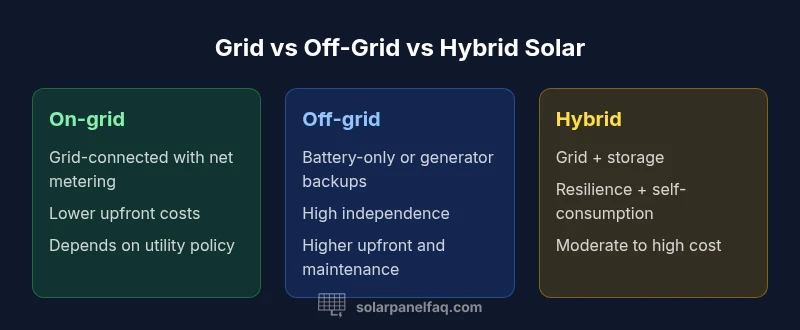
For homeowners evaluating solar panel on grid vs off grid vs hybrid configurations, the core choice centers on reliability, independence, and cost. On-grid systems optimize cost and incentives through net metering but rely on the utility; off-grid systems maximize independence with storage and backup, often at higher upfront cost; hybrid systems blend grid access with batteries to improve resilience and self-consumption. The best starting point for many households is a grid-tied system with optional storage to balance cost and resilience.
Understanding the Core Concepts: On-Grid, Off-Grid, and Hybrid Systems
Choosing a solar setup begins with understanding three archetypes: on-grid (grid-tied), off-grid (standalone), and hybrid systems. For homeowners evaluating solar panel on grid vs off grid vs hybrid configurations, the choice affects how you generate electricity, store energy, and interact with utilities. On-grid systems connect to the local grid, allowing net metering and credit for excess production, while remaining reliant on the grid for power when needed. Off-grid systems operate independently, usually with battery storage and sometimes generators, aimed at maximizing self-sufficiency. Hybrid systems combine grid connection with batteries, giving resilience during outages and the potential to optimize self-consumption. The right path depends on your location, utility policies, daily electricity use, roof space, and tolerance for storage costs. Throughout this guide, you’ll see how each model handles rainier days, peak-demand periods, and long winter seasons, so you can align your system with your energy priorities.
How Grid-Tied Solar Works: Benefits and Constraints
Grids-connected solar systems are designed to offset your daytime consumption and export excess production to the utility grid. The primary advantages are lower upfront costs, easier installation, and access to incentives or net metering programs that can reduce the effective price of electricity. The main constraints include dependency on the local grid, exposure to policy changes, and the need for a meter or interconnection agreement. In many regions, a grid-tied system can also participate in demand response programs, further optimizing energy use. When evaluating grid-tied options, you’ll assess how net metering credits apply, how seasonal production aligns with your load, and how outage risk is mitigated by staying connected to the grid. This model remains the easiest path for many homeowners seeking a balanced mix of cost efficiency and reliability.
Off-Grid Systems: When They Make Sense
Off-grid solar is designed for independence. Without a connection to the public grid, the system relies on batteries and sometimes backup generators to meet demand during cloudy days or at night. Off-grid configurations shine in remote locations, cabins, or when utility service is unavailable or prohibitively expensive. The trade-offs include higher initial costs, more complex maintenance, and the need for careful load management to avoid battery depletion. To succeed, homeowners size the system for their worst-case scenario and design a robust battery bank with an appropriate inverter. While modern lithium-based storage improves longevity and depth of discharge, off-grid performance hinges on dependable energy budgeting and seasonal storage planning.
Hybrid Systems: The Best of Both Worlds
Hybrid solar systems connect to the grid and also store energy in batteries. They offer outage resilience, better self-consumption, and the flexibility to reduce peak-load penalties. Hybrids can use the grid as a virtual back-up during outages, or shift consumption to daylight hours when solar is abundant. The added complexity and cost come from integrating storage controls, battery management systems, and compatible inverters. For many homeowners, a hybrid approach strikes a practical balance between cost, reliability, and energy autonomy, especially in regions with variable weather or frequent outages.
Storage and Batteries: Sizing and Chemistry
Battery storage is central to the decision between grid-tied, off-grid, and hybrid configurations. Properly sized storage supports daytime surplus, provides outage resilience, and improves self-consumption. Battery chemistry choices—such as lithium-based chemistries versus traditional lead-acid—affect upfront cost, life cycle, and depth of discharge. Solar Panel FAQ analysis shows that correct sizing hinges on daily usage patterns, climate, and the desired level of backup. In practice, you size the storage around critical loads and expected autonomy hours, then pair it with an inverter and battery management system designed for your chosen architecture.
Inverter and Efficiency: Matching Components
The inverter is the bridge between solar panels, storage, and your home. In grid-tied systems, a grid-t-tied inverter or string inverters with anti-islanding protection are common. Off-grid and hybrid setups require more complex combinations, including battery-based inverters or hybrid inverters that can manage charging, discharging, and grid interaction. Efficiency hinges on MPPT (maximum power point tracking) performance, temperature management, and proper wiring. Selecting components that are matched in voltage, current, and efficiency helps minimize losses and maximize self-consumption across all configurations.
Siting and Roof Considerations: Orientation, Shading, and Roof Condition
The feasibility of any solar configuration depends on roof orientation, shading, and structural integrity. An ideal orientation maximizes sun exposure through the day, while shading from trees, chimneys, or nearby structures can dramatically reduce energy output. In off-grid or hybrid setups, shading also affects battery charging efficiency and system longevity. For grid-tied systems, local codes may influence metering and interconnection rules. Assess roof condition, mounting options, and the potential for future expansion before choosing a configuration. Smart racking and shade analysis can help decide between a purely grid-tied approach or a hybrid that leverages storage during peak demand.
Cost and Payback: Upfront and Ongoing Costs
Cost considerations vary by configuration. Grid-tied systems typically have the lowest upfront costs due to simpler hardware and fewer storage components, though incentives and net metering policies will influence payback. Off-grid setups require substantial storage capacity and robust balance of system components, driving higher upfront expenses and ongoing maintenance. Hybrid systems sit between the two in terms of cost and complexity, with added storage hardware and intelligent control.
Feature Comparison
| Feature | On-grid solar | Off-grid solar | Hybrid solar |
|---|---|---|---|
| Primary energy source | Grid-connected electricity with potential net metering | Locally stored energy with no grid connection | Grid-connected with storage and backup |
| Storage needs | Generally optional (for outages) | Essential (for autonomy) | Essential (for resilience and optimized self-consumption) |
| Reliability during outages | Depends on grid status | Independent during outages (if battery bank sized) | Resilient with outages when battery is available |
| Installation complexity | Typically simplest | Most complex due to storage and controls | Moderate to high due to integration |
| Upfront cost range | Lower to moderate | Moderate to high | Moderate to high |
| Payback considerations | Net metering credits and incentives | Battery costs, cycles, and maintenance | Storage optimization and grid interaction incentives |
Strengths
- Potential for reduced utility bills through net metering and self-consumption
- Energy independence with batteries for hybrid/off-grid configurations
- Resilience during outages with hybrid and some off-grid setups
- Flexibility to scale storage and system size over time
Drawbacks
- Higher upfront costs and ongoing battery maintenance
- More complex permitting and maintenance for storage-heavy systems
- Dependency on local policies and incentives that can change
- Battery degradation and eventual replacement costs
Grid-tied with storage is the balanced starting point for most homeowners.
For most homes, a grid-tied system with optional storage offers cost efficiency and practical resilience. The Solar Panel FAQ team emphasizes starting with grid-tied fundamentals and adding storage as needed for outages or high self-consumption. If independence from the grid is essential, an off-grid or hybrid solution becomes more compelling, but it comes with higher upfront costs and ongoing maintenance.
Frequently Asked Questions
What is the main difference between on-grid and off-grid solar?
On-grid solar connects to the utility grid, allowing net metering and credits for excess production. Off-grid solar operates independently, relying on storage to meet needs during low production. Hybrid systems combine both approaches to balance cost, resilience, and self-consumption.
On-grid ties into the grid and uses credits, while off-grid runs independently with batteries. Hybrid mixes both for balance.
Can I switch from a grid-tied system to a hybrid later?
Yes, it is possible to add storage to an existing grid-tied system to create a hybrid setup, but it requires compatible inverters, wiring changes, and permit updates. A professional assessment is essential to ensure safety and code compliance.
You can add storage later, but you’ll need a proper assessment and possibly new equipment.
What affects the payback period for solar configurations?
Payback is influenced by system size, solar production relative to consumption, local incentives, electricity rates, and maintenance costs. Net metering policies and battery costs also play crucial roles in determining how quickly the investment returns.
Payback depends on production, usage, incentives, and policy changes.
Do I need batteries if I install on-grid solar?
Batteries are optional for grid-tied systems and primarily used to increase self-consumption or provide outage resilience. They add cost and maintenance but can improve energy autonomy.
Not always needed. Batteries help with resilience and self-consumption, but add cost.
How do local policies impact solar choices?
Local utility policies, net metering rules, and interconnection requirements influence the economics and practicality of each configuration. Always check current programs and future policy outlook before deciding.
Policies matter a lot; check net metering rules and interconnection requirements.
Is hybrid more expensive than grid-tied solar?
Hybrid systems generally cost more upfront due to storage and control hardware, but they offer outages resilience and higher self-consumption. The exact difference depends on local incentives and system size.
Yes, hybrids cost more up front but can be worth it for resilience.
Top Takeaways
- Define energy goals before choosing a system.
- Hybrid systems offer resilience with grid access.
- Storage sizing should align with daily usage and climate.
- Grid-tied with storage is often the most balanced starting point.