Solar Power Options for Residential Homes
Explore grid-tied, off-grid, and hybrid solar options for homes, plus storage, financing, installation timelines, and maintenance tips to help homeowners make informed choices.


By exploring solar power options for residential homes, you’ll learn how grid-tied, off-grid, and hybrid systems compare, including storage, roof compatibility, and costs. The key requirements to start are adequate sun exposure, suitable roof area, and local incentives or financing. This quick guide helps you choose a path, estimate rough costs, and plan your first steps toward a solar upgrade.
What are the main solar power options for residential homes?
According to Solar Panel FAQ, homeowners today have several practical paths to harness sunlight. The most common is a grid-tied photovoltaic system, which feeds electricity to the home and exports excess power to the utility grid through net metering. This option relies on the public grid for reliability and requires minimal on-site storage. For households seeking more independence, off-grid systems with battery storage add a buffer against outages, though they require careful sizing and backup planning. A third path, hybrid systems, blends grid connection with storage for limited autonomy while still letting you draw from the grid when needed. Beyond these, newer formats include solar shingles that integrate panels into the roof and community solar programs that let you buy or lease a share of a larger installation.
Each option has distinct advantages and trade-offs. Grid-tied systems with storage typically offer simpler permitting and faster returns, while off-grid setups demand more space and heavier upfront investment. Your choice hinges on roof space, shading, energy goals, and local incentives. Your plan should consider how long you plan to stay, your monthly energy bill, and the climate in your area. This guide walks you through each option and helps you compare apples to apples, with practical checklists and planning tips for Solar Panel FAQ readers.
Site and roof suitability: how to assess your home
Before you invest, gauge whether your site can support a solar installation. The most decisive factor is sun exposure: south-facing roofs with minimal shade deliver the most consistent energy. If your roof faces east or west, expect slightly lower output, but modern optimizers and microinverters can help balance that variance. If shading from trees or nearby structures is significant, you may need to prune or trim vegetation or choose a different orientation. The roof structure matters too: most residential roofs can bear solar equipment, but older homes may require reinforcement or a structural assessment. A qualified installer will inspect framing, deck strength, and the roof’s condition to avoid leaks after installation.
Materials aside, space is the other constraint. A typical residential system for a modest home might require several hundred square feet of unobstructed roof, though smaller or larger homes adjust accordingly. Additionally, local codes, HOA rules, and neighborhood aesthetics can influence whether certain options are allowed. When evaluating proposals, ask your installer to provide a shading analysis and a layout sketch showing panel positions and inverters. Solar Panel FAQ recommends using professional modeling tools to forecast annual production under different seasons and weather patterns, so you can visualize how different configurations perform in your climate.
Grid-tied, off-grid, and hybrid: choosing the right configuration
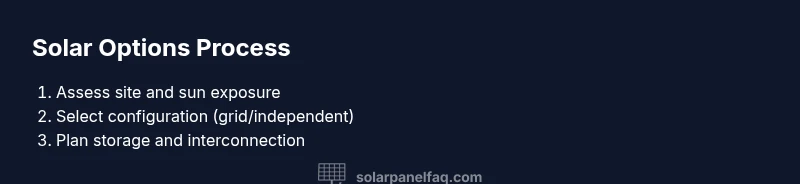
The most common residential setup is grid-tied photovoltaic with net metering. It feeds power to your home and credits excess energy back to the utility, reducing monthly bills. In this arrangement, you rely on the grid as your backup, so you don’t need to store large amounts of energy on site. Off-grid systems operate independently of the utility and require batteries, inverters, and sometimes generators for reliability. They are ideal in remote locations or for homeowners seeking maximum self-sufficiency, but they demand careful sizing and take longer to recoup investments. Hybrid systems combine a grid connection with battery storage, offering a balance between independence and simplicity. You can draw from solar during the day, use the grid when needed, and still maintain a backup during outages.
Choosing among these depends on your goals and constraints: how much space you have, what you expect from reliability, and what incentives are available. If your main aim is lower electricity bills with minimal disruption, grid-tied with optional storage is a practical middle ground. If resilience during outages is a priority, a larger battery bank with a hybrid setup can help, though it increases upfront costs. For many homeowners, a phased approach—starting with a grid-tied system and adding storage later—offers a safe path to growing solar capacity over time. This approach aligns with how Solar Panel FAQ frames practical, incremental upgrades for residential solar.
Storage options: batteries and how they change the math
Battery storage changes how much solar you can rely on after sunset and during outages. Lithium-ion batteries are the most popular today due to high energy density, longer lifespans, and lighter weight, but lead-acid options still exist for cost-conscious projects. A key design question is depth of discharge: you don’t want to deplete the battery completely every cycle, or you’ll shorten its life. Properly sized storage creates a buffer that helps you maximize self-consumption of your solar energy and can improve resilience during grid outages. However, batteries add upfront cost, require periodic maintenance, and occupy space. In a well-structured system, you can minimize export limits by using the battery to power essential circuits during peak-rate periods, then rotate back to grid power when solar generation ramps up again.
Important considerations include cycle life, warranty terms, and compatibility with your inverter setup. Some systems pair batteries with DC-coupled inverters for efficient charging, while others use AC-coupled arrangements that are easier to retrofit. If you expect to upgrade panels in the future, plan for expandability so your storage can grow with your solar array. Solar Panel FAQ notes that storage economics depend heavily on local electricity pricing, demand charges, and any time-of-use rates in your area.
Financing, incentives, and installation timelines
Financing options range from up-front cash purchases to loans and leases. Cash purchases maximize lifetime savings and simplify maintenance, while loans spread the cost over years, often with favorable interest rates if you have good credit. Leases and power purchase agreements transfer ownership to a third party and typically require little or no down payment, but the solar equipment remains the property of the financer for the term. Before choosing, compare total 10- to 25-year costs and consider how long you intend to stay in the home. Incentives vary by region and can significantly affect affordability; many areas offer tax credits, rebates, or performance-based incentives for solar installations. When combined with net metering policies and utility rates, these incentives influence the payback period and overall return.
Installation timelines depend on permitting, site readiness, and utility interconnection. A typical process includes a site assessment, system design, engineering approvals, equipment procurement, installation, inspection, and utility interconnection. Weather, supply chain delays, and backlog at local permitting offices can add time. A well-organized project will have a clear schedule and regular updates. Solar Panel FAQ emphasizes transparency: request a detailed quote with clear milestones, a defined warranty, and a plan for grid interconnection.
Choosing an installer: what to ask and verify
Your installer determines system quality and aftercare. Start by verifying NABCEP certification or equivalent credentials, and check recent project references. Ask about equipment brands, inverter compatibility, and panel efficiency ratings to gauge performance. Request a detailed system design that shows wiring, grounding, and placement to confirm it meets safety standards. Warranties matter: confirm both panel warranties and inverter/installation guarantees, and ask how service and replacement parts are handled over time. Pricing should be transparent: compare line-item costs for equipment, labor, permits, and any add-ons such as monitoring hardware. Some installers offer performance monitoring software, which helps you track energy production and detect deviations early.
Visit the home site with at least two quotes to compare approaches. Beware aggressive upsell tactics or vague promises; a thorough assessment should include a shading analysis, a bill of materials, and a realistic estimate of expected annual production. Solar Panel FAQ suggests asking for engineering-grade shading analysis and a copy of the interconnection agreement with your utility so you know exactly what to expect from the process.
Installation basics and safety considerations
On installation day, safety is paramount. Trained technicians will mount racking, connect wiring, and install inverters, usually working from a rooftop or a ground mount. Ensure you have clear access to your electrical panel and that the interconnection point is in a visible, safe location. After mounting, the system will be tested, and utilities may inspect the installation before you can interconnect and energize. If you rent or own a home in a region with extreme weather, plan for weather-related scheduling to avoid wind or storm exposure during mounting.
During the first weeks of operation, monitor energy production and consumption to verify that the system performs as expected. You may see differences between predicted and actual output due to shading, orientation, or seasonal variations. Ask your installer for a written maintenance plan that covers periodic inspections and cleaning to maintain performance and avoid micro-cracks or corrosion over time.
Maintenance, warranties, and monitoring
Solar panels require minimal maintenance—clean panels occasionally to remove dust, pollen, or leaves that block sunlight. Check the inverter display or your monitoring app for production trends and any fault alerts. Most warranties cover performance for many years and fixtures for installation; ensure you know what’s covered and for how long. Battery storage may require battery health checks and terminal maintenance. A monitoring system that alerts you to underperforming strings helps you catch issues early and minimizes downtime.
Consider the long-term value: a well-maintained system should continue generating a meaningful portion of your home’s electricity for many years. Keep records of service visits, upgrades, and changes to your electrical system. Annual or semiannual checks by a qualified technician help ensure safe operation and reliable performance. Solar Panel FAQ advises homeowners to review any schedule changes with their utility to retain optimal net metering and ensure compliance with any rate changes.
Future-proofing and scaling your system
As your energy needs evolve, design for future growth. Start with an initial system that covers essential usage, then plan for expansion by choosing modular inverters and panel layouts that accommodate additional capacity. If you anticipate EV charging, new appliances, or other additions, leave space for more panels and upgrade-able inverters. A staged approach reduces upfront risk and lets you validate savings before committing to more hardware. Keep an eye on evolving incentives and grid policies; some regions expand net metering or introduce time-of-use rates that reward daytime generation. Solar Panel FAQ suggests retaining a flexible, modular plan so you can adapt to changing technology without major rebuilds. The result is a resilient, scalable solution that aligns with your home’s architecture and climate.
Tools & Materials
- Solar site assessment checklist(A pre-site visit checklist for shading, roof orientation, and structural suitability)
- Measuring tape(For roof area estimation and panel layout)
- Safety gear (gloves, hard hat, non-slip shoes)(Important for any roof inspection)
- Ladder and fall protection equipment(Secure positioning and fall protection on roof access)
- Digital inclinometer/angle finder( Helpful for precise tilt planning)
- Camera or smartphone with good resolution(Photo evidence for quotes and shading analysis)
Steps
Estimated time: 4-6 weeks
- 1
Schedule a professional site assessment
Arrange a thorough on-site evaluation with a licensed installer. They will review roof condition, shading, orientation, and electrical compatibility. This step establishes a realistic baseline for design and budget.
Tip: Bring recent electrical bills to help estimate annual consumption. - 2
Capture measurements and shading data
Collect roof dimensions and record shading from trees or buildings at different times of day. This data informs panel count, tilt, and layout for optimal performance.
Tip: Use a shading analysis tool or app to quantify impacts. - 3
Review financing, incentives, and incentives
Compare cash, loan, and leasing options; identify regional incentives and how they affect your payback. Gather quotes with clear line items and any maintenance warranties.
Tip: Ask for a projected annual production and payback estimate. - 4
Request and compare multiple quotes
Obtain at least two comprehensive proposals showing equipment, layout, warranties, and interconnection steps. Ensure quotes reflect similar scope for a fair comparison.
Tip: Check inverter type, panel efficiency, and monitoring options. - 5
Plan permits and interconnection
Coordinate permits with local authorities and prepare the utility interconnection agreement. Delays here can shift installation timelines significantly.
Tip: Ask the installer for a written project schedule with milestones. - 6
Prepare for installation day and activation
Clear access, confirm safety steps, and ensure electrical panels are ready. After installation, expect inspections and a brief testing period before energization.
Tip: Request a maintenance plan and monitoring setup in writing.
Frequently Asked Questions
What is the difference between grid-tied and off-grid solar systems?
Grid-tied systems feed electricity to your home and the grid, relying on the utility for backup and credits for excess production. Off-grid systems operate independently and require batteries and generators to ensure power during outages. Your climate, space, and budget will guide which configuration best fits your needs.
Grid-tied systems work with the grid and may credit you for excess energy; off-grid systems run without the grid and need batteries, so plan for space and cost.
Do I need batteries for a residential solar system?
Not always. Many homes start with a grid-tied system without batteries and add storage later if resilience or daytime self-consumption is a priority. Batteries increase upfront cost but improve outage protection and daytime energy use.
You can go grid-tied first and add storage later if you want more resilience or higher daytime self-use.
How long does installation typically take?
Installation time varies by system size and permitting. A typical project progresses from site assessment to interconnection over several weeks, with weather and local approvals affecting the schedule.
Most projects take several weeks, with inspections and interconnection adding time depending on your local jurisdiction.
Will solar power increase my home value?
Solar installations are often viewed favorably by buyers, potentially improving resale value and reducing energy costs. The impact depends on system size, efficiency, and local market trends.
Many buyers see solar as a value-add, but the exact impact varies by market and system size.
What maintenance is required?
Solar panels require minimal upkeep—periodic cleaning and monitoring for performance. Inverters and batteries may need periodic checks or replacements according to the warranty terms.
Keep panels clean and monitor performance; inverter and battery checks follow their respective warranties.
Can I install solar panels myself?
Residential solar installation involves electrical work and safe roof access; most areas require licensed electricians and permits. DIY installation is generally not recommended due to safety and code compliance.
It’s usually not advisable to install solar yourself; hire licensed pros for safety and compliance.
Watch Video
Top Takeaways
- Evaluate roof shading and orientation early.
- Grid-tied with optional storage is a practical starting point.
- Batteries add resilience but require planning and budget.
- Shop multiple quotes and verify warranties.
- Plan for permits and interconnection from day one.