Cracked Solar Panel: Urgent Troubleshooting and Safe Fixes
Urgent guide to cracked solar panels: safety steps, thorough inspection methods, repair vs. replacement guidance, and prevention tips for homeowners.


A cracked solar panel is usually caused by impact or thermal stress, and it can pose electrical and fire risks. For safety, do not touch the damaged area, shut off the system if you can safely access the disconnect switch, and contact a licensed solar technician for assessment and repair. Quick fix: photograph the damage, note weather, and schedule a professional inspection.
Understanding the Risks of a Cracked Solar Panel
A cracked solar panel is more than a cosmetic blemish. Cracks can let moisture into the encapsulant, which can corrode cells and create hot spots that reduce efficiency. In severe cases, broken glass or exposed conductors can present electrical shock or fire hazards. According to Solar Panel FAQ, even small fractures can widen over time as modules heat and cool, accelerating failure. The Solar Panel FAQ team found that homeowners who overlook cracks often experience sudden performance drops after storms or cold snaps. This is why immediate assessment matters. Before you decide on DIY fixes or replacement, consider the panel's location, its electrical connections, and any signs of moisture or corrosion around the frame. If you notice continuing cracking, delamination, or a sharp edge, treat it as a warning sign rather than a simple blemish.
From a practical standpoint, cracks can lead to shaded cells, uneven current distribution, and increased leakage current. These issues can lower output and alter voltage under load. While a small horizontal crack near a corner may not sacrifice safety entirely, it’s still a red flag that should be evaluated by a pro. The bottom line is: cracks rarely heal themselves, and early, informed action protects your system and your home.
Immediate Actions You Should Take
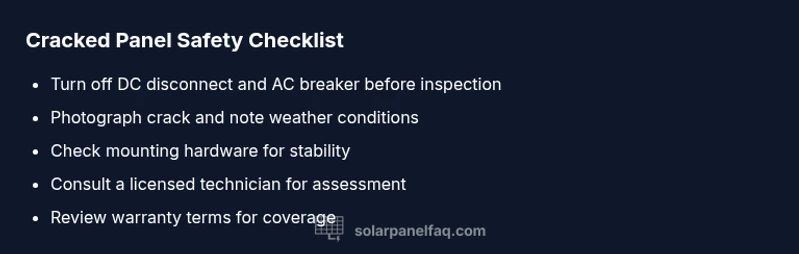
If you discover a cracked solar panel, your first steps are safety-driven and time-critical. Do not touch or apply pressure to the crack; moisture entering the panel can worsen damage and create shock risks. If you can access the system safely, shut off the DC disconnect switch and the AC breaker to de-energize the array. Photograph the crack from multiple angles, note the weather conditions, and document any visible moisture or broken glass. Notify your installer or a licensed solar technician immediately for a professional assessment. For homeowners, keeping a log of the date and a brief description of the incident helps with warranty claims or service scheduling. If the panel is in a high-traffic area or poses a falling hazard, cordon off the area and restrict access until a technician can evaluate.
In urgent weather events (hail, heavy wind, falling debris), consider temporary sheltering or removing the most at-risk panel if that can be done safely under supervision. Remember, attempting DIY fixes beyond basic safety can void warranties and create safety risks. The Solar Panel FAQ team recommends prioritizing professional inspection to determine structural integrity and energy impact.
How to Inspect a Cracked Panel Safely
Inspection should be methodical and safety-first. Start by visually inspecting the frame for warping, rust, or loose mounting hardware. Look for moisture inside the glass or along the edges, and check for discoloration around electrical connections or junction boxes. If you must handle the panel, wear cut-resistant gloves and avoid touching glass edges directly—panel shards can be sharp. Use a non-contact voltage tester to confirm that the DC wiring is de-energized before any close-up examination. Check the sealant around the edges for signs of delamination or water intrusion. If you notice any cracking that goes through the encapsulant, or if the crack runs along bus bars, treat it as a high-priority issue requiring professional evaluation. A thorough inspection should also confirm that the mounting brackets are intact and the tilt or mounting angle hasn’t contributed to mechanical stress. Keep a record of observed issues to share with your technician.
For a homeowner, the key outcomes of a safe inspection are: (1) whether the panel is structurally stable, (2) whether there are exposed conductors or moisture ingress, (3) the potential impact on neighboring panels in the string, and (4) a rough sense of replacement vs. repair costs. If you’re unsure at any point, stop and contact a professional for an in-person assessment.
When to Repair vs Replace
Deciding whether to repair or replace a cracked solar panel hinges on several factors. If the crack is superficial, localized, and does not compromise the glass, warranty terms may cover repair or replacement. However, if the crack penetrates the encapsulant, disturbs wiring, or threatens the module’s structural integrity, replacement is usually the safer and more economical option in the long run. Energy output loss due to cracks is often nonlinear and depends on panel type, string configuration, and shading. In some cases, a single damaged panel can cause decreased efficiency across the entire string due to mismatch losses. Your installer can perform diagnostic testing, including insulation resistance checks and current-voltage (I-V) curve analysis, to quantify output impact and determine the most cost-effective path. Keep in mind that replacing panels with newer, more efficient models might offer better payback and warranty coverage. Solar Panel FAQ analysis underscores that delaying replacement after a significant crack often leads to greater energy losses and higher repair costs later on.
When considering replacement, compare the cost of a new panel, installation labor, and potential inverter adjustments. If the frame or mounting hardware is bent or corroded, replacement is almost always favored. If a professional deems the crack cosmetic and the rest of the module is healthy, a repair or re-laminate might be feasible, but it is less common for residential systems. Always obtain a formal written assessment from a licensed technician before making a final decision.
Choosing the Right Professional
Selecting a qualified pro is critical when dealing with a cracked solar panel. Look for a contractor with valid licenses, transparent quotes, and recent experience with module warranty claims and glass repairs. Request a written evaluation that includes a visual inspection, system test results, and a clear cost breakdown. It’s reasonable to ask about available warranty coverage for both the individual panel and the overall system, as well as the expected lead times for replacement parts. Ask about whether the technician will test the entire string for mismatch losses and how they will handle shimming, mounting, and potential rework of bus bars. The right professional will communicate safety concerns, provide a neutral cost analysis, and present multiple repair or replacement options. Solar Panel FAQ notes that getting a second opinion can help homeowners compare quotes and ensure the chosen approach aligns with warranty terms and local codes.
Before committing, confirm whether the installer will supply a written warranty for labor and any new components. Written documentation helps with future maintenance and resale. If a panel is older or near the end of its warranty period, replacement with a newer module can offer better long-term reliability and energy efficiency. A trustworthy technician should also explain safety protocols, such as wearing PPE, isolating the array, and managing live wiring during service.
Preventing Future Cracks
Prevention starts with installation quality and routine maintenance. Ensure mounting rails are properly secured and that panels are not under excessive physical stress from wind, hail, or tree debris. Consider upgrading to tempered or laminated glass panels with higher impact resistance if your locale experiences severe weather. Regular inspections after major weather events help detect micro-cracks before they propagate. Clean panels with a soft, non-abrasive cloth and water to avoid scratches that can initiate cracks. Avoid stepping on panels or placing heavy objects nearby, and keep roof access clear to minimize accidental damage. If you live in an area with significant temperature swings, discuss with your installer about proper panel spacing and glare protection to minimize thermal stress. Solar Panel FAQ emphasizes that proactive maintenance and appropriate mounting choices are among the most cost-effective measures to extend panel life.
Common Myths About Cracked Panels
Myth: A cracked panel always stops generating power. Reality: Some cracks have minimal impact, while others can cause significant losses depending on size and position. Myth: DIY fixes can restore wear. Reality: Most repairs require professional evaluation; attempting resealing or crack-filling can void warranties and create safety hazards. Myth: Cracks are cosmetic and harmless. Reality: Cracks can worsen over time, allowing water ingress and potential electrical faults. Myth: Replacing all panels is always necessary. Reality: Replacement is evaluated on a case-by-case basis; sometimes a single damaged module can be swapped while the rest stay in service.
Cost Considerations and Payback
Cracked panels trigger a mix of direct costs (replacement parts, labor) and indirect costs (energy losses, downtime, potential warranty claims). The actual economics depend on panel age, energy output, and local electricity rates. Homeowners should obtain quotes for both repair and replacement options and factor in inverter compatibility and potential rebalancing of strings. While exact prices vary by region and system size, focusing on long-term efficiency and reliability often yields the best payback. Solar Panel FAQ analysis suggests that early replacement may offer superior returns in cases of significant energy loss, especially when newer panels deliver better performance per watt. Always compare the total lifecycle costs and consider any available incentives or tax credits for modern panels.
Step-By-Step: File a Warranty Claim
- Gather documentation: original purchase receipt, serial numbers, and photos of the crack. 2. Review warranty terms for the panel and the system, noting coverage for cracks and workmanship. 3. Contact the installer or manufacturer to initiate a claim and request an RMA (return merchandise authorization). 4. Have a licensed technician perform an independent assessment if required by the warranty. 5. Preserve all communication and keep copies of inspection reports for your records. 6. If coverage applies, coordinate replacement and ensure proper installation and testing after service. Remember: warranty claim processes vary by brand and region, so follow the exact steps in your documentation. The Solar Panel FAQ team recommends timely action to maximize claim success and minimize downtime.
Safety protocols after severe weather
Severe weather can induce hidden damage beyond visible cracks. After hail, high winds, or heavy snow, perform a cautious visual check from the ground if safe, and arrange a professional inspection promptly. Never climb onto a roof in wet or icy conditions. If you must access the roof, use fall protection equipment and have a second person nearby. Keep children and pets away from the area until a technician has completed a safety assessment. In the event of a major storm, consider temporary disconnection of the array to reduce risk, but only if you can do this safely without compromising electrical safety. The priority is protecting people and the home while preserving system integrity for future operation.
Steps
Estimated time: 2-6 hours for inspection and assessment; replacement or repair scheduling may take days to weeks
- 1
Power down safely
Shut off the DC disconnect and the AC breaker if safe to reach. Do not touch the crack. This prevents electrical shocks and reduces further damage.
Tip: If you’re unsure about disconnection, call a professional rather than attempting risky DIY. - 2
Document and secure the area
Take clear photos, note weather conditions, and restrict access to the area to prevent injuries from sharp edges or falling panels.
Tip: Photographs help with warranty and insurance claims. - 3
Initial on-roof inspection
From a safe position, check mounting hardware for looseness, look for moisture intrusion, and inspect for obvious signs of delamination.
Tip: Do not apply force to the cracked area. - 4
Call a licensed professional
Schedule a full assessment to determine whether repair, re-laminate, or replacement is the best long-term solution.
Tip: Ask for a written quote and a test report. - 5
Decide on repair vs replacement
Based on the professional’s advice, consider long-term energy yield, warranty coverage, and system compatibility.
Tip: Keep in mind newer panels may offer better efficiency and warranties. - 6
Post-service testing
Have the technician verify system operation, safety, and performance after any replacement or repair.
Tip: Retest insulation and ensure proper string balance.
Diagnosis: Cracked solar panel on roof with visible fracture
Possible Causes
- highMechanical impact (hail, debris, ladder strike)
- mediumThermal expansion and contraction
- lowImproper installation causing stress on the panel
Fixes
- easyInspect mounting hardware and ensure panels are securely fastened
- easyDe-energize the array and assess wiring continuity with a qualified tester
- mediumConsult a professional to determine repair vs replacement and perform any required panel replacement
Frequently Asked Questions
What immediate risks does a cracked solar panel pose?
Cracked panels can pose electrical shock or fire risks if wiring is exposed or moisture enters. Do not touch the crack, and shut off the system if safely possible. A licensed technician should assess the damage.
Cracked panels can be risky. Don’t touch the crack, shut off power safely, and call a technician for an assessment.
Will a cracked panel still generate electricity?
A crack can reduce output, cause electrical imbalance in the string, or lead to accelerated degradation. The amount of loss depends on crack location and severity. Only a professional can accurately quantify the impact.
Cracks can reduce power or affect the system; a professional assessment is needed to know how much.
Can I fix a cracked panel myself?
DIY repairs are not recommended for cracked panels due to electrical hazards and warranty considerations. Most fixes require a licensed technician or module replacement.
DIY fixes aren’t safe or advised. Use a professional for evaluation and repair or replacement.
How long does a replacement or repair take?
Timeline varies by supplier, part availability, and crew scheduling. Expect inspection days, followed by order and installation, which can take several days to weeks.
Inspections happen quickly, but replacement scheduling may take days to weeks depending on parts.
Should I file a claim with my warranty or insurer?
If the panel is under warranty, file promptly with documentation. Insurance claims depend on policy; consult your provider for coverage details.
Check warranty terms first; file promptly with photos and a report, and consult your insurer for coverage.
What should I ask a professional during evaluation?
Ask about crack severity, energy impact, replacement options, warranty coverage, and expected costs. Request a written quote and a test report.
Ask about severity, losses, and costs. Get a written quote and test results.
Watch Video
Top Takeaways
- Prioritize safety and professional assessment for cracked panels
- Repair vs. replace decisions depend on crack severity and energy loss
- Document incidents and maintain warranty records
- Professional inspection can prevent further losses and ensure proper system function
- The Solar Panel FAQ team recommends proactive evaluation after damage