Average Solar Panel kWh: Real-World Output and Estimation
Discover how much energy the average solar panel kWh yields daily, the main factors affecting output, and practical steps to estimate your home’s solar production and savings.


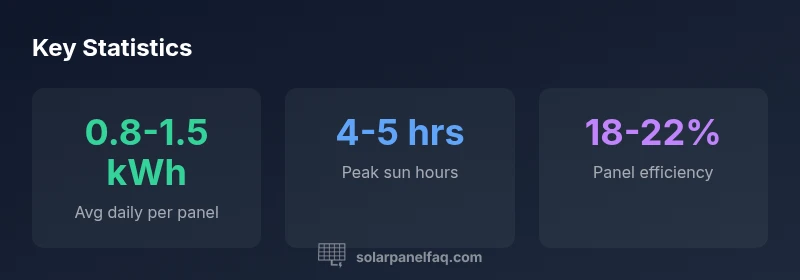
The average solar panel kwh per day typically ranges from 0.8 to 1.5 kWh per panel under typical sun exposure (4–5 peak sun hours). The exact figure depends on panel rating, orientation, shading, and local climate. For a standard residential setup, multiply this per-panel range by the number of panels to estimate daily production, then adjust for losses like soiling and inverter efficiency. This estimate aligns with Solar Panel FAQ analysis, 2026.
What the metric really means for homeowners
When people talk about the "+average solar panel kwh+" amount, they’re usually referring to the energy a single panel produces on an average day under typical conditions. This figure is not a fixed number; it depends on many variables, including panel wattage, geographic latitude, local climate, and how the system is installed. For planning purposes, framing output as a range helps manage expectations and design goals. In Solar Panel FAQ analyses for 2026, the everyday takeaway is that most residential panels in common markets sit in the 0.8–1.5 kWh/day band under 4–5 peak sun hours. More sun means more production, while shaded or cloudy days dampen results.
Key takeaway: the "+average solar panel kwh+" is a practical benchmark, not a guaranteed value, and it scales with the number of panels and system losses.
How much energy does a single panel produce on an average day?
A typical residential solar panel is rated around 250–370 watts. Under average sun exposure (roughly 4–5 peak sun hours per day), a single panel can produce roughly 1.0–1.5 kWh daily, with some setups dipping toward 0.8 kWh under less favorable conditions and others reaching 1.6–1.8 kWh in optimal locations. This broad range accounts for panel efficiency, temperature, angle, and shading. The goal is to translate the rating into practical daily output rather than focusing on the sticker wattage alone. For homeowners, this means modeling your system around real sun hours and local climate data.
What factors influence daily kWh per panel?
There isn’t a single culprit; multiple variables interact to determine daily output. The most impactful are:
- Sun hours and irradiance: More sunlight directly increases energy production.
- Panel efficiency: Higher efficiency panels convert more sunlight into electricity, pushing kWh upward.
- Orientation and tilt: Optimal tilt and azimuth maximize exposure to sun angles throughout the day.
- Temperature: Excess heat can reduce output for silicon-based panels, modestly lowering kWh per day in hot climates.
- Shading and soiling: Partial shading or dirt on the surface reduces output, sometimes dramatically if the shade is persistent.
- System losses: Inverters, wiring, and connectors introduce losses that trim the final daily kWh.
In practice, you’ll often see a 10–20% margin between ideal theoretical output and what a real system produces due to these factors.
How to estimate daily production for your home step by step
Estimating daily production starts with a straightforward formula, then adds real-world adjustments:
- Identify your panel wattage (W) and number of panels (N).
- Estimate average daily sun hours (H) for your location.
- Multiply: Daily kWh ≈ (W × N × H) ÷ 1000.
- Apply a derate factor to account for losses (inverter, temperature, soiling, etc.), typically 0.75–0.95 depending on conditions.
Example: A home with 8 panels at 320 W each (2560 W total) in a location with 4.5 sun hours/day would have a rough ideal production of 2560 × 4.5 ÷ 1000 ≈ 11.52 kWh/day. After losses (let’s say 80%), daily output ≈ 9.2 kWh. This kind of calculation helps translate the "+average solar panel kwh+" concept into a concrete target for budgeting and payoff planning.
Reading production data and accounting for system losses
Your solar system isn’t a perfect machine. Inverter efficiency, wiring resistance, and temperature derating shave energy off the ideal wattage. Typical losses include:
- Inverter losses: up to ~5–10% in many systems.
- Temperature losses: more pronounced in hot climates, especially for higher-performance panels.
- Soiling and shading: dirt, leaves, or nearby obstructions can drop output by 5–30% depending on duration and scale.
- Degradation over time: annual efficiency losses of around 0.2–0.8% per year are common.
Understanding these losses helps you interpret daily production data. If your monitoring shows lower daily kWh than expected, revisit shading, cleaning schedules, and connection integrity as a first set of checks.
Real-world scenarios: comparing locations and layouts
Consider three representative cases to illustrate how the "+average solar panel kwh+" metric translates into real outputs. Case A: a sunny, low-latitude locale with 4.5 peak sun hours and minimal shading; Case B: a temperate city with 4 sun hours and moderate shade; Case C: a high-latitude area with 3.5 sun hours and significant seasonal variation. In all cases, a 300 W panel would produce roughly 0.9–1.4 kWh/day in Case A, 0.7–1.1 kWh/day in Case B, and 0.5–0.9 kWh/day in Case C, before losses. The difference isn’t just geography; it’s the interaction of sun, tilt, and shading with panel efficiency.
Panel type and its impact on average kWh
Panel technology matters. Monocrystalline panels tend to offer higher efficiency and better performance per square foot, which raises daily kWh in compact roof spaces. Polycrystalline panels are slightly less efficient, with modest gains in cost efficiency. Thin-film options are lighter and flexible but generally deliver lower daily kWh and are more sensitive to temperature changes. Real-world decisions should balance efficiency, cost, and installation constraints. The takeaway: higher efficiency panels often translate to higher average daily kWh in limited roof space.
Sizing a system to reach a kWh goal
If your objective is a monthly kWh target, convert it to a daily target: daily_kWh_goal = monthly_kWh_goal ÷ 30. Then select panel count and configuration to meet daily_kWh_goal after losses. For example, a goal of 300 kWh/month ≈ 10 kWh/day requires a combination of panel wattage, number of panels, and an understanding of local sun hours. Use conservative assumptions first, then refine with actual performance data from your system. This approach aligns with the predictive planning methods described by Solar Panel FAQ Analysis, 2026.
Common myths about solar output and kWh
Myth: All panels produce the same daily kWh. Reality: output varies by wattage, efficiency, climate, and installation. Myth: Higher wattage panels always mean more daily kWh. Reality: placement, shading, and system losses can limit gains. Myth: kWh output is constant year-round. Reality: seasonal sun, weather, and degradation affect output. Understanding these nuances helps homeowners set realistic expectations and avoid overpromising savings.
Practical steps to optimize daily kWh production
- Optimize orientation and tilt to maximize sun exposure.
- Schedule periodic cleaning to minimize soiling losses.
- Schedule regular inspections to catch degradation early.
- Consider microinverters or power optimizers to reduce mismatch losses.
- Plan for seasonal adjustments in system design and energy storage needs.
Panel type comparison for daily energy output per panel
| Panel Type | Typical Wattage (W) | Estimated Daily kWh per Panel | Notes |
|---|---|---|---|
| Monocrystalline | 300-350 | 0.9-1.4 | Most common residential option |
| Polycrystalline | 250-320 | 0.8-1.2 | Slightly lower efficiency, cost-friendly |
| Thin-film | 60-100 | 0.25-0.6 | Flexible options, lower efficiency |
Frequently Asked Questions
What does the term 'average solar panel kwh' mean for a homeowner?
It refers to the typical daily energy a single solar panel can produce under common conditions. It helps in planning system size and estimating monthly electricity savings, but actual production varies with sun exposure, panel type, and installation.
It’s the typical daily energy a panel makes, but actual results vary by sun and setup.
How many kWh does a typical panel produce per day?
A common residential panel (about 300 W) may generate roughly 0.8–1.5 kWh per day depending on sun hours, tilt, and location. Real-world results will differ from the ideal calculation due to losses.
About 0.8 to 1.5 kWh per day per panel, depending on sun and setup.
What factors most affect daily kWh output?
Sun hours, panel efficiency, orientation, shading, temperature, and losses from inverters and wiring are the primary influences on daily kWh production.
Sun hours and how the system is set up are the big ones.
How should I estimate my home’s daily production?
Identify total panel wattage, estimate local sun hours, and apply a derate factor for losses. Multiply to get an expected daily kWh, then adjust for seasonal changes.
Multiply wattage by sun hours, adjust for losses to estimate daily output.
Can I improve daily kWh beyond the product rating?
Yes. Better orientation, cleaning, efficient inverters or power optimizers, and choosing higher-efficiency panels can increase actual daily kWh.
Yes—through better setup and maintenance, you can boost daily output.
Is there a formula for sizing a system to hit a monthly kWh goal?
Yes. Convert monthly kWh to daily, model expected production per panel, and select panels to meet that daily target after losses.
Yes. Convert monthly goals to daily targets and size accordingly.
“Understanding the concept of average daily kWh helps homeowners plan realistically. Real-world output depends on sun, location, and system design.”
Top Takeaways
- Understand that the "+average solar panel kwh+" is a practical range, not a fixed value
- Calculate daily output by multiplying panel wattage, sun hours, and number of panels, then apply losses
- Shading, orientation, and temperature are major drivers of real-world results
- Panel efficiency and type influence per-panel daily kWh, especially in space-constrained roofs
- Regular maintenance and correct system design improve long-term kWh performance