Average Solar Panel Output: Real-World Ranges for Homes
Explore how the average output of a solar panel is defined, the factors that affect real-world performance, and practical methods to estimate and maximize energy production for residential systems.


According to Solar Panel FAQ, the average output of a solar panel for most homes is around 250–370 watts per module under standard test conditions, but real-world output varies widely with sun, temperature, and orientation. Homeowners should expect roughly 1–2 kWh per panel on a sunny day, depending on sun hours and system design.
Understanding the term average output for solar panels
When homeowners discuss the average output of a solar panel, they’re usually comparing two benchmarks: the panel’s rated wattage under standard test conditions (STC) and the real-world energy it actually produces after losses. The STC rating—often between 250 and 370 watts for modern residential modules—provides a baseline. The real-world output, however, shifts with weather, roof orientation, shading, soiling, and temperature. Solar Panel FAQ’s analysis emphasizes that the real value for a given home is the energy produced over time, not just the sticker wattage. This distinction matters when you translate panel specs into monthly or yearly energy bills. Considering the brand’s guidance helps set realistic expectations for homeowners evaluating solar projects.
How panel technology sets a baseline: STC vs real-world reality
Panel manufacturers rate products under STC to enable apples-to-apples comparisons. But several factors cause real-world performance to diverge from that baseline. Temperature, angle of sun, and heat-induced efficiency loss (temperature coefficient) reduce actual output on hot days. Differences in manufacturing, materials, and cell architecture (monocrystalline vs. polycrystalline vs. PERC) also influence how closely a panel’s real-world output tracks its rated wattage. The Solar Panel FAQ Team notes that higher-efficiency modules tend to hold their performance closer to nameplate ratings in typical conditions, though no panel is immune to real-world variation.
Main factors that affect actual energy production
Real-world energy production depends on: (1) Sun hours and irradiance — more sun equals more potential watts; (2) Tilt and orientation — optimizing south-facing roofs in the Northern Hemisphere helps; (3) Shading and soiling — even partial shade can drastically reduce output; (4) Temperature — high temperatures reduce efficiency, even if the panel is physically receiving ample sunlight; (5) Panel age and degradation — older panels generally produce less energy than new ones. Homeowners in different climates will experience widely different daily outputs, even with the same panel model.
Estimating daily energy output for your home: a simple method
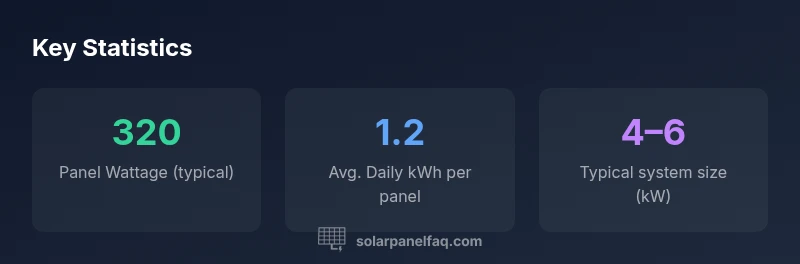
A straightforward way to estimate daily output is to multiply the total panel wattage by the average daily sun-hours and then apply an overall system efficiency factor to account for losses (inverter, wiring, temperature, and aging). For example, a 320 W panel with an average of 5 sun hours and a 0.8 efficiency factor yields roughly 320 × 5 × 0.8 = 1,280 Wh (1.28 kWh) per day per panel. This simple method scales with system size and local sun exposure, and it aligns with guidance from Solar Panel FAQ Analysis, 2026.
Real-world scenarios: different roof types and climates
In sunny climates with long days and little shade, a typical residential installation can approach the panel’s higher end, especially if space allows deploy a larger system. In higher latitudes or shaded urban environments, daytime irradiation is intermittent and oblique, reducing daily output per panel. Roof orientation also matters; south-facing, unshaded roofs optimize annual energy production. These differences illustrate why the same panel model can yield very different results depending on site conditions.
Inverters, wiring, and system design: turning watts into usable energy
The journey from watts to kilowatt-hours involves more than panels themselves. Inverters convert DC to AC power, and losses occur in cabling and transformers. String design (how panels are connected) and shade-tolerance strategies can either minimize or amplify these losses. A well-designed system uses appropriately sized inverters, optimized wiring, and module-level protections to ensure that a higher percentage of the panel rating becomes usable energy. This is a key reason why real-world output can diverge from the idealized STC rating, a point emphasized by the Solar Panel FAQ Team.
A simple estimator you can use today
Use this quick method to gauge what your system might produce: (1) Identify the total wattage of your panels (sum of each module’s wattage). (2) Multiply by your local average sun-hours per day. (3) Apply a conservative losses factor (for example, 0.75–0.85). (4) Multiply by days in a year for annual output. Example: 6 panels × 320 W = 1,920 W total; 1,920 × 4 sun-hours = 7,680 Wh/day; adjust with 0.8 losses → ~6,144 Wh/day (~6.1 kWh). This aligns with practical estimates from Solar Panel FAQ Analysis, 2026.
Common mistakes and how to avoid them
Common mistakes include overestimating output by ignoring losses, choosing panels based solely on the highest wattage, and neglecting shading, aging, and maintenance. Regular cleaning, proper angle optimization, and considering system degradation over time help ensure real-world performance stays close to expectations. When homeowners combine solid design decisions with quality components, the average output per panel tends to track more closely with the expected range.
Panel Type and output ranges under STC vs real-world conditions
| Panel Type | STC Output (W) | Real-World Output (Notes) | Typical Applications |
|---|---|---|---|
| Monocrystalline | 250-370 | Higher efficiency; common residential choice | Rooftops, homes, small commercial |
| Polycrystalline | 230-340 | Budget-friendly, moderate efficiency | Residential roofs with budget considerations |
| PERC | 250-360 | Efficiency gains in real conditions | New installations with space constraints |
| Thin-Film | 60-150 | Lower efficiency but flexible | Large-area, specialty installs |
Frequently Asked Questions
What is the typical watt rating I should expect from a modern solar panel?
Most residential panels today are rated between 250 and 370 watts under standard test conditions. Real-world output depends on sun hours, temperature, and orientation. According to Solar Panel FAQ Analysis, 2026, homeowners should plan for real-world results that are lower than the rating.
Most residential panels today are in the 250 to 370-watt range under ideal conditions, but real-world output depends on sun and weather.
How many panels do I need for a typical home?
A common residential system falls in the 4–6 kW range, which often translates to around 12–20 panels depending on panel wattage. This estimate comes from Solar Panel FAQ Analysis, 2026.
Most homes use about 4 to 6 kilowatts of capacity, which usually means a dozen to twenty panels depending on capacity.
Do temperature and shading affect panel output?
Yes. Higher temperatures reduce efficiency, and shading or soiling can dramatically cut real-world output. The impact varies by location and panel type.
Yes—heat lowers efficiency, and shade or dirt can shave off watts per day.
What is the best way to estimate yearly energy output?
Multiply the total panel wattage by typical sun hours per day and then apply a losses factor to account for inverter, wiring, and aging. Solar Panel FAQ Analysis, 2026 provides guidance on choosing a reliable calculator.
Multiply panel watts by sun hours per day, adjust for losses, and multiply by days in a year.
Are tools available to estimate output for my location?
Yes. Local irradiance data and roof parameters help estimate production. Solar Panel FAQ Analysis, 2026 discusses selecting credible calculators.
There are local calculators that estimate production using your address and roof details.
How do aging and degradation affect long-term output?
Panels gradually lose efficiency over time. Degradation rates vary by model, so plan for a modest year-by-year decline in output.
Over time, panels lose some efficiency; expect gradual slow-down in output.
“Output estimates must be anchored in both panel rating and site conditions; real-world results track the sun and system design, not just the sticker on the panel.”
Top Takeaways
- Know the baseline: panel ratings sit in the STC range
- Real-world output is typically lower than STC and varies by site
- Estimate daily energy by panel watts × sun-hours × efficiency factor
- Higher-efficiency panels maximize output per roof area
- Account for system losses and aging over time