Where to Install Solar Panels on Roof: A Practical Guide
Discover where to install solar panels on roof for maximum sun exposure, safety, and long-term performance. Learn orientation, shading, mounting options, permits, and maintenance with a homeowner-friendly approach.


Goal: determine the best roof locations for solar panels to maximize sun exposure, simplify maintenance, and reduce risk. You’ll learn about orientation, shading, mounting options, and permitting considerations. According to Solar Panel FAQ, roof location should maximize sun exposure while minimizing shading and roof penetrations. This quick guide points you toward practical, safe decisions for homeowners.
Why rooftop location matters
Choosing the right location on your roof is critical for maximizing energy production and minimizing wear. The question of where to install solar panels on roof isn’t just about proximity to the attic; it’s about sun exposure, shading, and mounting security. For homeowners, the goal is to place modules where they receive the most consistent sunlight throughout the day and year, while keeping access for cleaning and maintenance. Orientation matters: in the northern hemisphere, a south-facing roof typically yields the highest output, with east or west facing roofs offering good production with slightly different timing. Tilt should align with your latitude for optimal absorption; most residential systems perform best with a tilt within 10-40 degrees. Shading is a killer: even a small panel shade from a chimney or vent can reduce output. Before planning, inspect the roof for structural integrity and age; older roofs may need replacement or reinforcement before mounting. Finally, consider wind load and fire-safety clearances per local codes. These fundamentals shape every decision about where to install solar panels on roof.
Roof assessment checklist
Before marking where to install solar panels on roof, perform a roof assessment. Look at age, material, and overall condition. Older roofs may shed, leak, or fail under mounting load. If the roof is nearing replacement, weigh the cost of re-roofing before adding solar. Material matters: asphalt shingles are common; metal roofs are strong; tiles require careful handling to avoid cracking. Inspect rafters and decking: the system weight, plus wind loads, must be supported. A structural engineer or licensed installer can verify deck integrity and rafters spacing. A clear plan helps ensure safety and longevity. Solar Panel FAQ analysis shows that shading assessment and structural readiness are the gating factors for a solid roof installation plan. If risk is detected, address it before proceeding and document any repairs. Also check attic ventilation and electrical access routes from the proposed array to the inverter location. By completing a thorough roof assessment, you set the stage for where to install solar panels on roof that will perform for decades.
Orientation, shading, and spacing impact on output
The path of sunlight across your sky is the most influential factor in solar production. A roof that faces true south (in the northern hemisphere) typically yields the best annual energy. East or west facing roofs can work well, especially for offsetting morning or afternoon peaks. Shading from nearby trees, chimneys, vents, or satellite dishes can dramatically lower output, even if only a portion of a module is shaded. Plan spacing so that rows do not shade the panels behind them in winter when the sun sits lower in the sky. Keep clearances around the array for cleaning and emergency access. Across climates, maintaining consistent exposure and minimizing shading opportunities are the best ways to optimize long-term energy performance.
Roof types and mounting options
Your roof type drives mounting strategy. Asphalt shingles are common and straightforward to mount with standard rails. Metal roofs often use clamps that grip the panel rails without penetrating the metal, reducing leak risk. Tile roofs may require standoffs or underlayment to protect tile integrity; improper handling can crack tiles. In most homes, a balanced combination of rails, clamps, and weatherproof sealing creates a durable, wind-resistant array. For roofs with extreme angles or limited access, consider non-penetrating mounting systems or a ground-mounted alternative if space allows. The goal is a secure attachment that preserves roof integrity while enabling easy panel access for cleaning and maintenance.
Penetration vs ballast mounting and safety
Penetration mounting attaches hardware directly through the roof deck, creating potential leak paths but often providing a lower-cost, high-strength solution. Ballast or non-penetrating mounting uses ballast weights or ballast rails to secure the system without drilling into the roof; this approach is common on flat roofs or where roof warranties prohibit penetrations. In all cases, proper flashing, seals, and gasket materials are essential. Always use fall protection and ensure workers wear harnesses when working at height. Never work on wet or icy roofs, and always follow local codes and manufacturer instructions for wind load and load rating.
Where to place panels on different roof surfaces
Aim to place panels where they gain maximum sun without excessive shading. On steeper roofs, keep panels away from edge eaves where wind uplift is greater; on flatter roofs, space rows to avoid shading between modules. When possible, align rows with the roof’s slope to minimize airflow disruption and drainage issues. Keep important roof penetrations (vents, solar tubes) away from panel paths. For homes with limited south-facing exposure, a southeast or southwest orientation can still provide solid yearly production with careful tilt settings and module spacing.
Layout planning: modules, strings, and inverters
A well-planned layout begins with mapping the usable roof area, then deciding on module orientation and tilt. Group modules into strings that align with your inverter’s input limits or opt for microinverters for simpler wiring and better partial shading tolerance. Keep wiring runs short and use proper conduit protection to reduce voltage drop. Consider future expansion when planning the layout, and document your plan for permitting or warranty purposes. A clear layout saves time during installation and improves long-term performance.
Permits, codes, and warranties
Most jurisdictions require building permits for solar installations, and electrical work must meet national and local electrical codes. Plan to submit a permit packet that includes system diagrams, shade analysis, and mounting details. Warranties for panels, inverters, and mounting hardware depend on the installer and the manufacturer; some installers offer workmanship warranties for the roof work. Always verify warranty terms and ensure that the chosen mounting method does not void roof warranty where applicable.
Pre-installation checklist and on-site assessment
Before the first tool touches the roof, complete a pre-installation checklist: verify roof condition and age, confirm rafter capacity, review panel layout, confirm wiring routes to the inverter, and arrange for fall protection. Take photos of the roof and proposed mounting areas for reference. Confirm that you have all required permits and that electrical disconnections will be performed safely. This step reduces surprises during installation and ensures a smoother, safer process.
Maintenance and long-term considerations
Solar panels require minimal maintenance, but a yearly visual inspection helps detect loose hardware, seal failures, or debris buildup. Clean panels if dirt or snow accumulates, but avoid harsh cleaners or power washing that could damage surfaces. Monitor performance via the inverter or monitoring app to catch performance anomalies early. If you ever need to relocate or expand, preserve an accurate as-built map of the roof layout for future work.
Real-world planning scenario
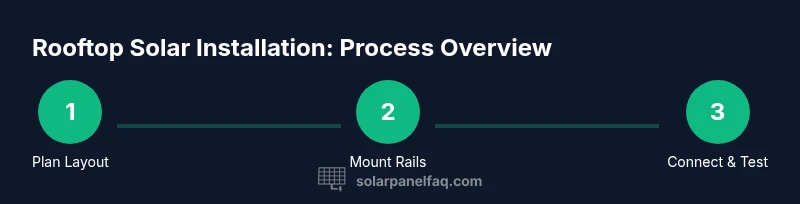
Imagine a typical single-family roof with moderate slope and a mostly southern exposure. Start by assessing the roof condition and shading from oaks nearby. Map a layout that keeps panels away from major vents and skylights, then choose a railing system compatible with asphalt shingles. After planning, obtain permits and schedule a staged installation: mount rails, run wiring, install modules, connect to the inverter, and finally perform commissioning tests. A thoughtful plan minimizes downtime and helps you achieve reliable energy production from day one.
Tools & Materials
- Ladder (extendable, non-slip)(Stable base; use stabilizer feet.)
- Fall-protection gear (harness, anchor)(Required for roof work.)
- Roof anchors and safety lines(Secure attachment points for fall arrest.)
- Cordless drill/driver with assorted bits(Masonry and wood bits as needed.)
- Measuring tape (at least 25 ft)(Accurate layout and spacing.)
- Carpenter pencil or marker(Mark rafter positions and rail locations.)
- Mounting rails and brackets(Check compatibility with roof type.)
- Roof sealant and flashing gasket material(Waterproofing at penetrations.)
- Level and straight edge(Ensure straight, level rails.)
- Torque wrench or driver with torque settings(Safe fastener torque per manufacturer specs.)
- Wrench set and pliers(Nuts, bolts, clamps, and wire management.)
- Safety gloves and eye protection(Personal protective equipment.)
- Conduit and electrical connectors(Weatherproofing and code-compliant wiring.)
- Screwdriver bits and sealant gun(Optional extras for finishing touches.)
Steps
Estimated time: 4-8 hours
- 1
Assess roof and plan layout
Inspect roof condition, verify rafters support, and draft a layout that minimizes shading. Determine the best south-facing zones and avoid vents or chimneys. Document all measurements for a precise install plan.
Tip: Take multiple measurements at different roof planes and verify consistency. - 2
Install mounting rails along rafters
Secure rails along the primary rafter lines using approved anchors. Ensure rails are level and spaced to match module width. Use a chalk line to maintain straight rows.
Tip: Use a level frequently during rail placement to prevent tilt issues. - 3
Attach clamps and weatherproofing
Install clamps per manufacturer instructions and apply flashing seals at all penetration points. Verify seals are flush and no gaps exist.
Tip: Test seals with a gentle water spray after installation to confirm watertightness. - 4
Mount solar modules and run wiring
Secure panels to rails with clamps. Route wiring through conduit to the inverter, avoiding sharp bends. Keep wiring off of hot surfaces.
Tip: Plan wire routes to minimize exposure and maximize ease of maintenance. - 5
Connect to inverter and perform safety checks
Connect panels to the inverter per electrical diagram. Verify grounds and disconnects; ensure main power is off during wiring.
Tip: Double-check all connections with the torque wrench and inspect for worn insulation. - 6
Commission and test the system
Power up the system and verify output using monitoring software. Check for alarms or faults and document the commissioning readings.
Tip: Record baseline production and compare against expected performance for the first week.
Frequently Asked Questions
Is my roof suitable for solar panel installation?
Roof suitability depends on age, condition, and structural support. A licensed installer can assess rafters, decking, and load capacity to confirm feasibility.
Roof suitability depends on age, condition, and structure. A licensed installer can confirm whether your roof can safely support solar panels.
Should I hire a professional or can I install myself?
For most homes, hiring a professional ensures proper mounting, electrical connections, and code compliance. DIY is possible for simple, non-penetrating systems but requires expertise.
Most homeowners should hire a professional for safety and code compliance. DIY is possible in limited cases but not recommended for complex roofs.
How does orientation affect energy production?
South-facing roofs generally maximize annual production in the northern hemisphere, while east/west faces offer different production curves. Tilt and shading can alter outcomes more than minor orientation changes.
South-facing roofs usually give the best annual output, but tilt and shading also matter a lot.
What permits or codes apply?
Most regions require building and electrical permits. Inspections ensure compliance with electrical codes, fire safety, and structural integrity. Always verify local requirements before starting.
Permits are typically required; inspections verify code compliance and safety.
How long do solar panels last and what warranties exist?
Panels and inverters come with manufacturer warranties; workmanship warranties depend on the installer. Understand terms and expected performance over the system life.
Panels and inverters have warranties; check installer workmanship terms for coverage.
What maintenance is required?
Minimal maintenance beyond occasional cleaning and visual checks. Monitor performance with a system tool and address issues promptly.
Keep an eye on performance and clean panels occasionally to maintain output.
Watch Video
Top Takeaways
- Assess sun exposure and shading first
- Choose mounting method that protects roof integrity
- Plan layout before purchasing modules
- Secure necessary permits and understand warranties
- Maintain a simple, future-proof maintenance routine