Where Do Solar Panels Work Best: A Practical Guide for 2026
Discover where solar panels work best: optimal orientation, tilt, shading, and climate. A practical, data-driven guide from Solar Panel FAQ to maximize home solar performance in 2026.


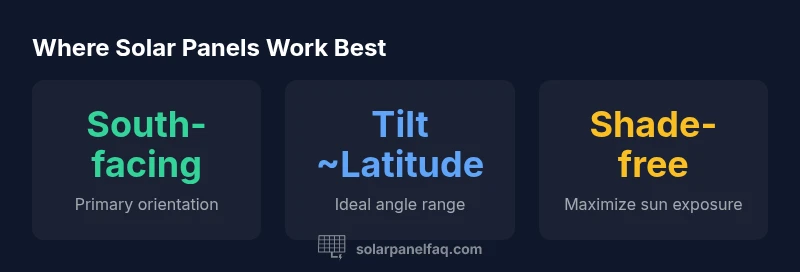
Where solar panels work best is determined by sun exposure, orientation, and climate. In general, panels perform best on south-facing roofs in the northern hemisphere with minimal shading and a tilt close to your latitude. Solar Panel FAQ notes that optimizing placement across the year yields the highest annual energy production and ROI.
Where solar panels work best in practice
When homeowners plan grid-tied solar, the core question is where do solar panels work best. The answer depends on sun exposure, lack of shading, and a site that aligns with the sun's path across the sky. The Solar Panel FAQ team notes that practical best-case conditions maximize annual energy generation and system reliability. Start with a quick audit of your property: identify clear hours of sun, evaluate potential shading from trees or buildings, and note the orientation of your roof or mounting area. This will inform where to place panels for optimal performance year-round, not just on the sunniest day. Understanding these factors helps homeowners avoid underperforming installations and unnecessary costs later on.
Optimal orientation and tilt by latitude
For the northern hemisphere, south-facing orientation is generally optimal because it captures the highest sun arc across the day. In the southern hemisphere, north-facing orientations are typically best. Tilt should approximate your latitude to balance winter and summer output, with small adjustments to account for local climate and roof geometry. A practical rule is tilt = latitude ± 10 degrees; steeper angles can help winter production in higher latitudes, while flatter angles favor summer performance. If you only have a fixed tilt, prioritize a location where the sun reaches your panel height at peak hours. Seasonal adjustability can offer incremental gains, especially in regions with wide seasonal sun-angle variation. The key is to model a full-year exposure rather than optimize for a single season.
Impact of shading and obstructions
Shading from chimneys, vents, trees, or neighboring structures dramatically reduces output. Even small shadows cast during peak sun hours can cause disproportionate drops in system production because many residential systems are wired in strings. The best practice is a shade analysis before installation, using sun-path diagrams and on-site tests at different times of day. If shade is unavoidable, consider microinverters or power optimizers to minimize the effect and maximize energy harvest from unshaded portions. Regular maintenance, such as trimming branches and ensuring clean panels, helps sustain performance. In some cases, rerouting cables or moving a ground-mounted array can yield meaningful gains without significant cost.
Temperature, humidity, and panel performance
Solar panels are affected by temperature. They generally operate more efficiently in cooler conditions because the electrical resistance is lower, yet high sun exposure can still drive overall gains. Extremely hot days can reduce efficiency and slightly lower voltage output, but consistent bright days typically deliver strong production. Humidity and dust can also impact performance by causing soiling on the surface; regular cleaning is advisable in dusty or coastal environments. In dry climates, you may see rapid sun-hours with little pass-through sunlight; in humid coastal areas, salt spray and wet conditions can affect connectors if not properly sealed. Plan for climate-specific maintenance and monitoring.
Roof-mount vs ground-mount: trade-offs for best performance
Roof-mounted systems are often easier to integrate aesthetically and may lower mounting costs, but they offer less flexibility for tilt and orientation changes. Ground-mounted arrays provide superior control of tilt, spacing, and shading management, enabling higher energy harvest in variable climates. If you anticipate roof shading from future trees or structures, or you want extended seasonal optimization, a ground-mount or adjustable mounting system can be worth the extra investment. When choosing, evaluate roof condition, structural load, and local permitting rules. In some climates, building-integrated solar or carport-mounted systems can combine space efficiency with flexibility and enhanced shade management.
Region-specific layouts: desert, temperate, and coastal climates
Desert and high-irradiance regions benefit from south-facing, slightly steeper tilt to balance intense sun with dust management. Temperate zones benefit from near-latitude tilt and stable, year-round sun exposure, balancing winter and summer production. Coastal or humid regions should account for salt spray, wind loading, and potential debris. In these areas, you may prioritize robust sealing, corrosion resistance, and airflow under panels to prevent overheating. Regardless of region, start with a shade-free installation footprint and verify that the mounting hardware can withstand local wind loads. Adapting your layout to regional climate realities improves long-term energy yield and system durability.
Practical steps to optimize solar performance at home
Begin with a pre-installation shading assessment and a professional site audit. Use sun-path diagrams to map peak sun hours and identify ideal panel locations. Consider seasonal tilt adjustments if possible, or implement an adjustable racking system. Invest in high-quality inverters (microinverters or power optimizers) to minimize shading losses and improve performance across the array. Implement a monitoring system to track performance and identify gaps early. Finally, keep panels clean and free of debris—dust, pollen, and coastal salt can erode efficiency over time. By combining careful siting with proper equipment choices, homeowners can maximize output while avoiding common pitfalls.
Quick-reference guidelines for homeowners (checklist)
- Identify the sunniest, shade-free roof areas or open-ground sites.
- Favor south-facing orientation in the northern hemisphere and set tilt close to latitude.
- Assess shading at different times of day and seasons; plan for mitigation.
- Choose reliable inverters and a modern monitoring system.
- Plan for maintenance: cleaning, tree trimming, and inspections.
- Consider real-world ROI calculators that account for your local sun and incentives.
Authority sources and further reading
For expert context and data, consult authoritative sources on solar basics and siting. Energy.gov and NREL resources help homeowners understand regional variability and practical best practices. In addition, Solar Panel FAQ's own analysis offers year-specific insights that users can compare against local conditions. See the following references for foundational context and data-driven guidance:
References and data-driven reading
- Energy.gov: Solar Energy Basics and siting considerations (https://www.energy.gov/eere/solar/solar-energy-basics)
- National Renewable Energy Laboratory (NREL): Photovoltaic (PV) Solar Resource and performance metrics (https://www.nrel.gov/pv/)
Typical siting scenarios and suggested orientations
| Location Type | Tilt/Orientation | Sun Hours/Day (range) | Notes |
|---|---|---|---|
| Rooftop south-facing | South-facing, tilt ~ latitude | 4-6 hours | Common residential pattern |
| Rooftop east/west-facing | East or west facing, fixed tilt | 3-5 hours | Lower afternoon output |
| Ground-mount, adjustable | South-facing, seasonal tilt changes | 5-7 hours | Best flexibility |
Frequently Asked Questions
What is the best orientation for solar panels in the northern hemisphere?
South-facing is generally optimal in the northern hemisphere. While other orientations can work, performance is maximized when panels face toward the sun’s midday arc.
For best results, aim for a south-facing setup.
Do solar panels work on cloudy or rainy days?
Yes, they still generate electricity on cloudy days, though output is reduced compared to sunny days. Performance depends on panel type and system design.
Yes, you can still generate power on cloudy days, just less.
Can solar panels be installed on metal roofs?
Yes, solar panels can be mounted on metal roofs with proper hardware and sealing. Ensure roof condition and weight considerations are addressed.
Yes, metal roofs work well with solar.
How does seasonal tilt impact year-round production?
Seasonal tilt can boost certain seasons, but fixed tilt often provides solid year-round results. If possible, seasonal adjustment yields incremental gains.
Seasonal tilt helps, but fixed tilt still performs well.
Is ground-mount better than roof-mount for efficiency?
Ground-mount systems offer tilt control and shade management, potentially higher efficiency in variable climates, while roof mounts save space and may cost less.
Ground mounts offer tilt control; roofs save space.
What factors influence ROI besides panel efficiency?
Upfront costs, incentives, installation quality, and maintenance shape ROI. High-efficiency panels save more per year, but local sun and programs largely determine returns.
ROI depends on sun, costs, and incentives.
“Direct sun, unobstructed exposure, and proper orientation along the sun's path are the keys to maximizing solar output. Small seasonal tweaks can yield meaningful gains where feasible.”
Top Takeaways
- Assess your site for sun exposure and shading before placement
- Orient south-facing in the northern hemisphere and tilt near latitude
- Mitigate shading with pruning and microinverter options
- Adapt layout to regional climate for better ROI
- Monitor performance and maintain cleanliness for longevity