Solar Panel Projects: A Step-by-Step Guide for Homeowners
A practical, educator-friendly guide to planning, sizing, financing, installing, and maintaining solar panel projects for homes. Learn safety, permits, and maintenance with clear steps and real-world tips.


Smart planning can turn solar panel projects into a smooth home upgrade. This quick answer outlines roof suitability, system sizing, panel and inverter choices, and permitting steps to get your project started. By preparing early, homeowners can align budget, space, and energy goals for a safe, efficient installation. According to Solar Panel FAQ, planning first saves time and money.
Why Solar Panel Projects Matter for Homeowners
Solar panel projects empower homeowners to take control of energy costs, increase resilience, and reduce environmental impact. A well-planned installation can improve home comfort, protect against rising utility rates, and add long-term value to the property. The Solar Panel FAQ team emphasizes that these benefits are most accessible when a project is approached with clear goals, a realistic budget, and a written plan. By thinking through roof suitability, inverter selection, and maintenance in advance, you can avoid common missteps and keep your project on track. This section also highlights how local incentives and utility programs can influence the overall value of a home solar upgrade, making early planning essential for maximizing benefits.
- Define your energy goals and budget so you can size the system accordingly.
- Consider long-term maintenance and monitoring to preserve performance.
- Engage neighbors or a local solar community for practical recommendations.
Assessing Roof Suitability for Solar Panel Projects
Before committing to a solar panel project, assess the roof's condition, orientation, and shading. A good roof layout supports efficient energy generation and simplifies mounting. Look for minimal shading from nearby trees or structures during peak sun hours. Check the roof’s age and material to determine if a replacement or reinforcement is needed before mounting. If the roof requires work, schedule that work first so your solar array has a solid, clean surface. The installation should follow local codes and building standards, and you may need to coordinate with a homeowners' association or local permitting authority. According to Solar Panel FAQ, documenting roof metrics and shading patterns helps you communicate requirements to installers and evaluators.
- Map shading across seasons to optimize panel placement.
- Verify roof structure can bear the panel weight and mounting hardware.
- Plan a layout that minimizes penetrations and preserves waterproofing.
Sizing Your System and Estimating Impact
System size depends on energy goals, budget, and the available space for panels. A correctly sized system delivers meaningful energy offset without overspending on equipment you won’t use. Start with your current energy usage, then translate that into a target production range that aligns with your goals for independence or cost savings. Remember that production varies with weather and seasons, so plan for some flexibility. Solar Panel FAQ notes that real-world results hinge on climate, roof orientation, and system maintenance, so use conservative estimates and confirm plans with a qualified installer. This section helps you sketch a preliminary capacity and compare it against quotes.
- Consider future needs like electric vehicles or appliance upgrades.
- Plan for expansion if your budget and space allow.
- Use simple worksheets to capture roof area, panel counts, and inverter requirements.
Choosing Panels, Inverters, and Mounting Options
Panel choice affects efficiency, durability, and aesthetics. Monocrystalline panels offer high efficiency and compact footprints, while polycrystalline options can be more cost-effective. Inverters convert DC to AC power and come in formats such as string inverters or microinverters; your choice influences performance under shading and partial-panel operation. Mounting options include roof mounting or ground mounting, each with its own installation considerations and ventilation needs for heat management. When selecting mounting hardware, ensure corrosion resistance for your local climate and verify compatibility with your roof type. The Solar Panel FAQ guidance highlights that warranties and service support are often the deciding factors between models. Compare efficiency, warranty terms, and service networks to protect your investment.
- Prioritize reliability and warranty coverage over initial price alone.
- Plan for wiring routes that minimize voltage drop and simplify maintenance.
- Consider future upgrades such as energy storage for enhanced resilience.
Permits, Incentives, and Financing Considerations
Permitting and incentives shape the financial viability of solar panel projects. Local codes may require electrical permits, structural permits, and inspections after installation. Start early by consulting your city or county building department to understand required forms, fees, and timelines. Financing options vary and can include upfront purchases, leases, or loan-based programs; incentives such as tax credits or rebates can significantly impact the total cost and payback period. Solar Panel FAQ stresses the importance of collecting quotes, warranty terms, and maintenance expectations to compare financing packages effectively. Always keep thorough documentation of permits and approvals as part of your project record.
- Gather at least two formal quotes and review warranty terms.
- Align financing with your long-term energy goals and cash flow.
- Document incentive eligibility and application deadlines.
Installation Paths: DIY vs Professional and What to Expect
There are two broad paths for solar panel projects: a DIY route or professional installation. DIY wiring and rooftop work carry safety risks and local code implications, especially when connecting to the service panel. A professional installer offers expertise in electrical connections, mounting integrity, and compliance with codes and warranty terms. If you choose DIY for the non-electrical portions (racking, panel mounting on a fixed platform with non-live work), ensure you have proper fall protection and follow manufacturer instructions closely. The Solar Panel FAQ team notes that for most homeowners, hiring licensed professionals for electrical work yields better reliability and peace of mind.
- Understand safety procedures, especially for rooftop work and electrical connections.
- Verify installer credentials and warranty alignment before signing.
- Plan for inspection and potential rework cost if code compliance flags issues.
Maintenance, Cleaning, and Long-Term Care
A well-maintained solar panel system sustains performance over years. Regular cleaning to remove dust, leaves, and bird droppings helps keep panels efficient, especially in dry climates. Inspect mounting rails for corrosion, check inverter status indicators, and monitor energy production against expected benchmarks. Schedule periodic reviews of wiring connections and seals to prevent water intrusion. The Solar Panel FAQ guidance explains that ongoing maintenance also extends equipment life and preserves warranty validity when performed by qualified personnel. Establish a simple maintenance log and set reminders for inspections after major weather events.
- Clean panels with a soft brush or sponge and water—avoid harsh cleaners.
- Track production to detect performance declines early.
- Consult a professional if you notice unusual dimming or a loss of output.
Final Planning Checklist for Your Solar Panel Projects
To finish your planning, run through a concise checklist that confirms critical steps: roof suitability, system sizing, part selection, permit readiness, financing structure, and maintenance plan. Keep your documentation organized, including quotes, warranties, and inspection records. If you encountered any uncertainties, revisit those items before finalizing the project scope. This closing section mirrors the practical, action-focused tone promoted by Solar Panel FAQ and reinforces the value of a deliberate plan for solar panel projects.
- Confirm roof integrity and shading analysis.
- Finalize system size and component selection.
- Secure permits and finalize financing terms.
- Prepare for professional installation or DIY tasks with safety gear in place.
- Establish a maintenance schedule and monitoring plan.
Tools & Materials
- Safety gear (gloves, safety glasses)(Protect hands and eyes during handling and installation)
- Ladder or roof access equipment(Stable access to roof)
- Rooftop harness and fall protection(Required for elevated work; follow local safety rules)
- Power tools (drill, screwdriver, wrenches)(For mounting hardware and electrical connections)
- Measuring tape and level(Accurate layout and alignment)
- Solar panels (array according to plan)(Size and quantity defined by system design)
- Inverter(s) and mounting hardware(Choose matching to system design)
- Electrical conduit, junction boxes, and weatherproof fittings(For safe and compliant wiring)
- DC/AC disconnect switch(For safety during maintenance)
- Permitting guidance or plan(Sourced from local authority; may require professional help)
- Digital voltage tester / multimeter(Verify circuits and safety)
Steps
Estimated time: 6-10 hours
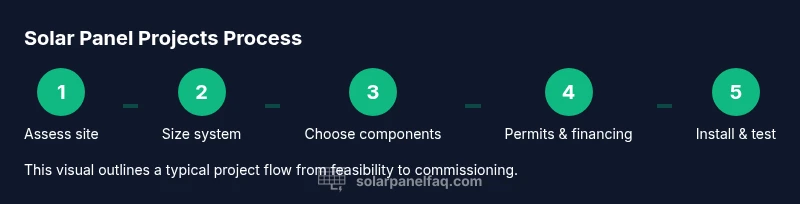
- 1
Assess site and load capacity
Evaluate roof orientation, shading, and structural support; check for constraints that would limit panel placement. Confirm local code requirements and obtaining approval from homeowners' association if applicable. Document findings to guide layout decisions.
Tip: Take clear photos of the roof and attic junctions to reference during planning. - 2
Estimate system size and energy goals
Review your current energy usage and outline a target production range aligned with your budget and comfort goals. Consider potential future needs like an electric vehicle or additional appliances. Use a simple worksheet to capture roof area, panel counts, and inverter requirements.
Tip: Use a rough calculation based on daily energy use and expected sun hours to sanity-check the plan. - 3
Select panel types and inverters
Compare panel efficiency, durability, and warranties. Decide between monocrystalline and polycrystalline panels, and between string vs microinverters based on shading patterns and maintenance preference. Verify warranty terms and service networks.
Tip: Prioritize long warranties and after-sale support to protect your investment. - 4
Plan mounting layout and wiring route
Draft a layout showing panel orientation, tilt, and rack placement. Plan the wiring path from the panels to the inverter and service panel, aiming to minimize distance and wiring complexity. Check for ventilation to avoid overheating.
Tip: Minimize penetrations and preserve roof integrity; plan for water seals around enclosures. - 5
Secure permits and financing
Consult local authorities for required permits and inspections. Compare financing options and gather quotes that include warranties and maintenance terms. Make sure to document incentive eligibility and application deadlines.
Tip: Collect all quotes and terms in one accessible file for easy comparison. - 6
Install and connect safely
Install mounting rails, attach panels, and connect wiring using proper disconnects. If wiring is unfamiliar, hire a licensed electrician and schedule inspections as required. Always follow manufacturer instructions and safety guidelines.
Tip: Never work on live circuits; shut off main DC and AC disconnects before wiring. - 7
Commission, test, and monitor
Inspect all connections, test continuity, and set up monitoring to track production. Compare actual output with expectations and document any deviations. Schedule follow-up checks to ensure sustained performance.
Tip: Record initial readings and maintain a maintenance log for future reference.
Frequently Asked Questions
What qualifies as a solar panel project for a homeowner?
A homeowner solar panel project covers planning, sizing, permitting, installation, and ongoing maintenance for a residence. It can involve a DIY component for non-electrical tasks or a full professional installation for electrical work. Always align the project with local codes and warranties.
A homeowner solar panel project includes planning, installing, and maintaining solar panels on a home, while following local codes and warranties.
Do I need permits for solar panel projects?
Most locations require electrical and structural permits for solar projects, plus inspections after installation. Check with your city or county early to understand forms, fees, and timelines.
Yes, permits are usually required and inspections may follow installation; check with your local authority.
Should I DIY or hire a professional for installation?
DIY work can handle mounting and non-electrical tasks, but electrical connections should typically be done by a licensed professional to ensure safety and code compliance. Weigh the risks, costs, and warranties before deciding.
Consider hiring a licensed pro for electrical work to ensure safety and code compliance.
How do incentives affect solar panel projects?
Incentives and rebates reduce upfront costs and can improve payback, but eligibility varies by location and program term. Gather details from local programs and installers.
Incentives reduce upfront costs, but eligibility varies by place and program terms.
How long do solar panels last?
Solar panels are designed for long life with ongoing maintenance. Expect performance to gradually decline over many years, which is normal and accounted for in most warranties.
Panels are built to last many years, with gradual performance decline expected over time.
What maintenance is required after installation?
Regular cleaning, inspection of mounting hardware, and monitoring of production help maintain efficiency. Schedule periodic checks and address any issues promptly to preserve warranty terms.
Keep panels clean, inspect hardware, and monitor output regularly.
Can I add storage later to a solar project?
Storage addition is possible but depends on the existing system design and inverter compatibility. Plan for future expansion in the initial layout when possible.
Storage can be added later if the system supports it, but plan for compatibility from the start.
Is DIY installation recommended for beginners?
Beginners can handle non-electrical steps, but electrical wiring and grid connection typically require professional expertise. Prioritize safety and local code compliance above all.
DIY is generally not recommended for electrical work; safety and codes come first.
Watch Video
Top Takeaways
- Assess roof condition and shading early
- Size the system to energy goals, not just budget
- Choose reliable panels and inverters with solid warranties
- Secure permits and understand financing options
- Maintain a regular cleaning and monitoring routine