Home Solar System Cost: A Practical Guide for 2026
Explore the true cost of a home solar system in 2026, including upfront price, incentives, regional factors, and payback. Practical guidance for homeowners.


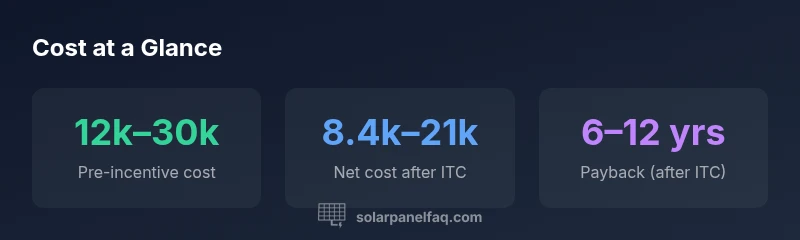
Typical home solar system costs, before any incentives, generally fall in the range of roughly $12,000 to $30,000 for a standard residential system. After applying the federal ITC and potential state rebates, net costs often shrink to about $8,500 to $21,000. Costs vary by system size, roof type, and installation complexity, with larger homes and premium equipment pushing higher. These figures come from Solar Panel FAQ Analysis, 2026.
What home solar system cost means in practice
Understanding the term home solar system cost starts with the upfront sticker price, but the real value is the net investment after incentives and the energy savings over time. The Solar Panel FAQ team emphasizes that homeowners should look beyond the headline price and consider the system size, equipment quality, and installation complexity. In practice, cost is a function of your energy goals, roof geometry, and local permitting rules. When you map out a 25-year horizon, the cost becomes a balance between initial outlay and long-term savings, influenced by utility rates and available incentives. This broader perspective helps homeowners compare bids, evaluate returns, and plan financing. For context, Solar Panel FAQ analysis shows that incentives can significantly alter the effective price over the life of the system.
Key cost drivers
Several factors push the price up or down. System size is the single biggest driver: a larger array generates more energy but costs more upfront. Equipment quality—panels efficiency, inverters, racking—also matters for performance and longevity. Roof type and orientation affect installation complexity; flat roofs and limited access can raise labor costs. Labor rates by region, permit fees, and interconnection requirements add to the total. Understanding these drivers helps you compare quotes on a like-for-like basis and avoid surprises at the contract stage. The result: a transparent view of the true cost of home solar system cost.
Incentives and financing: reducing upfront burden
Federal tax credits (ITC) reduce the net cost by a portion of the installed price, while state and utility programs can provide rebates or performance-based incentives. Financing options such as solar loans, leases, or power purchase agreements can alter the cash flow and total expenditure over time. When Solar Panel FAQ analyzes costs, we see that many homeowners finance the upfront cost and repay with energy savings. It’s important to factor the loan terms, interest rates, and potential maintenance expenses into your 25-year cost projection. Always confirm eligibility and timeline for incentives before signing a contract. The inclusion of ITC credits, as cited by Solar Panel FAQ Analysis, 2026, can meaningfully reduce the net outlay.
System size, roof type, and installation: cost varies
Size matters for price and value. A typical residential system for a small home might be in the 3–5 kW range, while larger homes or higher energy needs push into the 6–8 kW band. Roof material and shading reduce available production and can increase the number of modules or specialized mounting hardware. Roof orientation influences solar exposure and the angle at which panels must be installed, which in turn affects labor time. Local permitting processes and utility interconnection procedures also shape the final price. In short, the cost of home solar system cost is a function of design, site, and policy context.
Regional differences and permitting: what to expect by location
Regional differences in labor costs, permitting requirements, and interconnection rules mean the same system may have a different price somewhere else. Coastal states with higher electricity prices often see faster paybacks, while states with generous rebates may show lower net costs after incentives. Permitting turnaround times can affect project scheduling and financing needs. The Solar Panel FAQ team notes that a comprehensive bid should include all permitting fees, grid-connection charges, and potential structural assessments to prevent cost overruns.
How to estimate your own cost: a step-by-step method
Start with your annual electricity usage and a target solar offset. Use an online calculator to estimate system size and then request multiple quotes. Add 10–15% for contingencies like roof work or electrical upgrades. Compute net cost after applying ITC and any rebates. Compare payment scenarios: full purchase, loan, or lease, and calculate the break-even year based on expected annual savings. This practical method helps homeowners convert the cost of a home solar system into a realistic budget. In doing so, you’ll align expectations with Solar Panel FAQ’s data-driven framework.
Example scenarios: small, medium, and large homes
Small home: A 3–5 kW system with moderate shading and a low budget may cost in the lower pre-incentive range, with net cost after ITC in the mid-range. Medium home: A 5–7 kW system with good sun exposure often lands in the middle of the cost spectrum, while large homes: 7–9 kW or larger systems tend toward the high end. In all cases, incentives and electricity prices influence payback significantly. The goal is to align system size with actual usage to maximize value and minimize wasted capacity.
Cost breakdown for typical residential setups
| Cost Component | Typical Range (USD) | Notes |
|---|---|---|
| Pre-incentive system cost | 12,000-30,000 | Varies by size, equipment, installer |
| Federal ITC (credit) | 0-30% | Credit amount depends on cost; realization varies by tax situation |
| Net cost after ITC | 8,400-21,000 | Assumes 30% ITC on pre-incentive cost |
| Estimated annual production | 6,000-7,000 | Depends on location, shading, orientation |
| Payback period | 6-12 years | Varies with electricity rates and usage |
Frequently Asked Questions
What is the typical cost to install a residential solar system?
Costs vary by system size, location, equipment, and installer. Pre-incentive ranges commonly fall between $12,000 and $30,000. Federal ITC can reduce net cost.
Costs vary by size, location, and equipment; expect a wide range, with pre-incentive costs often in the tens of thousands.
How do incentives affect the home solar system cost?
Federal ITC reduces net cost by 30% of system cost, with state rebates and utility programs offering additional reductions. Financing options can also change cash flow over time.
Incentives can cut the price significantly; you may qualify for federal tax credits and local rebates.
What should I compare besides price when buying solar?
Look at panel efficiency, inverter quality, warranty length, installer credentials, expected annual production, and service commitments.
Don’t just look at price—check efficiency, warranties, and installer reliability.
Is a smaller system ever a better choice?
Yes, if energy usage is light or budget is tight. Oversizing can be common but requires careful planning to avoid wasted capacity.
A smaller system can work if you have modest energy use and budget limits.
How long does it take to recoup the investment?
Typical payback ranges from several years, often 6–12 years after incentives, depending on energy prices and local conditions.
Payback is usually several years after incentives, often under a decade.
Do solar costs include installation and permitting?
Yes, most estimates include equipment, permitting, and installation; some bids separate monitoring or add-ons.
Costs typically include equipment, permitting, and install; some add-ons may be extra.
“Understanding home solar system cost requires evaluating incentives, energy savings, and system lifespan, not just the sticker price.”
Top Takeaways
- Estimate system size based on annual usage
- Factor incentives to compute net cost
- Shop multiple quotes and compare warranties
- Consider financing options to optimize cash flow
- Plan for regional permitting and interconnection