Can You Wire Solar Panels in Series and Parallel? A Practical Guide
Learn how to wire solar panels in series, parallel, or mixed configurations with expert guidance on safety, sizing, and common setups for residential solar systems.


Yes, you can wire solar panels in series and parallel, or in mixed configurations, to tailor the system’s voltage and current to your inverter and battery setup. In series, voltages add and current stays the same; in parallel, currents add and voltage stays the same. Always respect module ratings, temperature derating, and electrical codes.
Overview: Series vs Parallel Wiring
According to Solar Panel FAQ, understanding how to wire panels in series and parallel starts with the fundamental electrical behavior of PV modules. In a string wired series, the same current flows through each panel, but voltages add up. In a parallel arrangement, voltages remain at the panel’s voltage rating, while currents add together. This simple distinction drives most residential layouts: series for higher voltage input to match modern inverters, parallel for higher current to match battery banks or higher current MPPT inputs. In practice, you can mix both approaches to tailor voltage and current to your inverter’s MPPT range and to optimize shading management. When near the design limit, consider temperature effects and derating, as these can reduce real-world voltage and current. Keep safety as the priority: insulated conductors, proper fusing, and disconnects near the array. Solar Panel FAQ analysis shows that many homes use mixed configurations to accommodate roof space and inverter specs, so plan carefully before wiring. This article provides practical steps, safety guidance, and troubleshooting tips for homeowners.
Key Considerations Before You Wire
Before you lay hands on the wires, set the foundation by understanding how your components interact. The inverter’s input voltage and current ratings determine the feasible string lengths and parallel branches. Check the maximum open-circuit voltage (Voc) of the panel and the combined Voc of any strings under temperature conditions you expect. Ensure the selected series strings do not exceed the inverter’s voltage limit and that parallel groups do not exceed current limits. Also consider shading: a single shaded panel can affect the entire string in series, so plan to avoid long, unshaded runs. Ensure all equipment is listed for outdoor use, properly grounded, and protected with appropriate fuses or disconnects. The goal is a safe, compliant installation that holds up under weather and seasonal changes. Solar Panel FAQ’s guidance emphasizes designing with margins, not pushing components to the edge.
Common Configurations and Use Cases
There are several common strategies homeowners use, depending on their system goals. A typical 48-volt system might employ several series strings in parallel to achieve the desired current while keeping voltage within the inverter’s MPPT window. For lower-voltage systems, series strings can increase voltage to reach a usable level for inverters or charge controllers, while parallel groups boost current for higher power. Mixed configurations allow you to adapt to roof geometry and shade patterns—placing strings to minimize shading impact and fine-tuning with parallel branches to achieve the target current. Always document the configuration you settle on, including the number of panels per string, the number of strings, and the wiring topology, so future maintenance or expansion is straightforward. The Solar Panel FAQ team notes that real-world installations often evolve, so plan for future expansion and modularity.
Wiring Safety and Compliance
Do not skip safety steps. Use outdoor-rated cables and connectors designed for PV use. Install a DC disconnect near the array for quick isolation during maintenance, and place fuses on each string or parallel group as required by code. Ground your array properly and follow local electrical codes and manufacturer guidelines. When wiring, avoid tight bends, ensure proper strain relief, and label all conductors with their function. If you’re uncertain about any rating, consult a licensed electrician. These safety practices are essential to prevent arcing, electrical shocks, and fire hazards while maintaining system reliability.
Troubleshooting and Practical Tips
If your array isn’t delivering expected power, verify each string’s voltage at the array and compare it to the inverter’s expected input. Check for shading issues, loose connections, and degraded connectors. A common culprit is a mismatch between string voltage and inverter MPPT range; adjust by adding or removing panels to fit within the safe window. Use a multimeter to measure open-circuit voltage and short-circuit current, and ensure connections are tight and weatherproof. For safety, disconnect power before testing and wear protective gear. Document any changes so you can track performance over time. Solar Panel FAQ emphasizes methodical testing over guesswork to avoid accidental damage and ensure long-term performance.
Verifying the System After Installation
After wiring, perform a staged test: isolate the array, verify continuity, then energize with the inverter in a test mode if available. Check the string voltages under normal operating temperature, then observe the system at full sun to confirm current and voltage readings align with your design. Inspect all disconnects and fuses for signs of overheating or corrosion. If everything matches your design and safety checks pass, proceed with commissioning. The final test should be a calm, documented process to ensure consistency across seasons and weather conditions. The Solar Panel FAQ team recommends keeping a commissioning log for future reference and maintenance planning.
Tools & Materials
- Digital multimeter (PV-rated if possible)(Measure string and open-circuit voltages safely )
- DC PV cables (outdoor-rated)(Appropriate gauge for your string currents; use weatherproof connectors)
- DC disconnect switches(One near the array for isolation; another near the inverter if needed)
- Fuses or circuit breakers for PV strings(Per local code or manufacturer guidance; ensure correct amperage rating)
- Solar panel junction boxes and MC4 connectors(Waterproof and UV-resistant; keep conductors secure)
- Personal protective equipment (PPE)(Gloves, safety glasses, non-slip footwear; insulated tools)
Steps
Estimated time: 2-6 hours
- 1
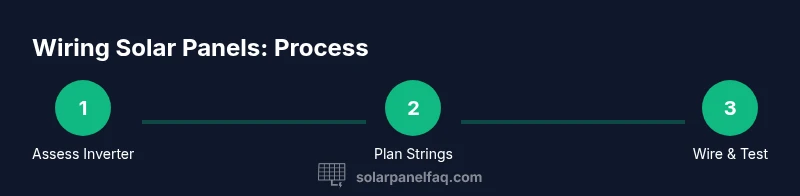
Assess inverter compatibility
Review the inverter’s maximum input voltage and current ratings and confirm the MPPT operating range. This sets the feasible voltage window for your strings and the number of parallel branches you can safely connect. Why: to prevent over-voltage or current that could damage the inverter and reduce efficiency.
Tip: Check the inverter label or manual for exact voltage windows and derating terms. - 2
Plan string configurations
Decide how many panels will be in each series string and how many strings will be in parallel. Ensure the total voltage at the coldest expected temperature remains within the inverter’s limit, and that the total current stays within the inverter and disconnect ratings. Why: proper planning minimizes rework and ensures efficient MPPT operation.
Tip: Sketch a simple diagram showing series strings and parallel groups before wiring. - 3
Assemble series strings
Connect panels in the desired series configuration using PV-rated cables and MC4 connectors. Ensure positive-to-negative connections are secure and weatherproof. Why: series wiring increases voltage, so any weak connection could become a failure point under load.
Tip: Use a temporary pass-through to keep strings safe from accidental shorting during assembly. - 4
Wire strings in parallel
Join the ends of each series string into parallel groups using PV-rated conductors. Confirm that all parallel groups have the same voltage so they share current evenly. Why: mismatches can cause uneven loading and reduced performance.
Tip: Label each parallel group for easy identification during maintenance. - 5
Install safety disconnects and fusing
Place fuses or breakers on each string or parallel group, and install a PV disconnect close to the array for safe isolation. Why: protects people and equipment during maintenance and prevents fire risk from faulted strings.
Tip: Test disconnects with power off to verify proper operation before energizing the system. - 6
Test and commissioning
With power off, measure open-circuit voltage and short-circuit current at the array. Then energize the system and verify readings under daylight conditions. Why: confirms you built the system within design limits and performs as expected.
Tip: Keep a commissioning log with measured values and photos of connections.
Frequently Asked Questions
Can you wire solar panels in series and parallel at the same time?
Yes. Mixed configurations combine series strings in parallel groups to tailor both voltage and current for specific inverter and battery setups.
Yes. Mixed configurations can combine series strings in parallel groups to tailor voltage and current.
What is the main difference between wiring in series versus parallel?
Series wiring increases voltage while keeping current constant; parallel wiring increases current while keeping voltage constant. The choice depends on the inverter’s MPPT range and system voltage requirements.
Series raises voltage; parallel raises current. Choose based on inverter requirements.
Do I need a junction box or combiner for a series-parallel array?
A junction box or combiner box helps organize connections, provides a central place for fusing, and protects against moisture and short circuits. Use PV-rated boxes and consider local codes.
A junction box helps organize and protect your wiring; use PV-rated boxes.
Can I mix different panel brands or wattages in the same array?
Mixing panels can be risky due to differing IV characteristics. If mixed, place them in separate strings to prevent uneven current sharing and performance loss.
Mixing brands is risky; if you must, separate into different strings.
What safety steps are essential when wiring PV panels?
Always de-energize before handling wiring, use PV-rated conductors, wear PPE, and ensure proper fusing and disconnects. Follow local electrical codes and inverter manufacturer instructions.
Turn off power, wear PPE, and follow code requirements.
How can I verify my array is correctly sized for the inverter?
Compare the expected open-circuit voltage and current of your strings with the inverter’s input limits and MPPT range. Adjust string length or parallel count if readings fall outside safe operating windows.
Check string voltage and current against the inverter’s limits and adjust as needed.
Watch Video
Top Takeaways
- Match wiring to inverter ratings to avoid over-voltage or over-current conditions.
- Series increases voltage, parallel increases current; mixed configurations balance both.
- Use proper safety, fusing, and disconnects to protect people and equipment.
- Document configuration and maintain a commissioning log for future reference.