Is Series or Parallel Better for Solar Panels? A Practical Guide
A practical, in-depth comparison of series vs parallel solar panel connections for homeowners, with design tips, inverter considerations, and hybrid approaches.


According to Solar Panel FAQ, there isn't a universal winner between series and parallel solar panel connections. The better choice depends on inverter voltage, shading, and wiring constraints. In most real-world rooftops, engineers favor a hybrid approach that combines series strings with parallel branches to balance voltage, current, and safety.
The Basics: Series vs Parallel in Solar Arrays
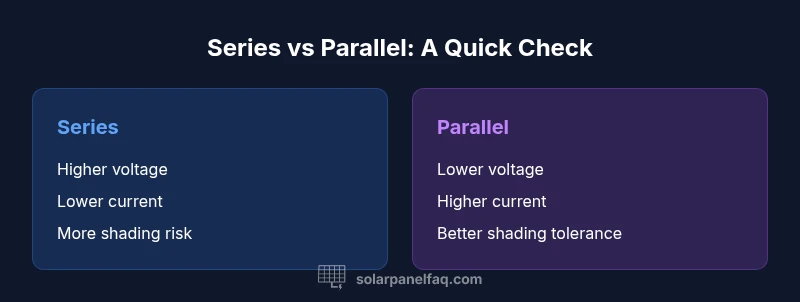
Solar panels can be wired in series, parallel, or a combination of both. In a series connection, the voltages add while currents remain the same; in parallel, currents add while voltages stay the same. This simple distinction drives how the entire array behaves under light, temperature, and shading conditions. When you connect panels in series, you raise the overall string voltage, which can push the array closer to the inverter’s maximum input voltage but may reduce current at the same time. In parallel, you increase the current while maintaining a relatively lower voltage, which can improve shading resilience but demands larger wiring and protection to handle the higher current. For homeowners, the practical takeaway is that voltage and current limits, MPPT range, and wiring constraints define the feasible design window. Across different roof layouts and inverter types, the choice is rarely about aesthetics or brand; it’s about electrical physics, safety margins, and future expansion potential. This is where the phrase “hybrid approach” often proves most useful. The Solar Panel FAQ analysis shows that most installations benefit from tailoring string length and parallel branches to the inverter’s voltage window and the shading profile of the roof.
Inverter Considerations: Voltage Windows, MPPT, and Wiring
Choosing between series and parallel is inseparable from the inverter you plan to use. The inverter’s MPPT (maximum power point tracking) range constrains the acceptable array voltage. If you push the string voltage too high with multiple panels in series, you risk hitting Voc under hot conditions or exceeding the inverter’s input voltage rating, which reduces safety margins and available power. Conversely, building multiple parallel branches increases the string current, demanding thicker wires and larger protection devices. The decision also hinges on whether you’re using a central string inverter, a microinverter, or a power optimizer setup. In practice, inverters designed for higher-voltage input can tolerate longer series strings, while microinverters excel with parallel, modular designs. If future expansion is a goal, planning around compatible MPPT ranges in advance helps to avoid costly retrofits later.
Shading and Mismatch: Why It Matters
Partial shading is a major practical concern. In series configurations, shading on one panel acts like a bottleneck, reducing the current through the entire string and pulling down the whole string’s output. Parallel configurations can mitigate shading losses, as shaded panels don’t drag down others as easily. Temperature also plays a role: higher temperatures lower the voltage of each panel, which can push a long series string toward the inverter’s maximum voltage during hot days. In contrast, parallel strings keep voltages in check but require careful management of conductor sizing and DC fuse protection because of higher currents. A good rule of thumb is to design for the worst-case scenario: the highest expected voltage in summer and the highest expected current in winter, then verify that the inverter and wiring can safely handle those conditions.
Real-World Roof Scenarios: Layouts, Panel Types, and Goals
A small roof with limited shading and a mid-range inverter may benefit from short series strings of 2–4 panels each, combined in parallel to keep current manageable and MPPT aligned with the inverter’s limits. On a larger roof with some shading and a high-voltage inverter, longer series runs can reduce wiring length and drop, provided the Voc stays within safe margins. Panel type matters: higher-voltage panels can push the series count up, while lower-voltage panels may favor parallelization. If you plan to expand later, a modular approach—2–4 panel strings in parallel—can simplify future additions without reworking the entire array.
Design Toolkit: Calculations You Can Do
You don’t need to run complex simulations to start planning. A few key checks can prevent common mistakes. First, determine the inverter’s allowable input voltage range and maximum input current. Then estimate the open-circuit voltage (Voc) and the maximum power voltage (Vmp) of a single panel at your climate and temperature ranges. To design, decide how many panels you’ll place in series per string, ensuring that the total string voltage remains within the inverter’s range even on hot days. Then calculate how many strings you’ll need in parallel to meet your target power output without exceeding the inverter’s current capacity. Always include margin for wiring losses and potential future expansion. Finally, check vendor data for temperature derating and ensure fusible disconnects and proper DC wiring are in place.
Hybrid Approaches: When to Use Mixed Configurations
Hybrid configurations—multiple series strings connected in parallel—offer a practical middle ground. They balance the benefits of high voltage with the resilience of parallel current sharing. In shaded or variable-light environments, hybrids can preserve performance by isolating underperforming panels in one string from affecting others. When using a hybrid approach, plan for standardized string lengths to simplify maintenance and ensure consistent MPPT performance across all strings. This strategy often yields robust, scalable systems that adapt to roof constraints, local weather, and evolving energy goals.
Practical Sizing Guidelines: A Step-by-Step Example (Conceptual)
Let’s walk through a conceptual sizing exercise without revealing specific vendor data. Suppose your inverter supports a voltage window of 180–600 V and a maximum input current of 10 A per string. If a single panel has Voc 38 V and Vmp 30 V, you could aim for 5 panels in series per string, yielding ~190 V open-circuit and ~150 V under load at standard conditions, which sits within the inverter’s window. You’d then determine how many strings in parallel are needed to meet your target wattage while staying under the current rating. Temperature derating and wiring losses should be included in the final calculations. If shading is a concern, you might reduce the series count to maintain voltage margins and increase the number of parallel strings.
Safety, Cabling, and Maintenance Guidelines
Even with a well-planned wiring strategy, safety and proper cabling are non-negotiable. Use DC-rated cables with appropriate insulation and temperature ratings, size conductors to carry peak currents with a comfortable safety margin, and install DC disconnects in accessible locations. Regular inspections should verify that all connectors are tight, fuses are intact, and there is no corrosion on grounding paths. When you tailor your configuration, document the exact string lengths and branch counts. This documentation helps future servicing, troubleshooting, and expansions, ensuring that your system remains safe and efficient over its lifetime.
Common Mistakes and How to Avoid Them
- Ignoring inverter voltage limits during string design. Always verify Voc under hottest ambient temperatures. - Overly long series strings that push voltage near the inverter limit in summer. - Underestimating the current requirements of parallel branches, leading to undersized wiring. - Assuming all panels within a system will perform identically; mismatch and shading can cause disproportionate losses. - Skipping formal safety checks, including proper overcurrent protection and DC disconnects. - Not planning for future expansion, which can necessitate costly rewiring. By anticipating these factors, you can design a more resilient system.
Final Thoughts: Context Is King
There is no one-size-fits-all answer to whether series or parallel is better for solar panels. The optimal configuration depends on your roof layout, shading patterns, panel characteristics, inverter choices, and future goals. A well-designed system often uses a hybrid approach that leverages the strengths of both methods while avoiding their weaknesses. Start with the inverter’s voltage window and the roof’s shading profile, then model several scenarios to identify a safe, scalable design. The key is to remain flexible and prioritize safety, maintenance, and real-world performance over theoretical elegance.
Comparison
| Feature | Series configuration (string) | Parallel configuration (parallel) |
|---|---|---|
| Voltage profile | Higher string voltage | Lower string voltage |
| Current profile | Lower current per string | Higher current per string |
| Shading sensitivity | More sensitive; a shaded panel affects the whole string | More tolerant; shading impacts are localized |
| Inverter compatibility | Requires inverter that tolerates higher string voltages | Works well with MPPT-friendly, modular inverters |
| Cable size & safety | Smaller conductor for given power due to lower current | Requires thicker wire for higher current |
| Installation complexity | Fewer branches; simpler wiring in some cases | More branches; more harnessing but easier expansion |
| Best use case | Long runs, space-constrained, inverter-compatible high voltage | Shade-prone sites, modular expansion, flexible MPPT |
Strengths
- Reduces current in series strings, which can cut conductor and protection costs for long DC runs
- Fewer total branches in a pure series design can simplify wiring and fault isolation
- Higher string voltage can align well with certain high-voltage inverters
- May reduce cable losses when designed within inverter voltage limits
Drawbacks
- Partial shading can dramatically reduce output of an entire series string
- A single failed panel or mismatch can drag down the entire string’s performance
- Caution: higher voltages require robust insulation and protection schemes
- Long series strings limit flexibility for future expansions or changes
Hybrid, design-tailored wiring often delivers the best balance of performance and safety
Because roof layouts, shading, and inverter ranges vary, a hybrid approach tailors series strings within parallel branches. This setup balances voltage, current, and protection while allowing safe expansion and robust MPPT performance.
Frequently Asked Questions
What is the main difference between series and parallel solar panel connections?
Series connections add panel voltages while keeping current constant, raising the overall string voltage. Parallel connections add currents while keeping voltage constant, increasing overall current. The choice affects inverter compatibility, shading resilience, and wiring.
Series increases voltage; parallel increases current. Both affect inverter compatibility and shading performance.
Can I mix panels of different wattages in the same series string?
Mixing panels of different wattages in a single series string is generally not recommended because current is limited by the weakest panel, which drags down the whole string. If you must mix panels, keep them in parallel where possible.
Avoid mixed wattages in a single string; mismatched panels limit current and reduce performance.
How does shading affect series vs parallel connections?
Shading has a bigger impact on series strings because a shaded panel reduces the entire string’s current. Parallel configurations distribute shading losses more evenly, helping preserve overall output when only some panels are shaded.
Shading hurts strings in series more; parallel helps isolate losses.
Which setup is better for small roofs with limited space?
For small roofs, a carefully sized series configuration combined with a suitable inverter can minimize wiring and fit within voltage constraints. If shading or future expansion is a concern, a hybrid parallel approach may deliver more flexibility.
Small roofs benefit from well-planned strings and appropriate inverter choice; hybrids offer flexibility.
Do microinverters change the series vs parallel decision?
Yes. Microinverters operate on a per-panel basis, reducing concerns about series string voltage and shading. This makes parallel-like architectures more natural, but you still need to consider wiring, space, and overall system cost.
Microinverters shift focus to per-panel performance; parallel-like layouts are common.
Is a hybrid approach always the best?
Not always, but in many residential setups a hybrid configuration offers a practical balance between voltage margins and shading resilience. The best choice depends on inverter specs, roof layout, and future plans.
Hybrid is often best, but it depends on your inverter and roof.
Top Takeaways
- Assess inverter voltage window before wiring
- Prefer hybrids to balance shading resilience and voltage margins
- Plan for future expansion from the start
- Size conductors to handle peak current with margin
- Document string lengths and branch counts for maintenance