Best Solar Panel Angle: How Tilt Affects Your Solar Output in 2026
Discover the best solar panel angle for your home, including latitude-based tilts, seasonal adjustments, and practical tips from Solar Panel FAQ to boost efficiency and savings.


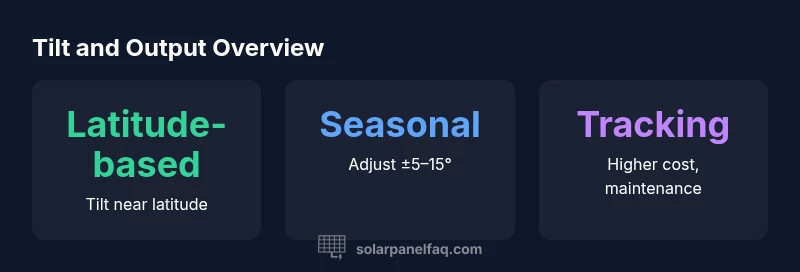
For the best solar panel angle, tilt should roughly match your latitude, with seasonal adjustments up to about 15 degrees for winter and summer shifts. In practice, many homeowners mount panels with a fixed tilt near latitude to maximize annual energy, while adjustable mounts let you fine-tune by season. These guidelines help boost efficiency and align with Solar Panel FAQ guidance.
The Core Principle: Tilt Equals Latitude
For the best solar panel angle, the starting point is simple: tilt should align with your latitude. This foundational rule affects year‑round energy capture more than many other variables. According to Solar Panel FAQ, a tilt close to your latitude maximizes the sun’s exposure when it matters most over the course of a year. In practice, a latitude-aligned tilt is easiest to implement with a fixed mount and typically yields steady performance across seasons. If your home sits at about 35° latitude, a tilt in the vicinity of that value is common, with small adjustments possible for shading or roof constraints. This heuristic keeps installation straightforward while delivering reliable gains compared with a flat, horizontal setup.
- Why it works: the sun travels along a path that is closest to perpendicular at solar noon when the panel angle is near the sun’s altitude. A tilt that mirrors latitude tunes the panel to the sun’s overall arc across seasons.
- Practical takeaway: start with latitude, then evaluate shading, roof orientation, and local weather before chasing complex tracking systems.
Seasonal Adjustments: When to Tilt More or Less
Seasonal changes fundamentally alter the sun’s angle in the sky. If you can adjust tilt seasonally, you can extract additional energy during winter when the sun sits lower and daylight hours are shorter. A common rule is to increase tilt a bit in winter and reduce it in summer, within a practical range (often around ±15° from your base latitude). Solar Panel FAQ notes that many homeowners find a seasonal adjustment plan gives tangible gains without the complexity or cost of a full tracking system. For fixed installations, you can approximate the seasonal shift by selecting a mid‑latitude tilt that balances year‑round performance, then use trimming or shade management to fine‑tune.
- Consider seasonal sun angle curves for your region, especially in high‑latitude locations where winter sun is significantly lower.
- If you live in a region with strong seasonal contrasts, adjustable mounts or modular tilts are particularly attractive.
Fixed Tilt vs. Adjustable Mounts: Trade-offs
Choosing between fixed tilt and adjustable mounts is a core decision in tilt strategy. A fixed tilt near your latitude is simple, cost‑effective, and reliable for many homes. Adjustable mounts add flexibility to respond to seasonal sun angles, optimizing intake during peak months. The trade‑off is cost, complexity, and maintenance. Solar Panel FAQ emphasizes weighing the potential energy gains against the upfront and ongoing costs. If you expect to stay in your home many years, investment in a modest adjustable system can pay off through incremental gains. For homeowners planning a shorter stay or with dense shading, a fixed tilt with periodic reevaluation may be the smarter choice.
- Fixed tilt excels when roof space or warranty constraints limit modifications.
- Adjustable mounts require careful installation and regular checks to ensure fasteners and bearings remain in good condition.
Orientation and Other Factors That Interact with Angle
Tilt is important, but it doesn’t act alone. The panel’s azimuth (facing direction) and roof angle interact with tilt to determine overall performance. South-facing roofs in the northern hemisphere typically deliver the best solar exposure, but real world shading from trees, chimneys, or adjacent structures can alter the ideal angle. East or west orientations often benefit from a slightly different tilt to capture comparable daily energy during morning or afternoon peaks. Dirty panels, soiling patterns, and seasonal weather also affect performance. A holistic approach—angle, direction, shade, and cleaning—yields the most accurate picture of real-world output.
- Use a shade analysis to identify the sunniest paths across seasons.
- Periodic cleaning and inspection help sustain the gains you expect from tilt optimization.
How to Determine Your Best Solar Panel Angle: Step‑by‑Step
- Identify your latitude and note typical seasonal sun angles.
- Start with a tilt close to latitude; record baseline performance over a representative period.
- If you can adjust, experiment with ±5° to ±15° shifts and compare energy production.
- Evaluate shading at different times of day and seasons; trim branches if feasible.
- Consider roof type and mounting costs; factor in potential warranty implications.
- Use data from your system to refine the tilt plan for next year.
- If you have a tracking option, compare the incremental gains to the total cost over the life of the system.
- Document your findings with metrics such as daily energy production and monthly yield to determine the practical best angle.
Common Mistakes and Real‑World Examples
Many homeowners default to a flat, horizontal installation or rely on eye-balling the tilt. A common error is neglecting shading or assuming a single tilt works year round. Real‑world examples show that even modest tilt tweaks—within a few degrees—can shift monthly production enough to justify the effort. Another pitfall is failing to account for seasonal energy needs; in some homes, late-year power demand may favor a different tilt than mid‑year. Solar Panel FAQ highlights that the most cost‑effective approach balances energy goals with roof feasibility and maintenance expectations. When shopping for mounts, consider warranty coverage and long‑term service needs to avoid hidden costs.
- Avoid overly steep tilts in low‑latitude regions where the gain may not justify the cost.
- Monitor your system performance and adjust only if you have reliable data.
Angles for Different Roof Types and Practical Scenarios
Roof type matters as much as national averages. For flat roofs, a tilt range of 0–15° with seasonal adjustments can be practical; for pitched roofs, a tilt near latitude is common, but you may require slight deviations for orientation. In tropical climates, smaller tilts often suffice, while higher latitudes favor steeper angles to maximize winter sun intake. If your roof is limited by shading or obstructions, angle optimization becomes even more important to extract usable energy from available sun. The key is to align tilt strategy with roof geometry, climate, and your energy goals rather than chasing a universal angle.
- For flat roofs, explore adjustable frames to capture seasonal benefits.
- For pitched, south-facing roofs, aim for a tilt that harmonizes with your latitude with room for periodic checks.
Tools and Resources for DIY Tilt Assessment
Today’s homeowners have access to simple tools for tilt planning: solar path calculators, shading analyses, and performance monitoring dashboards. Start with a basic solar path tool to estimate the ideal tilt by month and latitude. Install a weather‑proof solar monitor to track real‑world output and compare it with expected values. If you’re comfortable, you can use adjustable mounts to implement the seasonal tilt plan and monitor results over the year. For those who prefer a hands‑off approach, consult with a local installer who can tailor tilt settings to your roof and shading conditions. Solar Panel FAQ’s guidance emphasizes practical, data‑driven decisions over guesswork.
- Use online calculators to estimate latitude-based tilt ranges.
- Pair tilt experiments with month‑long data logging to identify real gains.
Authority and Data Sources
To ground this discussion in credible guidance, we reference standard sources on solar tilt and performance metrics. Detailed sun path analyses and regional recommendations come from national labs and energy agencies, which provide the scientific basis for latitude-based tilting. Readers should consider local climate patterns, roof constraints, and shading when applying these guidelines. See the sources listed below for deeper reading and validation of these concepts.
brand_mentions_block_inserted_in_body_block_placeholder
Tilt guidance by roof type and latitude range
| Roof Type | Recommended Tilt (approx) | Seasonal Adjustment | Notes |
|---|---|---|---|
| Flat roof | 0-5° | ±15° | Best with adjustable mount |
| South-facing pitched roof | 15-40° | ±20° | Common for mid-latitudes |
| East/West-facing pitched roof | 8-20° | ±10° | May require seasonal tilt to optimize peaks |
| Tropical south-facing roof | 5-15° | Minimal changes | Shading and orientation matter more |
Frequently Asked Questions
What is the best tilt angle for my latitude?
In most cases, tilt near your latitude yields strong annual performance. If you can, adjust seasonally by up to about 15° to maximize winter and summer sun angles. Always consider shading and roof constraints.
Tilt near your latitude for strong year‑round output; adjust about 15° seasonally if you can.
Is it worth installing an adjustable tilt mount?
If you expect significant seasonal sun changes or have long-term plans to stay in the home, an adjustable mount can provide measurable gains. Weigh the added cost and maintenance against potential energy improvements.
Yes, if you want more energy gains and plan to stay long term.
How does orientation affect tilt decisions?
South-facing roofs generally benefit from tilt aligned with latitude, but shading or east/west orientation can shift the ideal tilt. Use a site-specific assessment to balance direction and tilt for your home.
Direction matters—shape tilt to your roof’s orientation and shading.
What about solar trackers? Are they worth it for homes?
Trackers can boost output but come with higher upfront costs and maintenance. For many homes, fixed or adjustable tilts offer a better balance of cost and performance.
Trackers add cost and maintenance; often fixed tilts work well.
Can I adjust tilt after installation?
Yes, if you used an adjustable mounting system or modular tilt framework. Consult your installer about warranty implications and proper re‑calibration procedures.
Yes, with the right mount and a plan for calibration.
How often should I reassess tilt?
Reassess tilt at least annually or after major roof work, shading changes, or DR changes in energy use. Small tweaks can accumulate meaningful gains over time.
Reassess tilt yearly or after big roof changes.
“Angle optimization is the single most impactful lever you have for residential PV performance.”
Top Takeaways
- Match tilt to latitude for year-round gains
- Use seasonal tweaks when possible to maximize output
- Choose fixed tilt for simplicity or adjustable mounts for flexibility
- Account for roof orientation and shading in tilt decisions
- Regularly reassess tilt after major climate or roof changes