Should Solar Panels Face South? Practical Guidance for Homeowners
Explore why south-facing orientation is often best for solar panels, how latitude and shading change results, and practical steps homeowners can take to maximize energy production.


Yes, for most homeowners in the Northern Hemisphere, solar panels should face south to maximize annual energy production. South-facing panels typically deliver the best balance of sun exposure and steady output across seasons. If your roof can’t face due south, a near-south orientation (slightly southeast or southwest) is acceptable, but tilt and shading will influence performance more than a minor directional shift.
Should solar panels face south? Why it matters
In many climates, facing solar panels toward the south optimizes the sun’s path from morning through afternoon. This direction helps capture the most sunlight over the year, especially in temperate regions where the sun tracks across the southern sky. The Solar Panel FAQ team highlights that orientation interacts with roof pitch, shading, and local latitude, so the ideal direction should account for practical constraints. Even when perfect due-south isn’t possible, a near-south orientation can still yield strong performance. Keeping a clear, unobstructed southern exposure is the easiest way to maximize energy production without installing specialized equipment.
This section establishes the core idea: south-facing orientation is typically the default starting point for planning, but it’s not a one-size-fits-all prescription. Every roof has unique limitations—chimneys, vents, trees, and neighboring structures all affect how much sun reaches the panels. Understanding these interactions helps homeowners set realistic expectations and choose mounting options that preserve southern exposure where feasible.
Latitude, sun path, and shading influence orientation choices
The sun’s arc changes with latitude, so the best azimuth and tilt aren’t identical from coast to coast. In practice, people in higher latitudes may benefit from a more pronounced tilt to capture low winter sun, while those nearer the equator might tolerate flatter angles with strong midday exposure. Shading from nearby trees, chimneys, or roof dormers can dramatically reduce output for any orientation. If a permanent south-facing roof is partially shaded in the afternoon, a slightly east-facing or west-facing layout can distribute shade-free exposure more evenly across the day. When evaluating orientation, consider both seasonal sun angles and daily shading patterns rather than focusing on a single moment in time.
Tilt, mounting, and roof types
Tilt angle matters almost as much as azimuth. A tilt near the latitude of your location generally provides strong year-round output, while fixed angles lower the risk of wind damage and simplify installation. Adjustable tilt mounts can optimize seasonal performance but add cost and complexity. Roof type and pitch influence mounting choices: flat roofs often accommodate easy tilt adjustments, while pitched roofs require racking that preserves structural integrity. For homes with complex roofs or limited southern exposure, ground-mounted systems offer the option to optimize azimuth and tilt independently of the roof line.
This section emphasizes that the combination of azimuth (direction) and tilt (angle) defines performance. Practical constraints, including roof geometry, wind loads, and local building codes, shape the final orientation strategy. A well-planned orientation respects safety and durability while maximizing sun capture over the system’s life.
Seasonal patterns and storage considerations
Seasonal changes affect how much energy a panel array produces. In winter, the sun sits lower in the sky, and a slightly steeper tilt can help gather more daylight hours. Conversely, in summer, a flatter tilt may maximize mid-day output. Energy storage strategies, such as batteries, interact with orientation by shaping when energy is captured and used. Even with a south-facing setup, real-world performance is influenced by climate, battery sizing, and consumption patterns. A holistic approach—combining orientation with tilt, shading management, and storage—helps homeowners optimize energy independence and reduce reliance on the grid.
Real-world planning: roof type, obstacles, and constraints
Before committing, map out roof obstructions: vents, skylights, and chimneys can cast shadows at key times. Neighboring structures, trees, and seasonal foliage may change exposure during the year. If your roof faces slightly off-south, you can still pursue strong performance with careful tilt selection and possibly a microinverter or power optimizer to mitigate string shading. Professionals should verify structural integrity for mounting hardware and assess wind zone requirements. This planning phase also includes checking local codes, HOA rules, and permits to ensure a smooth installation.
Practical steps to verify and optimize orientation
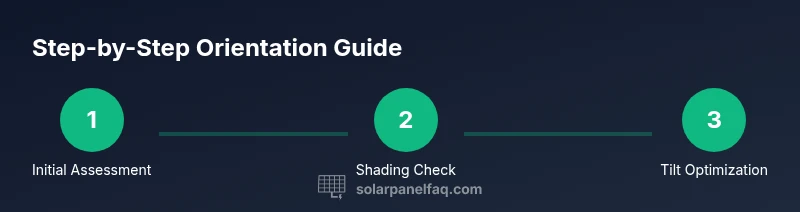
Start with a simple assessment of true south using a compass, then confirm with a sun-path visualization app for your location. Take photos and notes of potential shading throughout the day and across seasons. Compare several orientation and tilt scenarios using a reputable solar calculator or installer proposal. If feasible, consider a ground-mounted system or adjustable tilt mount to fine-tune performance. Finally, work with a licensed installer who can translate your site specifics into an optimized layout that preserves southern exposure where possible.
Tools & Materials
- Compass or smartphone compass app(To determine true south; account for magnetic declination for your location)
- Sun-path visualization tool or app(Visualize sun arc across seasons for accurate azimuth and tilt planning)
- Tape measure(For layout planning and mounting footprint on the roof)
- Ladder and fall protection gear(Use proper safety procedures; hire a pro for roof work if uncomfortable)
- Tilt meter or inclinometer (optional)(Helpful for fine-tuning tilt on-site)
- Shading analysis tool or app (optional)(Identify potential shade at different times of day and year)
- Mounting hardware and fasteners supplied by installer(Ensure compatibility with your roof type and local codes)
Steps
Estimated time: 3-6 hours
- 1
Assess current roof orientation
Identify the primary roof surface that could host panels and estimate its azimuth relative to true south using a compass. Document any interruptions like vents or dormers that limit coverage. This initial scan sets the baseline for further optimization.
Tip: Take multiple readings from different roof sections to find the best south-facing plane. - 2
Check shading throughout the day
Evaluate potential shading from trees, chimneys, or other structures at different times. Use a sun-path app or on-site observations to map worst-case shading windows to avoid peak production losses.
Tip: Visit during solstices if possible to capture extreme shading patterns. - 3
Measure roof tilt and surface suitability
Record roof pitch and assess whether a fixed or adjustable tilt would be most practical. Consider roof condition, accessibility, and mounting feasibility before choosing a tilt strategy.
Tip: A slightly steeper tilt can improve winter collection in many climates. - 4
Evaluate mounting options
Decide between roof-mounted and ground-mounted solutions. Each has pros and cons for access, shading, and tilt adjustability. Ensure mounting supports wind loads and code compliance.
Tip: Ground-mounted systems offer easier tilt adjustments and shading control. - 5
Run production simulations
Use a solar calculator or installer proposal to compare orientation scenarios (south, near-south, east/west) and tilt settings. Focus on annual yield rather than short-term fluctuations.
Tip: Ask for a breakdown by season to understand long-term performance. - 6
Plan installation with licensed professionals
Obtain multiple quotes and verify installer credentials. Confirm that proposed orientation and tilt align with site realities and warranty terms.
Tip: Never shortcut safety checks; roof work requires proper fall protection and permits. - 7
Verify post-install performance
After installation, monitor real-world output and compare against projections. Document any discrepancies and adjust tilt or layout if feasible.
Tip: Keep a production log for the first year to identify optimization opportunities.
Frequently Asked Questions
Do solar panels always need to face due south?
Not always. Due south is ideal in many locations, but if your roof limits orientation, near-south or slightly east/west can still deliver strong results, especially when combined with appropriate tilt and monitoring.
South is ideal in many places, but other directions can work if necessary.
What if my roof faces north in the Northern Hemisphere?
North-facing roofs are usually the least productive. Consider a different roof plane, a ground-mounted system, or high tilt with a professional assessment to maximize sun exposure.
North-facing roofs pose challenges; alternatives may be better.
Can I tilt panels differently than the roof angle?
Yes. Tilt can be adjusted with mounting hardware. A tilt near the latitude often yields the best annual production, while adjustable tilts offer seasonal optimization at added cost.
Tilt can be adjusted, and near-latitude tilt is usually best for yearly output.
How much does shading affect orientation choices?
Shading reduces output significantly regardless of orientation. Identify and mitigate shading from trees, vents, and nearby structures. Microinverters or optimizers can help minimize losses if shading can’t be avoided.
Shade is a major factor; address it if you want optimal performance.
Is south-facing always the best in every location?
Generally yes, but feasibility depends on location, roof, and obstructions. If south is not feasible, east or west with a suitable tilt can still provide strong results.
South is usually best, but feasible alternatives exist.
What role does latitude play in orientation?
Latitude shapes the optimum azimuth and tilt. Closer to the equator offers more flexibility, while higher latitudes benefit from a pronounced south-facing orientation and tailored tilt.
Latitude determines the best angle and direction for year-round performance.
Watch Video
Top Takeaways
- Aim for true south orientation when practical.
- Shading and tilt have major impact on output.
- Latitude guides the optimal tilt and azimuth.
- Professional install improves safety and accuracy.