What Will a 100 Watt Solar Panel Run? A Practical Home Guide
Discover what a 100W solar panel can power in real-world conditions, with load examples, planning tips, and storage options for homeowners.


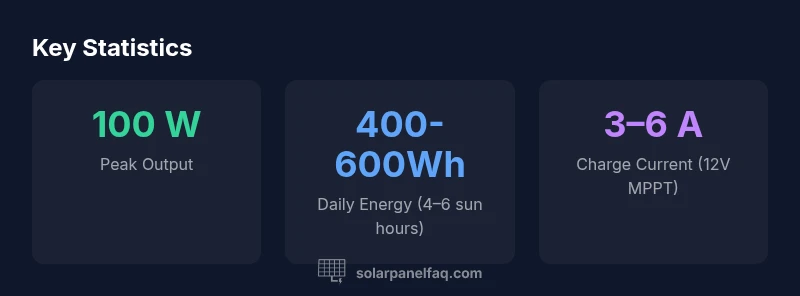
A 100-watt solar panel can power small, essential loads under ideal sun, such as smartphone chargers, laptops, LEDs, and some 12V accessories. In real-world conditions, expect roughly 60–100 watts of usable output when sun is strong, with a charging current of about 3–6 A into a typical 12V battery system, depending on the inverter/charger efficiency and battery state.
What a 100-watt panel can power in real-world conditions
In ideal sun, a 100-watt solar panel delivers about 100 watts of electrical power. But every installation has losses and variability. So what will a 100 watt solar panel run for a typical homeowner? The short answer is: you can power small, essential loads and charge batteries; smartphones, tablets, LED lighting, and other low-draw devices are realistic targets for daily use when paired with a battery and a suitable charge controller. Understanding sun hours, panel orientation, and system losses helps you plan more accurately. The actual usable energy depends on your location, time of year, and how efficiently your system converts sunlight into usable current.
Key factors that affect output
Output from a 100-watt panel is not fixed. Several variables drive real-world results:
- Sun hours: Regions with 4–6 peak sun hours per day will generate more energy than areas with fewer hours.
- Angle and orientation: Facing your panel toward the sun at the right tilt maximizes exposure.
- Temperature: Higher temperatures can reduce voltage and overall efficiency, especially for silicon panels.
- System losses: Inverters, cables, and connectors introduce losses that trim the effective power,
- Battery state: A charged battery limits the current because the controller reduces charge when the battery nears full. A healthy battery bank and a modern MPPT controller help recover some of these losses.
Understanding these factors helps homeowners estimate real-world performance and set realistic expectations.
Real-world use cases for a 100W panel
A 100W panel excels for small, portable power setups. Common use cases include:
- Charging smartphones, tablets, cameras, and other USB devices.
- Powering LED lighting for a cabin, RV, or shed.
- Running a low-energy 12V coolant fan, small vehicle accessories, or a compact water pump for garden arts.
- Providing intermittent power to a laptop or a mini router when paired with a storage battery.
These use cases assume a path to a storage battery and a charge controller. Without storage, you’ll experience shorter run times and depend on direct sun.
How to estimate load and plan with a 100W panel
To translate a list of devices into actionable planning, start by listing each device’s draw in watts and estimate how many hours you’ll need it each day. Sum the watt-hours (Wh) for all devices: Wh = watts × hours. Compare this to the panel’s daily energy potential, which is roughly 100 W × average sun hours. If you expect 4 hours of peak sun, that’s about 400 Wh per day. Add a battery and MPPT controller to store energy for intermittent use. If your daily load exceeds 400–600 Wh, consider adding another 100W panel or a larger storage system. Always factor in losses, which can reduce actual output by 10–30% depending on conditions.
Practical setups: single panel, storage, and load balancing
A typical setup includes a 100W panel, a charge controller (MPPT preferred), and a 12V deep-cycle battery. For higher reliability, pair two panels in series (or parallel, depending on voltage requirements) to increase voltage or current to the same battery bank. A small inverter allows AC devices to run, but efficiency drops as loads increase. Balance your loads to ensure the sum of your devices’ energy needs stays within the daily harvest of the panel-battery system, considering sun variability and seasonal changes.
Maintenance, safety, and maximizing efficiency
Keep panels clean and free from shade or debris. Inspect wiring and fuses regularly, and protect batteries from deep discharge. Use high-quality cables, weatherproof enclosures, and a properly sized battery bank to minimize losses. When possible, schedule charging during peak sun hours to maximize energy capture, and consider a backup plan (another panel or a larger storage system) for overcast days or extended cloudy periods.
Illustrative comparison of common loads and runtimes for a 100W solar panel under ideal sun conditions
| Load Type | Draw (W) | Estimated Runtime per Hour of Peak Output (hours) | Notes |
|---|---|---|---|
| Phone charger (USB-C) | 5 | 20 | Phases of charging under ideal sun |
| Laptop (avg 60W) | 60 | 1–1.5 | Light-use laptop with modest screen brightness |
| Mini fridge (12V) | 40 | 2–2.5 | Low-energy unit; performance varies by temperature setpoint |
| LED lighting (total) | 10 | 10 | Home lighting for a small space |
| Small coffee maker (low watt) | 80 | 1.25 | Simple brew during peak sun |
Frequently Asked Questions
Can a 100W solar panel power a small fridge?
A 100W panel can support a small 12V fridge intermittently if you have a storage battery and a high-efficiency compressor. Expect limited runtime and plan for days with better sun or a larger storage system.
A 100W panel can run a small 12-volt fridge briefly if you have a battery and efficient equipment, but expect limited daily use unless you add more panels or storage.
How many hours of sun are needed to run everyday loads?
Sun hours vary by location. Typical daily output from a 100W panel is around 400–600 Wh with 4–6 peak sun hours. If your loads exceed this, consider extra panels or storage capacity.
Most places need about four to six good sun hours per day for a 100W panel to cover common loads; more sun or more panels improves results.
Do I need a charge controller for a 100W panel?
Yes. A charge controller regulates current into the battery and prevents overcharging. An MPPT controller improves efficiency, especially in cooler or hot conditions, compared with a PWM unit.
Yes. Use a charge controller—MPPT if possible—for safe, efficient charging.
Is a single 100W panel enough to meet my energy needs long-term?
For most households, a single 100W panel covers only small, intermittently used devices. To meet regular daily energy needs, you’ll likely need more panels and/or a larger storage system.
Usually not enough for full daily energy needs; more panels or storage are often required for steady use.
Can I connect a 100W panel directly to a battery without a controller?
Direct connection to a battery is not recommended. A controller protects the battery from overcharge and manages charging, extending battery life.
You should use a controller; direct connection can damage the battery.
What affects the efficiency of a 100W panel the most?
Sun availability and panel orientation are the biggest factors. Temperature and wiring losses also reduce efficiency, especially during hot days or long runs.
Sun exposure and proper orientation matter most; keep wiring losses in check.
“A 100-watt panel is a solid starting point for basic off-grid needs. The key is pairing it with storage and a smart controller to capture and use energy efficiently across variable sun conditions.”
Top Takeaways
- Power a small, essential set of devices with a 100W panel when sun is strong.
- Plan around sun hours and losses; expect 60–85% real-world efficiency.
- Add a storage battery and MPPT controller to maximize usable energy.
- Scale up with another panel if daily energy needs exceed 400–600 Wh.