How Much Power Does 1 Solar Panel Make? A Practical Guide
Learn how much power a single solar panel can produce under real-world conditions, plus factors that influence output and practical steps to estimate your home’s solar potential.


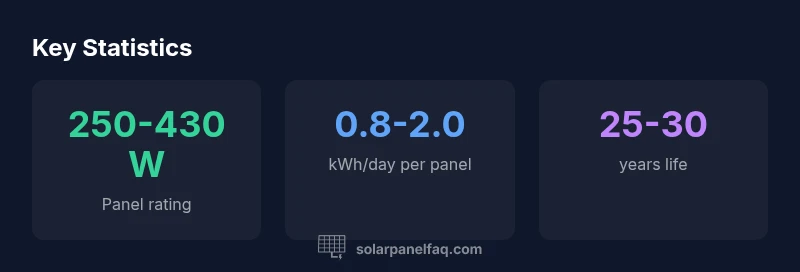
A single solar panel typically outputs 250–430 watts under standard test conditions, but real-world output depends on sun hours, orientation, temperature, and shading. Practically, a panel often generates about 0.8–2.0 kWh per day, depending on location and weather. To estimate your setup, multiply the panel rating by daily peak sun hours and apply losses for your region.
Why power from a single panel varies
If you ask how much power does 1 solar panel make, the straightforward answer is that it depends. A panel rated at a certain wattage under Standard Test Conditions will not always deliver that exact number in your yard. The actual output depends on how much sun shines on the panel, the panel’s orientation and tilt, the ambient temperature, and whether parts of the system are shaded or dirty. According to Solar Panel FAQ, real-world output is shaped by irradiance levels, which follow the sun’s arc across the sky and are affected by weather, season, and location. A 300 W panel may produce something close to that rating on a clear, unshaded afternoon, but only for a small portion of the day. In practice, homeowners see daily energy amounts expressed in kilowatt-hours that reflect both the panel rating and the local climate. The key takeaway is to start with the watt rating and then apply the sun-hours and losses for your region.
Key factors that determine power output
Power from a single solar panel is not fixed; several interacting factors set the final result:
- Sun hours: The more peak sun hours you receive, the more energy per panel per day.
- Orientation and tilt: Panels pointed toward the sun and tilted to optimize altitude produce more energy.
- Temperature: High temperatures can reduce voltage and overall output for crystalline silicon panels.
- Shading and soiling: Even partial shade or dust can dramatically lower power.
- System losses: Wiring, inverters, and age cause some losses.
In practice, homeowners in sunnier regions may see output closer to the panel’s rated wattage for much of the day, while those in cloudy or shaded areas will see lower outputs. Remember that the rating is a ceiling under ideal conditions.
STC vs real-world conditions
Panel wattage is rated under Standard Test Conditions (STC): a specific irradiance and temperature. Real-world conditions deviate: cold mornings, heat, partial shade, dirt, and aging reduce actual output. Solar Panel FAQ Analysis, 2026 notes that a derate factor commonly brings a portion of the STC rating down; a practical estimate is that real-world output is roughly 60-85% of the STC rating, depending on locale and setup.
Reading panel ratings and watts
Panel labels show wattage (W) and sometimes voltage (V) and current (A). A higher-watt panel can produce more energy, but efficiency and temperature coefficients influence performance under hot sun. The common shorthand: a 320 W panel rated under STC will still produce roughly 320 W only under ideal conditions. The rated efficiency, typically in the 15-22% range for residential panels, reflects the panel’s ability to convert sunlight to electricity. Temperature coefficients explain how output falls as temperature rises.
Estimating daily and yearly output per panel
To estimate, start with the rating W, multiply by the number of peak sun hours (which vary by location and season), and apply a derate to account for real-world losses. Example: for a 330 W panel with 4 to 5 peak sun hours per day, daily energy is roughly 1.3 to 1.7 kWh before losses. Apply an additional 10–25% loss for wiring, inverters, and dirt, which lowers the final figure to a realistic range.
Real-world examples by region
Consider two different climates: a sunny, low-latitude area with about 5 peak sun hours per day versus a northern, cloudier region with around 3.5 hours. In the first region, a 320–340 W panel may produce roughly 1.3–1.8 kWh per day, while in the second region, daily output per panel could fall to about 0.8–1.2 kWh. Seasonal changes will widen these ranges, with summer providing the best daily output and winter offering lower daily energy.
Putting it all together: a practical estimation for homeowners
Steps to estimate your panel output:
- Find the panel’s watt rating (W).
- Determine your location’s average peak sun hours per day (urban, rural, and seasonal factors matter).
- Multiply panel rating by sun hours to get a rough daily kWh, then subtract system losses (10–25%).
- Compare with your household energy usage to decide how many panels you need. Example: a 300 W panel with 4 hours of peak sun and 15% losses yields about 0.94 kWh per day.
Maintenance to maximize output
Keep panels clean and free of debris, especially in dusty or pollen-heavy areas. Check for shading from trees or building features that change with seasons. Ensure the mounting angle remains optimized for your latitude, and verify inverter operation and wiring connections are in good condition. Regular inspections can prevent efficiency losses and help keep real-world output closer to your expectations.
Monitoring and next steps
Use a monitoring system or a smart meter to track actual energy production over days, months, and seasons. Comparing measured output against your estimates helps refine future planning and may reveal panel or inverter issues that need attention. If you plan a larger installation, consult a solar professional to verify roof suitability, shading, and system sizing.
Key metrics for estimating single-panel output
| Metric | Value range | Notes |
|---|---|---|
| Panel rating (W) | 250-430 | Typical residential panel wattage range |
| Estimated daily output per panel (kWh/day) | 0.8-2.0 | Depends on sun hours and losses |
| Lifetime (years) | 25-30 | Typical warranty and durability |
Frequently Asked Questions
What is the difference between a panel’s watt rating and its actual output?
The watt rating reflects output under ideal conditions (STC). Real-world output is reduced by sun hours, temperature, shading, soiling, and system losses. Use the rating as a ceiling and apply a local derate to estimate actual production.
A panel’s watt rating is a best-case number; real output is lower due to sun hours, temperature, and shading.
How many panels would I need to meet a certain daily kWh goal?
Calculate daily kWh needs, estimate per-panel daily output for your location, then divide needs by per-panel output. Add a small safety margin for losses and future growth.
To meet a daily kWh goal, estimate per-panel output and divide your target by that number, adding a margin for losses.
Do inverters affect the output of a single panel?
Inverters affect overall system efficiency, not the instantaneous wattage of a single panel under STC. They influence how well panel power is converted and delivered to your home circuit.
Inverters don’t change a single panel’s wattage rating, but they impact how efficiently the system delivers power.
How does shading impact a single panel's power?
Shade dramatically reduces a panel’s output because even partial shading can block current flow. Regularly check for shading from trees, chimneys, or nearby structures.
Shade can dramatically cut a panel’s output; keep it clear of obstructions.
Does panel orientation change output in winter?
Orientation affects daily output year-round, but winter sun is lower in the sky. Proper tilt and azimuth still maximize winter production, though total annual output may be lower.
Yes—orientation matters year-round; winter sun is lower, so adjust tilt for optimal winter performance.
“Under real-world conditions, the power from a single panel depends on sun exposure, temperature, shading, and system losses; use the rating as a starting point, then adjust for your locale.”
Top Takeaways
- Start with the watt rating as a ceiling, not a guaranteed output.
- Real-world output is driven by sun hours, orientation, and temperature.
- STC ratings are a best-case baseline; plan for losses.
- Use a simple formula to estimate daily kWh per panel and adjust for your location.
- Regular maintenance and monitoring help maximize real-world performance.