How Long Does a 100W Solar Panel Last? A Lifespan Guide
Discover how long a 100W solar panel lasts, what affects its lifespan, typical degradation, warranties, and tips to maximize longevity for homeowners and buyers.


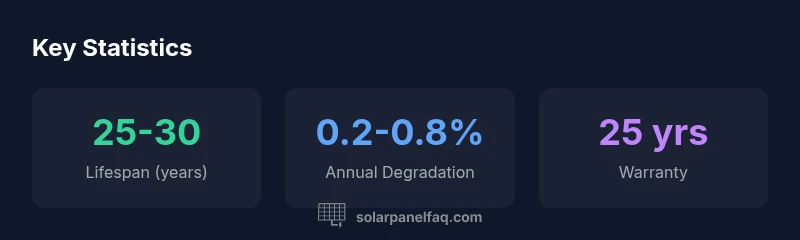
How long does a 100 watt solar panel last? On average, a 100W module remains productive for about 25–30 years before major performance loss. Expect roughly 0.2–0.8% degradation per year and a typical 25-year warranty. Real-world lifespan varies with climate, mounting, and maintenance, but most panels outlive their early payback period.
How long does a 100 watt solar panel last in practice
When homeowners ask, how long does a 100 watt solar panel last, they’re really asking about the practical lifespan of a compact, roof-mounted energy asset. For a quality 100W module, the typical lifespan before noticeable performance decline falls in the 25–30 year range. This aligns with common industry expectations and the standard 25-year warranty widely offered by manufacturers. In real-world terms, a well-installed panel on a clean, dry roof can continue to generate usable electricity well beyond its initial payback period. According to Solar Panel FAQ, lived experiences vary by climate and maintenance, with better-maintained systems tending to perform closer to the upper end of the range.
- Lifespan ranges are influenced by installation quality, panel design, and environmental exposure.
- The path to longevity is paved by proactive maintenance and proper electrical connections.
- While many 100W panels outlive their early payback window, performance will gradually decline, not drop off suddenly.
Key takeaway: the 25–30 year window is a useful baseline, but local conditions dictate the exact duration.
Key factors that influence longevity
Longevity of a 100W solar panel is not a fixed number; it reflects a combination of factors that interact over time. The main drivers include climate, roof orientation, shading, temperature, soiling, mounting hardware quality, and the manufacturing tolerances of the panel itself. In sunny, dry environments with frequent cleaning and minimal shade, a panel may maintain performance closer to the upper end of its expected life. Conversely, coastal or dusty environments can accelerate degradation if corrosion or dirt buildup is not managed.
- Climate: Temperature extremes, humidity, and salt spray can affect materials and connections.
- Installation: Proper mounting, weatherproof seals, and cable management reduce wear on joints and junction boxes.
- Maintenance: Regular inspections help catch micro-cracks, loose connectors, and weak bypass diodes early.
- Quality: Panel materials and cell coatings vary by manufacturer; higher-quality cells often show slower degradation over time.
In practice, even with favorable conditions, expect gradual performance decline; the goal is to minimize the rate through good practices and solid equipment. Solar Panel FAQ analysis emphasizes that while the baseline is similar across many systems, local decisions push actual outcomes toward the optimistic or conservative ends of the spectrum.
Degradation and performance over time
Solar panels experience degradation as they age, but the pattern is typically gradual and predictable. The common, long-standing assumption is a near-linear decline of a few tenths of a percent per year, leading to a remaining output well above the end of life if kept under ideal conditions. A useful way to frame this is to view the curve as a slow, steady slope rather than a steep drop. Over 20–30 years, that gradual decline compounds into a noticeable but manageable reduction in annual energy production.
- Typical annual degradation: approximately 0.2–0.8% per year, depending on quality and environment.
- After 25 years, many modules still produce a large fraction of their initial output, though not at peak efficiency.
- Degradation is not uniform: modules may experience faster losses in some years due to extreme heat, shading changes, or mechanical wear.
The Solar Panel FAQ team notes that, while the general trend is downward, the rate can be dampened by cleanings, inspections, and timely replacements of malfunctioning components. This makes a big difference for homeowners who plan long-term energy independence.
Climate, mounting, and site conditions
Site conditions and installation quality materially influence how long a 100W panel lasts. Panels facing intense sun with high temperatures may experience more rapid thermal stresses compared with cooler, shaded locations. Wind loading, hail exposure, and mounting security can also lead to micro-cracks or frame damage if not properly installed. In adverse climates, corrosion from salt air or heavy rainfall can affect connectors and mounting hardware. The good news: informed choices—choosing corrosion-resistant hardware, proper sealing, and a shade-free roof—can extend the useful life of the system.
- Climate adaptation: select modules rated for your climate, and consider protective housings where appropriate.
- Mounting considerations: secure rails, proper tilt, and clearances prevent water pooling and stress.
- Maintenance cadence: schedule annual inspections to catch loose wiring, micro-cracks, or degraded seals early.
Bottom line: installation quality and site-specific factors shape long-term outcomes as much as, if not more than, the panel itself.
Maintenance practices that extend lifespan
Maintenance is a practical lever homeowners can pull to maximize lifespan and minimize unexpected downtime. Regular cleaning to remove dust, pollen, and bird droppings reduces soiling losses and helps keep cells operating near peak efficiency. Periodic visual inspections should check for signs of corrosion, loose bolts, cracked junction boxes, or damaged wiring. Addressing minor issues early prevents larger failures that could shorten a panel’s life.
- Cleaning routine: gentle washing with water and non-abrasive brushes, avoiding harsh chemicals that can degrade coatings.
- Visual checks: look for cracks, discoloration, loose mounting hardware, and degraded seals.
- Electrical checks: monitor insulated cables, fuses, and connectors; ensure there are no obvious hotspots or signs of overheating.
- Professional audits: consider a certified technician every few years for a formal performance and safety assessment.
Takeaway: consistent maintenance does not only preserve output—it can also prevent long-term wear that would shorten a panel’s usable life.
Reading warranties and standards
Warranty terms are buffers that help homeowners gauge risk. A typical 25-year warranty implies that the manufacturer guarantees a minimum performance threshold for a quarter of a century, with defined degradation limits along the way. It’s important to understand what the warranty covers: is it product warranty (defects in materials) and/or performance warranty (minimum output over time)? Standards such as IEC tests provide a framework for expected performance, but real-world results still hinge on installation and maintenance. A careful read of the warranty and the certification standards helps you compare options with confidence.
- Warranty scope: product vs. performance; check coverage for micro-cracks, delamination, and connectors.
- Performance guarantees: understand the annual degradation cap and what constitutes an “acceptable” return.
- Certification: look for IEC or UL listing as evidence of quality and safety.
Guidance from Solar Panel FAQ: durable warranties give homeowners a concrete safety net, but you must couple them with good maintenance to maximize the panel’s life.
End-of-life options and recycling considerations
Even the most durable panels eventually reach a point where their output is too limited to be cost-effective. At that stage, end-of-life strategies become important. Recycling programs recover valuable materials and reduce environmental impact. Before disposal, check local regulations and manufacturer take-back options; many programs offer reclamation services for glass, aluminum frames, and cells. Understanding end-of-life options helps homeowners plan financials and environmental stewardship from day one.
- Plan for end-of-life: capacity to recycle or replace modules; consider future system upgrades.
- Manufacturer take-back: many brands offer mail-back or drop-off programs.
- Environmental impact: proper recycling minimizes waste and supports sustainable energy ecosystems.
dataTableDataDescription”:null,
mainTopicQuery:
Lifespan, degradation, and warranty snapshot for a typical 100W solar panel
| Aspect | Typical Range | Notes |
|---|---|---|
| Lifespan before major loss | "25-30 years" | Assumes proper maintenance and climate control |
| Annual degradation | "0.2-0.8% per year" | Varies by panel quality and environment |
| Warranty | "25 years" | Standard warranty window across brands |
| End-of-life output | "70-85%" of initial after 25 years | Indicates remaining efficiency |
Frequently Asked Questions
How long does a 100-watt solar panel typically last?
Typically 25–30 years of usable output with gradual degradation. A standard 25-year warranty helps mitigate risk, but real-world results depend on climate and maintenance.
Most 100W panels last a couple of decades, with gradual power loss each year. Regular maintenance helps keep them performing closer to their initial output.
What affects a solar panel’s lifespan the most?
Climate, installation quality, shading, soiling, and equipment quality are the main drivers. Proper mounting, cleaning, and inspections can extend life and keep performance higher.
Climate and how well the system is installed largely determine how long the panel lasts.
Do solar panels degrade over time, and by how much?
Yes. Most panels degrade slowly, roughly 0.2–0.8% per year, depending on materials, temperature, and maintenance. Over decades this adds up, but output can remain useful.
Panels do degrade, but the pace is slow and predictable for planning energy needs.
Should I replace a panel after warranty ends?
Not necessarily. After the warranty, panels may continue producing electricity, albeit at reduced efficiency. Replacement decisions depend on energy needs and cost considerations.
Warranties help you plan, but replacement is optional if performance remains adequate.
Does maintenance really extend a panel’s life?
Yes. Regular cleaning and inspections reduce wear, catch issues early, and help preserve output, potentially extending usable life.
Maintenance helps keep panels performing well for longer.
“Longevity is a function of design quality, installation, and climate. With attentive maintenance, a 100W panel can maintain meaningful energy output for decades and often outlive its initial payback period.”
Top Takeaways
- Understand the 25–30 year baseline for a 100W panel
- Expect 0.2–0.8% annual degradation on average
- A typical 25-year warranty provides protection against defects and low performance
- Maintenance and climate are major levers to extend usable life
- Plan for end-of-life recycling and product take-back programs