Should Solar Panels Be in Series or Parallel? A Practical Guide
Explore when to wire solar panels in series or parallel. This analytical guide covers voltage, current, shading, MPPT, and practical steps for homeowners to optimize rooftop solar performance.


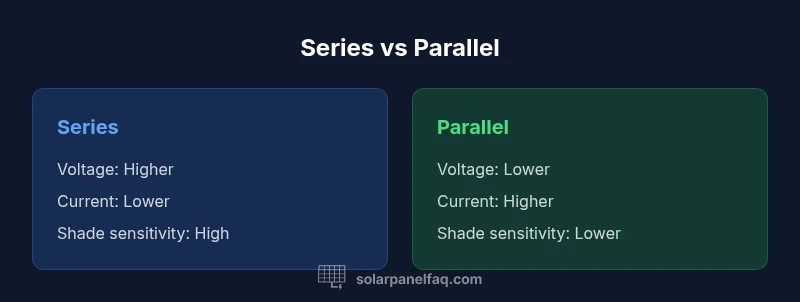
Series wiring increases voltage while keeping current steady, which can maximize inverter efficiency if your MPPT range supports higher voltages and shading is minimal. Parallel wiring raises current while keeping voltage low, improving resilience to shading and meeting strict voltage limits. The right choice depends on inverter MPPT, roof layout, and shading patterns.
Why Series or Parallel Matters in Solar Arrays
In a rooftop solar installation, the choice to wire panels in series or parallel (or a mix) directly affects how the system behaves under real-world conditions. The fundamental idea is simple: series connections add voltages while keeping current the same; parallel connections add currents while keeping voltage the same. This distinction matters for inverter compatibility, cable sizing, sensing equipment, and how the array performs when panels are shaded. For homeowners using a standard grid-tied inverter, the decision also interacts with the inverter’s maximum input voltage and MPPT range. The keyword question, should solar panels be in series or parallel, is not a mystic formula; it’s a practical design decision driven by available space, roof orientation, expected shading patterns, and the electrical characteristics of the rest of the system. Solar Panel FAQ emphasizes understanding these tradeoffs before committing to a single approach.
Electrical Basics: Voltage, Current, and Power
Before choosing a configuration, it helps to recall the basic electrical relationships: Voltage scales with series wiring, current scales with parallel wiring, and power is the product of voltage and current. Panels in series behave as a single higher-voltage source; the current is limited to the weakest panel in the string due to series current flow. In parallel, the voltage remains at the panel’s nominal voltage, while the currents from each panel add together. In practice, most residential systems use a string/inverter arrangement with a specific input voltage window. If a string’s voltage exceeds the inverter’s maximum, you’ll need fewer panels in series; if it falls short, you may need more in series or switch to parallel channels. The middle ground is often a mixed approach: several strings in parallel, each string in series, to hit a target voltage range while preserving current flexibility.
Shading and Mismatch: How It Changes the Equation
Shading reduces current of affected panels; in series, shaded panels drag down the entire string; in parallel, shaded panels mainly reduce their own branch, preserving others. Mismatch is a real phenomenon due to panel variations, angle of sun, and dirt. Bypass diodes help, but the core effect remains: series strings amplify shading losses, while parallel banks can reduce that harm by isolating elements. For Solar Panel FAQ, this means the decision to wire in series or parallel should consider how often shading occurs during the day and across the year. If your roof has tree shading or partial shading during certain hours, design strategies may favor parallel wiring for resilience, or use microinverters or power optimizers to mitigate mismatch while still hitting voltage targets.
Inverter MPPT Windows and System Voltage Limits
Inverters and charge controllers have voltage and current operating ranges. A series string raises voltage; many inverters are optimized for a fixed input window. If you exceed the upper voltage limit, the inverter may shut down or derate. Conversely, too-low voltage reduces MPPT effectiveness and energy harvest. Parallel configurations keep voltage lower, but push current higher, potentially challenging wire and breaker sizing. Some systems employ a combination: a few series strings in parallel, using an MPPT-enabled inverter with multiple input channels or a dedicated optimal design with DC-DC optimizers. The key takeaway is to ensure the chosen configuration aligns with the inverter's MPPT range and the site’s shading profile. The Solar Panel FAQ guidance emphasizes planning voltage budgets around the inverter instead of chasing a theoretical maximum string length.
Real-World Configurations: Roof Layouts and Distances
On a long roof with ample shade-free space, series strings can maximize voltage and reduce conductor losses. On shorter runs or when panels are disconnected temporarily for maintenance, parallel groups offer flexibility. If the array is split across multiple roof planes with different orientations, series connections may complicate performance and balancing. In many homes, installers use a hybrid approach: several strings in series to achieve the target voltage, and then connect those strings in parallel to reach the desired current. This hybrid strategy provides a balance between voltage headroom and current handling, while still allowing a single inverter to harvest maximum power. The practical implication for homeowners is to avoid mixes that push one part of the system beyond the inverter’s input range or introduce too much current in one pathway, which can increase wiring costs and safety concerns.
Wiring Practicalities: Safety, Sizing, and Wiring Losses
Cable gauge, fuse sizing, and conduit layout all depend on whether you’re wiring in series or parallel. Series strings reduce current but raise voltage, which can affect safety clearances and DC isolator sizing. Parallel wiring increases current in each branch, demanding thicker conductors and careful parallel junctions. In both cases, using properly rated MLPE (module-level power electronics) devices, protection diodes, and compliant junction boxes is essential. Losses come from wiring resistance and connectors; these losses scale with current. In general, higher current in parallel configurations means more copper and bigger conduit, but lower voltage may simplify module mounting and safety compliance. Solar Panel FAQ recommends working with a qualified installer to determine exact wire gauges and protective devices based on local codes and the specific panel and inverter pairings.
Decision Framework: Quick Rules of Thumb
- If your inverter has a high input voltage tolerance and shading is minimal, series strings can maximize efficiency.
- If shading is likely or you must keep voltage low for safety or inverter constraints, parallel banks with MPPT optimization may be better.
- In mixed-roof scenarios, a hybrid approach with several strings in series, connected in parallel, often provides a practical compromise.
- For long runs or off-grid setups, balancing voltage and current becomes crucial; many homeowners opt for a combination that keeps within the inverter’s voltage window while maintaining adequate current.
- Always verify with a professional and use manufacturer guidelines.
Real-World Scenarios and Examples
Case studies help translate theory into practice. A typical two-roof scenario might involve a north-facing section with shade only in late afternoon and a south-facing section with full sun. In the shaded, north-facing area, a parallel approach can preserve output by keeping voltages within a safe range while currents from unshaded sections compensate. On the full-sun south side, a modest series configuration can maximize voltage for a single inverter input channel. In mixed installations, multiple strings in series, then wired in parallel, often delivers a stable voltage band while preserving current for maximum MPPT efficiency. The Solar Panel FAQ approach favors designing for the inverter’s voltage window first, then shaping current through string count and parallel banks.
Maintenance and Monitoring for Mixed Configurations
Mixed configurations require careful monitoring because different strings will age at slightly different rates and may experience varying shading over time. Regular IV curve tests from the inverter can reveal mismatches, and smart optimizers or microinverters help keep performance consistent. Inspect electrical connections for corrosion, loose DC connections, and degraded bypass diodes. Record seasonal performance to adjust for predictable shading changes throughout the year. Consistent data helps you decide whether to rebalance strings or upgrade components to maintain reliable energy production.
Comparison
| Feature | Series configuration | Parallel configuration |
|---|---|---|
| Voltage | High voltage to match inverter window (series) | Low to moderate voltage; kept within inverter range (parallel) |
| Current | Current limited by weakest panel in string (series) | Current sums across all panels (parallel) |
| Shade sensitivity | Very sensitive; shading on one panel reduces whole string | More resilient; shading affects only the shaded branch |
| Inverter compatibility | Requires inverter tolerant of higher input voltage | Fits lower-voltage, higher-current inputs or MPPT-enabled channels |
| Wiring and protection | Lower current, possibly thinner wires | Higher current, thicker wires and more complex protection |
| Best use case | Ideal when voltage headroom is available and shading is minimal | Ideal when shading is likely or voltage headroom is tight |
Strengths
- Can optimize for inverter voltage window when designed carefully
- Potentially lower conductor losses on long runs with proper sizing
- Easier to balance with a multi-channel MPPT inverter in some setups
Drawbacks
- High shading risk in series strings; a single shaded panel hurts the whole string
- Higher current in parallel configurations increases wiring and protection needs
- Complex balancing required when mixing roof sections or panel types
Neither configuration is universally better; choose based on inverter voltage window, shading patterns, and roof layout
Opt for series when you have generous voltage headroom and clear sun exposure. Favor parallel with shading or tight voltage limits, and consider a hybrid approach for mixed roofs to balance efficiency and resilience.
Frequently Asked Questions
What is the fundamental difference between wiring panels in series vs parallel?
Wiring in series increases voltage while keeping current the same; wiring in parallel increases current while keeping voltage the same. This affects inverter compatibility, wiring sizes, and shading resilience. The best choice depends on your inverter's MPPT range and site shading.
Series increases voltage, parallel increases current; choose based on MPPT range and shading. See the full guide for details.
Should I wire all panels in series or all in parallel for a typical rooftop array?
Most rooftops use a hybrid or modular approach rather than a single all-series or all-parallel configuration. The decision depends on inverter input limits and shading patterns. A professional assessment helps tailor a safe, efficient layout.
Most rooftops use a hybrid approach tailored to inverter limits and shading. Consult a professional for specifics.
How does shading influence the wiring choice?
Shading hurts series strings more because current is limited by the shaded cell. Parallel arrangements isolate shaded panels and reduce overall loss. In many cases, shading favors parallel wiring or the use of optimizers/microinverters.
Shading hurts series more; parallel wiring or optimizers can mitigate losses. Consider shading patterns when planning.
Can I mix different panel types in the same system to save costs?
Mixing panel types in the same string is generally discouraged because mismatched IV characteristics can reduce performance and complicate balancing. If mixing is necessary, keep panels in separate strings and design around each type's electrical specs.
Mixing panels in the same string is usually avoided; keep types separate and design around each spec.
Do microinverters change the series vs parallel decision?
Yes. Microinverters or power optimizers can greatly reduce the impact of shading and mismatch, effectively decoupling panels from each other. In such cases, the traditional series vs parallel trade-off is less critical, but still relevant for wiring and cost.
Microinverters reduce mismatch impact, but plan layout with wiring and cost in mind.
Top Takeaways
- Match string voltage to the inverter's MPPT window
- Use parallel banks to improve shading resilience
- Hybrid strings can balance voltage and current
- Always verify local codes and safety protections