Series vs Parallel Solar Panel Connection: A Practical Guide
Compare series vs parallel solar panel connections for rooftop installs, covering voltage, current, shading, and design considerations to optimize home solar performance.


Series vs parallel solar panel connection affects voltage, current, and how a rooftop array handles shade and mismatches. Series increases voltage but keeps current low; parallel increases current while maintaining voltage, improving shading resilience. Most homes benefit from a hybrid approach with panel-level optimizers or microinverters to balance performance, safety, and wiring, rather than a single configuration for the entire array.
Understanding Series vs Parallel: Core Concepts
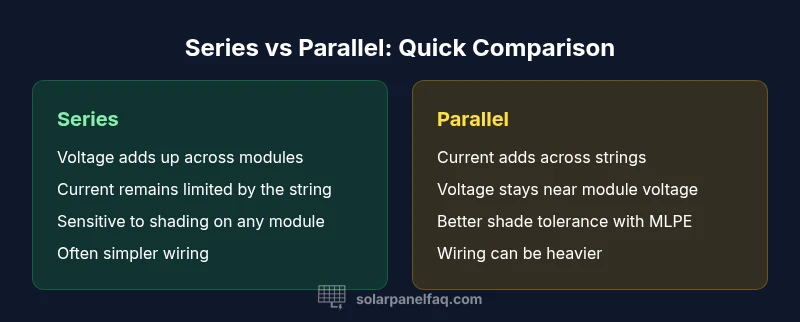
The series vs parallel solar panel connection hinges on two fundamental electrical properties: voltage and current. When you connect modules in series, their voltages add up while the current remains governed by the smallest cell in the string. In a parallel arrangement, currents add together while the voltage remains roughly the same as a single module. Understanding these differences helps you predict how an array behaves under varying irradiance and temperature. In practice, most residential installers think in terms of strings (series connections) that feed a common inverter, or parallel groupings that feed panel-level electronics. The goal is to match the array's electrical characteristics to the inverter's input and the site’s wiring constraints. The keyword series vs parallel solar panel connection captures the core trade-offs: higher voltage with fewer conductors in series, or higher current with more lines in parallel. For homeowners, the practical questions are about shading impact, safety clearances, and how to protect conductors and junction boxes. The right configuration depends on roof layout, cable lengths, and the energy management strategy chosen (string inverters, microinverters, or optimizers).
How Configuration Affects System Voltage, Current, and Power
Electrical power in a solar array is governed by the relationship P = V × I. In a series configuration, voltages add up across modules, while current remains limited by the weakest link in the string. In a parallel configuration, currents sum across strings, but the voltage stays near the level of a single module. Practically, this means a series-connected string can deliver higher voltage to a compatible inverter, reducing conductor thickness for the same power, while parallel strings deliver higher total current to an inverter with multiple inputs or a panel-level device. Designers must ensure the inverter and any DC wiring can safely handle the resulting voltage and current, factoring in temperature, cable length, and connector ratings. The goal is to maximize energy capture while maintaining safety margins and minimizing mismatch losses caused by shading or soiling. This section sets the stage for choosing between pure series, pure parallel, or a hybrid approach.
When to Use Series (Higher Voltage, Low Current)
Series configurations are often favored when the physical layout supports long DC runs with minimal current through each conductor. Higher voltage at the inverter input can improve efficiency over long distances because it reduces I²R losses in the cables. Series is also advantageous when using inverters that are optimized for higher input voltages or when combining a small number of high-voltage strings to match a fixed inverter voltage range. However, shading on even a single module can reduce the current of an entire string, causing noticeable drops in power output. In warm climates with clean panels and minimal shade, a series approach can be straightforward and cost-effective. Consider a series-first strategy if your roof geometry yields short wire lengths to the inverter and you can keep shading to a minimum.
When to Use Parallel (Higher Current, Lower Voltage)
Parallel connections excel in shading-prone environments or rooftops with multiple modules receiving different sun exposure. Because currents add while voltage stays stable, partial shading of one string has less catastrophic impact on the total array power. Parallel strings can also be more forgiving on wiring voltage ratings, as the total system voltage remains near the module voltage. This approach suits systems that feed panel-level electronics, microinverters, or optimizers, which can manage multiple input voltages and balance each string independently. Expect increased copper usage and possibly larger protection devices, but with the benefit of improved shade tolerance and modular maintenance. A parallel-first strategy pairs well with microinverters or optimizers to maximize performance under real-world conditions.
Hybrid Approaches and Modern Equipment
A growing number of residential designs use a hybrid approach, combining series strings with panel-level electronics to achieve both high voltage efficiency and shading resilience. In practice, microinverters or optimizers attached to each panel can compensate for mismatch losses without sacrificing the benefits of a higher voltage string to the main inverter. Hybrid configurations enable flexible system sizing, easier retrofit options, and better compatibility with existing inverters. Additionally, modern combiners and disconnects provide robust protection while maintaining clear separation between strings. When planning a hybrid configuration, ensure the inverter’s input stage and the MLPE devices can coordinate effectively, and account for maintenance access and labeling. This section outlines how to balance voltage, current, and protection in a single design.
Practical Design Guidelines for Homeowners
Designing a solar array around the series vs parallel question begins with your roof geometry, shading profile, and inverter choice. Start with a site assessment: map shade patterns by hour, measure roof area, and estimate cable lengths to the main service panel. Then determine an initial architecture: prefer series for long runs with compatible inverters, or parallel for shade-prone areas with MLPE. Use string sizing to ensure the chosen inverter can accept the combined voltage, and consider panel-level devices to mitigate mismatch losses. Finally, plan for safety and codes: install appropriate overcurrent protection, use correctly rated conductors, and label all connections. A thoughtful hybrid configuration can often deliver the best blend of efficiency, safety, and ease of maintenance over the system’s lifetime.
Comparison
| Feature | Series connection | Parallel connection |
|---|---|---|
| Voltage behavior | Voltage adds up with every module in the string | Voltage stays roughly the same as a single module |
| Current behavior | Current is limited by the weakest module in the string | Currents from multiple strings add together |
| Shade sensitivity | Highly sensitive; shading on one module affects the whole string | More tolerant; shading on one string has less impact on others |
| Wiring requirements | Lower current per string; often smaller conductors | Higher total current; may require larger cables and protective devices |
| Best use case | Long runs to a compatible high-voltage inverter; simple wiring | Shading-rich rooftops and systems with MLPE (microinverters/optimizers) |
Strengths
- Voltage optimization for long runs reduces conductor size
- Parallel strings improve shading resilience and mismatch tolerance
- Hybrid designs offer flexible system sizing and retrofits
- MLPEs simplify balance across strings and ease monitoring
Drawbacks
- Series can be severely affected by partial shading
- Higher current in parallel requires heavier wiring and protection
- Hybrid designs may increase upfront cost
- More complex design and maintenance requirements
Hybrid/MLPE approaches generally offer the best balance for residential systems.
For most homeowners, a hybrid configuration or panel-level optimization provides strong performance across shading scenarios and simplifies safety considerations. Purely series or purely parallel designs may suit specific sites, but the hybrid approach yields broader flexibility and easier future upgrades.
Frequently Asked Questions
What is the fundamental difference between series and parallel connections?
In series, voltages add while current stays the same; in parallel, currents add while voltage stays the same. This fundamental distinction drives how a solar array behaves under shade and over distance. Selecting the right approach depends on inverter compatibility, wiring constraints, and shading patterns.
Series sums voltages, parallel sums currents. The choice depends on inverter compatibility and shading.
How does shading affect series vs parallel strings?
Shading can dramatically reduce output in series strings because the current is limited by the weakest module. Parallel strings can mitigate some of this loss since unshaded strings continue to contribute to the overall current, especially when paired with MLPE devices.
Shading hurts series more; parallel with optimizers handles shade better.
Can I mix series and parallel in the same system?
Yes, many residential designs use a hybrid approach, combining series strings with panel-level optimizers or microinverters. This setup aims to balance high-voltage efficiency with shading resilience and modular maintenance.
Hybrid designs mix both to get the best of each approach.
What role do inverters and optimizers play with these configurations?
Inverters convert DC to AC and determine the voltage window the array must meet. Optimizers and microinverters manage panel-level performance, minimizing mismatch losses and improving shading response in mixed configurations.
Inverters and optimizers help balance the strings and boost real-world output.
Are there safety or code considerations I should know?
Yes. Follow local electrical codes, maintain clearances, use appropriate overcurrent protection, and ensure correct conductor sizing. Any mixed configuration should be reviewed by a licensed electrician to confirm compliance and safe operation.
Always have a professional check your wiring and codes.
Top Takeaways
- Assess roof shading and inverter compatibility before choosing config
- Series = higher voltage, lower current; parallel = lower voltage, higher current
- Hybrid/MLPE designs balance efficiency, safety, and maintenance
- Plan for future upgrades and local electrical codes
- Use module-level optimization to mitigate mismatch losses