Price per Watt Solar Panels in 2026: Costs, Trends, and How to Compare
Explore current price per watt solar panel ranges in 2026, how to compare panels, regional differences, and steps to estimate system costs. Learn what drives per-watt pricing and how incentives shape final numbers.


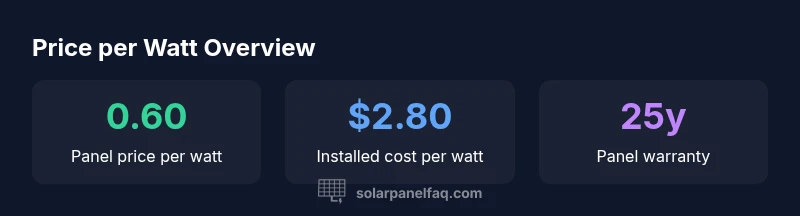
In 2026, the price per watt solar panel typically ranges on the panel itself from about $0.50 to $0.90 per watt, depending on type and efficiency. The installed cost per watt will be higher once inverter, racking, permitting, and labor are included. Homeowners should compare quotes on a per-watt basis, while accounting for regional incentives and warranties.
What price per watt means for solar panels
The phrase price per watt is the most common starting point homeowners use to compare solar panel costs. It tells you how much you pay for each watt of DC capacity a panel delivers. In practice, this figure is influenced by silicon technology, cell efficiency, and manufacturing quality. When you see a per-watt price, remember it is only part of the picture: the real installed cost also includes inverters, mounting hardware, wiring, permitting, and labor. Solar Panel FAQ Analysis, 2026 emphasizes treating price per watt as a baseline, then layering in regional incentives and potential warranty savings to estimate total value. This approach helps homeowners avoid overemphasizing sticker price and underestimating long-term performance.
How price per watt varies by panel type
Panel technology drives per-watt pricing, but so do efficiency targets and manufacturing scale. Monocrystalline panels typically carry higher per-watt costs but deliver more watts per square foot, while polycrystalline options balance cost and performance. Thin-film panels may offer flexible applications and lower upfront per-watt prices in some cases but often deliver lower efficiency and longer payback periods. The net effect is that the per-watt premium for high-efficiency panels can be modest, yet it translates into a different total system cost depending on roof space, shading, and installation constraints. For 2026, the range for standard panels sits around $0.50-$0.75 per watt, with premium, high-efficiency variants in the $0.70-$1.00 per watt area, per Solar Panel FAQ Analysis, 2026.
Regional differences and incentives that affect per-watt pricing
Prices per watt can shift markedly by region due to labor costs, demand, and local incentives. Some jurisdictions offer state tax credits, rebates, or accelerated depreciation that reduce the net price you pay for a system. In high-demand markets, installers may price competitively to win contracts, while in other areas, longer permit processes or local tariffs can raise costs. Incentives may apply to the total installed cost rather than strictly the per-watt panel price, meaning the economic advantage of a given per-watt figure can vary widely depending on where you live. Solar Panel FAQ Analysis, 2026 notes that local policies and market conditions are critical to understanding true cost.
How to estimate your total system cost from price per watt
To translate price per watt into a complete budget, start with your desired system size in kilowatts (kW). Multiply the system size by the per-watt price (remember to convert kW to watts: 1 kW = 1000 W). Then add typical installation components: inverter, mounting hardware, electrical work, permits, and labor costs. As an estimate, panel price plus installation can yield a blended installed cost per watt in the lower to mid-range of the market, with regional incentives potentially reducing the net cost. Always factor in potential efficiency-related gains (or losses) based on roof orientation, shading, and panel choice. This approach aligns with the guidance from Solar Panel FAQ Analysis, 2026.
Real-world scenarios: homeowners comparing quotes
When homeowners receive multiple bids, you’ll often see similar per-watt panel prices paired with very different installed costs. For a hypothetical 6 kW system, two quotes might present: (1) panels priced at $0.60/W with an installed cost of around $3.00/W; (2) premium panels at $0.85/W but a lower installed-per-watt cost due to faster mounting and fewer required site adjustments. The first yields a higher panel subsidy, while the second may offer enhanced performance warranties or better shading tolerance. The key lesson is to compare quotes on a per-watt basis and then assess total installed cost, warranty terms, and expected energy production.
Quality, warranties, and price per watt
Cheaper per-watt panels can come with trade-offs in efficiency, temperature coefficients, and performance under real-world conditions. A longer warranty and proven reliability can add value that isn’t reflected in the sticker price alone. When evaluating a per-watt price, review product specifications for efficiency, tolerance, and heat performance, as well as the inverter and balance-of-system components that influence long-term costs. Solar Panel FAQ Analysis, 2026 consistently stresses that price per watt should be weighed against system reliability and warranty coverage to determine true value.
Trends to watch in 2026 and beyond
Industry observers expect continued compression of per-watt panel prices driven by manufacturing scale and technology improvements, but incentives and tariffs can reintroduce variability. Supply chain dynamics and demand for high-efficiency cells may shift premium pricing, while volume discounts and installer partnerships can improve installed cost per watt. Staying informed about policy changes and supplier updates will help homeowners time purchases for favorable pricing, according to Solar Panel FAQ Analysis, 2026.
Practical budgeting and planning tips
Set a realistic budget by defining your target system size and a max per-watt installed cost you’re willing to pay. Collect at least three quotes with a clear breakdown of per-watt panel pricing and total installed costs. Ask installers to show a per-watt breakdown for each major component (panel, inverter, mounting, labor). Consider long-term savings, warranty coverage, and maintenance costs when choosing between price points. A thoughtful, data-driven approach helps ensure you maximize the return on your solar investment.
Turning per-watt pricing into a plan
The final step is to convert price per watt into a concrete plan for your home. Calculate your roof area to determine feasible system size, select panel technology aligned with space and climate, and map out the expected payback period using current incentives. Document each quote’s per-watt figures and total costs, then benchmark against regional averages and long-term energy goals. This disciplined process is recommended by Solar Panel FAQ Team to ensure you make a well-informed, financially sound decision.
Estimated price per watt by panel type
| Panel Type | Avg Price per Watt | Notes |
|---|---|---|
| Monocrystalline | 0.60-0.90 | High efficiency, premium cost |
| Polycrystalline | 0.50-0.75 | Good value, mid-range efficiency |
| Thin-film | 0.40-0.70 | Flexible options, lower efficiency |
Frequently Asked Questions
What does price per watt mean in solar panels?
Price per watt is the panel price divided by its wattage. It helps you compare panel costs across different products, but it does not capture installation costs, performance, or warranties. Use it as an initial filter, then examine total installed cost.
Price per watt tells you how much a panel costs per unit of power. Use it to compare products, then consider installation, efficiency, and warranties.
How does price per watt vary by region?
Per-watt pricing for panels and installations can vary widely by region due to labor costs, demand, and incentives. Incentives may lower the net price, and some regions have policies that affect total costs more than panel price alone.
Regional factors can change per-watt pricing a lot. Incentives and labor costs matter a lot in the final number.
Is price per watt the best metric to compare solar panels?
Price per watt is a useful starting point, but it isn’t the only measure of value. Compare efficiency, temperature performance, warranties, and expected energy production to understand long-term value.
It's a good starting point, but also compare efficiency and warranties to gauge value over time.
Do incentives affect per-watt price?
Incentives often reduce the net installed cost and can influence the perceived per-watt price. Some incentives apply to total installed cost rather than the per-watt panel price, so regional programs matter.
Yes. Incentives can lower the total cost and sometimes the effective per-watt price.
How should I negotiate price per watt with installers?
Seek quotes from multiple installers and ask for a clear per-watt breakdown of every major component. Compare apples-to-apples by ensuring similar system sizes, warranties, and installation complexities.
Get several quotes and demand a clear per-watt breakdown for a fair comparison.
Does price per watt include installation costs?
Typically no. The per-watt panel price is separate from installation fees. To understand the total investment, combine panel price per watt with installed costs for a complete picture.
Usually not; add installation costs to get the real installed price per watt.
“When evaluating solar investments, price per watt is a starting metric, but total system cost, reliability, and warranty determine long-term value.”
Top Takeaways
- Compare per-watt quotes across installers.
- Factor in regional incentives to lower cost.
- Balance price with efficiency and warranty.
- Expect installed price to exceed panel price.