Cost per Solar Panel in 2026: A Homeowner's Guide
Explore the cost per solar panel, factors that drive price, and how to estimate total installed cost in 2026. Includes incentives and financing guidance for homeowners.


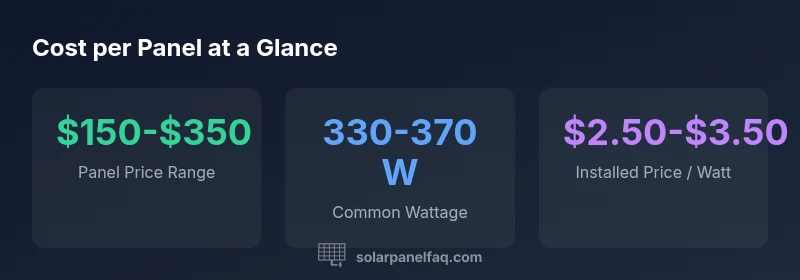
Typically, cost per solar panel ranges from $150 to $350 before installation. In 2026, total system price also reflects mounting hardware, inverters, and permitting, but the panel cost remains a major component. According to Solar Panel FAQ, shoppers should compare price per watt and consider long-term savings from efficiency and warranties rather than sticker price alone.
What cost per solar panel means in practice
For homeowners evaluating solar projects, the starting point is the cost per solar panel, but this number is only part of the story. The sticker price on a single panel does not capture the value you receive over the system’s life. According to Solar Panel FAQ, the best way to interpret panel pricing is to compare price per watt, not price per panel alone, and to couple that with estimated energy output, warranty length, and degradation rate. Most residential panels sold in 2026 fall into a broad price band of $150 to $350 before installation, with higher-efficiency models commanding the upper end. Variety exists because manufacturers chase different targets: efficiency, heat tolerance, and durability. From a homeowner’s perspective, the goal is to maximize kilowatt-hours produced per dollar spent, while maintaining a reliable warranty and reasonable maintenance cost. When you add in inverters, mounting hardware, and permitting, the panel price is a major, but not sole, driver of the project total.
The full picture: total system cost vs panel price
The sticker price of a panel is only one line item in a larger budget. A typical residential solar project includes the panel array, an inverter (or microinverters), racking and wiring, electrical labor, and permit fees. Balance-of-system (BOS) components can rival or exceed the cost of the panels themselves, depending on roof layout, shading, and local labor rates. In 2026, most homeowners see BOS costs ranging from a modest percentage to a substantial portion of the total installation. The exact mix depends on project specifics, but understanding how these pieces fit together helps ensure you’re not overpaying for a component you don’t actually need. An informed approach considers the long-term savings from higher efficiency and better warranties, which may offset a higher upfront panel price.
How to estimate cost per panel for your home
A practical method starts with your desired system size in kilowatts (kW). If you target roughly 6-8 kW for a typical home, you’ll likely need about 18-24 panels, depending on wattage. Suppose you obtain panels priced at $150-$350 each. Panel costs would be in the ballpark of $2,700-$8,400 for the array alone. Balance-of-system costs commonly add 50-70% more on top of the panel costs, though actual figures vary by roof type, location, and permitting. This means a rough installed price range of $4,000-$14,000 is plausible for the array plus BOS on a standard home. Use price-per-watt comparisons when quoting multiple installers to get apples-to-apples results, and factor in incentives that reduce net cost.
Pricing trends and market dynamics in 2026
Pricing for solar panels reflects supply chain dynamics, manufacturing capacity, and policy signals. Global production tends toward efficiency gains and higher cell efficiency, which can push up per-panel price slightly but reduce installed cost per watt through fewer panels needed. Tariffs and shipping costs influence regional variability, while domestic manufacturing investments can stabilize prices over multi-year horizons. Solar Panel FAQ analysis notes that price per watt has generally trended downward over the long term, but the pace can differ by market segment and geography. Homeowners should watch national and local incentives, as these directly affect net cost and payback periods. Staying informed about policy changes helps homeowners calibrate expectations and maximize value.
Panel types and price implications
Panel technology affects both cost and performance. Monocrystalline panels typically offer the highest efficiency and better space utilization, often with a higher price tag per panel. Polycrystalline panels tend to be cheaper per panel but offer slightly lower efficiency, which can necessitate more units to reach the same system size. Thin-film panels, while cheaper per watt in some cases, usually have lower efficiency and higher land or roof area requirements. For most homeowners with standard roof space, monocrystalline remains the preferred balance of performance and price, but regional incentives and space constraints can tilt the choice toward polycrystalline or even thin-film in niche situations.
Hidden costs to consider when calculating cost per panel
Don’t forget the extra items that add to the total bill. Shipping and freight can affect price, especially for remote locations. Mounting hardware, racking, wiring, and conduit are essential BOS components that add to the upfront cost. Labor for permitting, electrical work, and rooftop installation varies by region and contractor. Some projects also require upgrades to the electrical panel, which can be a notable expense. Budget for these items by requesting detailed quotes and itemized line items that separate panel costs from BOS costs. By understanding hidden costs, you avoid sticker shock and achieve a more accurate total.
Financing options and incentives shaping net cost
Financing options—cash purchase, loans, leases, or power purchase agreements (PPAs)—alter the visible price and the effective payback period. Tax credits and rebates reduce net cost and can vary by jurisdiction; some incentives apply at the federal level, others at the state or utility level. When evaluating quotes, include any applicable incentives and model how they affect your return on investment. A strong approach combines an upfront cost analysis with a long-term energy savings forecast to determine the true value of the investment.
How to evaluate quotes and avoid common pitfalls
To compare quotes effectively, ask installers to provide a consistent, itemized breakdown: panels (brand, model, kilowatt rating), BOS components, labor, permitting, and an exact installed price. Request price-per-watt figures for panels and total price per watt for the complete system. Check warranty terms for panels and inverters, and verify expected performance under real-world conditions. Look for third-party certifications and independent performance data. Beware aggressive discounts that omit essential BOS components or warranties, and prefer quotes with transparent, itemized scopes of work.
Scenario walk-throughs: small vs large homes
Small home scenario: A 5 kW system using mid-range monocrystalline panels priced around $180-$300 per panel could involve 16 panels. Panel cost would be roughly $2,880-$4,800. BOS costs may add 60% on top, bringing total installed cost to approximately $4,600-$7,680, depending on location and permits.
Large home scenario: An 8 kW system using higher-efficiency panels priced around $230-$350 per panel could involve 24 panels. Panel cost would be roughly $5,520-$8,400. BOS costs could add 60% more, yielding a total installed cost around $8,800-$14,000 or more with complex roof geometry or higher labor rates.
What Solar Panel FAQ recommends for homeowners
The Solar Panel FAQ team emphasizes a balanced approach: prioritize price per watt, warranty adequacy, and energy yield estimates alongside the panel sticker price. Consider financing and incentives to improve value and keep payback reasonable. A well-informed buyer screens quotes for BOS inclusions, avoids unnecessary upgrades, and selects a system that aligns with roof space and energy needs. In short, the best choice combines solid solar technology with transparent pricing and strong post-install support.
Typical panel types and price ranges (pre-installation)
| Panel Type | Avg Cost per Panel (range) | Typical Wattage | Notes |
|---|---|---|---|
| Monocrystalline | $150-$350 | 330-370 | High efficiency, best long-term value |
| Polycrystalline | $120-$280 | 300-340 | Moderate efficiency, lower cost |
| Thin-Film | $100-$220 | 100-170 | Flexible or specialized use, lower efficiency |
Frequently Asked Questions
What is the typical cost per solar panel in 2026?
Most panels cost $150-$350 before installation, depending on wattage and efficiency. The best approach is to compare price per watt and expected output across models.
Most panels cost between one hundred fifty and three hundred fifty dollars before installation; compare price per watt for real value.
How does panel efficiency affect price?
Higher efficiency panels often cost more per panel, but they may reduce the number of panels required and improve performance in shaded or limited-space roof layouts.
Higher efficiency panels usually cost more per unit, but you may need fewer panels and get better performance in tight spaces.
Do more expensive panels save money in the long run?
Expensive panels can offer better performance and longer warranties, potentially lowering payback time in favorable conditions. ROI depends on climate, shading, and energy use.
Better panels can pay off over time with higher output and longer warranty, but ROI varies by climate and usage.
Are prices different by region or installer?
Yes. Local labor, permits, and shipping influence installed prices. Getting multiple, itemized quotes helps ensure a fair comparison.
Region and installer matter for price; always compare several quotes.
Is buying in bulk or multi-panel discounts useful?
Installers often offer discounts for multiple panels, and the installed price per watt can decrease with higher volume. Always check the total installed price.
Yes, buying more panels can reduce the price per watt in many cases.
What about used or refurbished panels?
Used panels can lower upfront cost but carry risks like shorter warranties and uncertain remaining lifespan.
Used panels might save money upfront but come with warranty and reliability risks.
“The cost per solar panel is an important data point, but homeowners should evaluate price per watt, warranty, and expected energy output to judge true value.”
Top Takeaways
- Compare price per watt, not just sticker price
- Include balance-of-system costs in the total
- Account for incentives and financing to reduce net cost
- Choose panel type based on efficiency, warranty, and space
- Plan for hidden costs like labor and permits