Solar Price per Watt in 2026: A Homeowner's Guide
Learn current solar price per watt, factors that influence cost, regional incentives, and practical steps to estimate your installed price for your home.


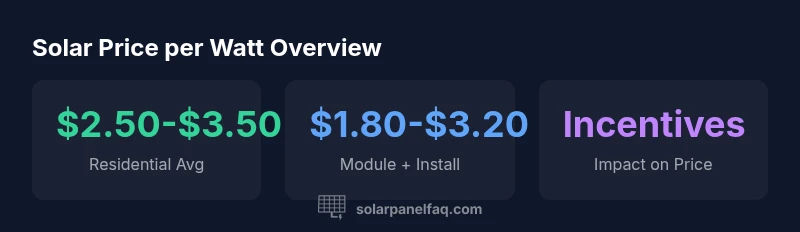
Solar price per watt typically ranges from $2.00 to $4.00 installed in the United States, with most residential systems landing around $2.50 to $3.50 per watt before incentives. Costs vary by roof complexity, panel type, inverter choice, and installation conditions. Regional incentives and utility programs can narrow the final bill, sometimes reducing the price per watt by 10–30% after rebates.
What price per watt really means for homeowners
For most homeowners, the price per watt is a practical way to compare different solar bids. It expresses the ramp-up cost divided by the expected system size, enabling apples-to-apples competition between installers and panels. In 2026, the typical installed price per watt in the U.S. sits in a broad band, but individual bids can swing widely based on equipment selection, roof geometry, and local permitting. According to Solar Panel FAQ, understanding this metric helps you budget accurately and evaluate incentives effectively while avoiding sticker shock during execution. This section lays the groundwork for interpreting the numbers you’ll encounter on quotes and proposals.
- Per-watt pricing makes it easier to scale up or down: a 6 kW system roughly doubles or halves the total price, depending on price stability.
- It’s a normalized unit: even if installers use different panel brands or inverters, price per watt lets you compare the underlying economics.
- Always consider the whole package: warranties, performance expectations, and annual degradation matter more than a single price point.
Using the per-watt lens, homeowners can align expectations with reality and avoid overpaying for hoops-jump installation processes. The Solar Panel FAQ Team emphasizes the value of a consistent unit when evaluating bids and incentives.
Core cost components that determine price per watt
The price per watt is not a single-number snapshot; it aggregates several cost components. The modules themselves account for a sizable portion, but inverters, mounting hardware, wiring, and labor all contribute. Permitting, interconnection fees, and the installer’s logistics influence the final tally as much as the panel efficiency. In many markets, regional labor costs and supplier competition shape the per-watt figure more than panel brand alone. The key components are:
- Panels: technology (monocrystalline vs polycrystalline), efficiency, and warranties.
- Inverter: string vs microinverters, efficiency, and monitoring features.
- Mounting hardware and racking: roof type, wind load requirements, and corrosion protection.
- Labor and permitting: crew hours, roof access, and local code compliance.
- Interconnection and grid readiness: utility charges and net metering rules.
- Soft costs: design, engineering, and project management.
Understanding these parts helps homeowners identify where price deltas come from and how to negotiate effectively. The Solar Panel FAQ notes that swapping a single component (e.g., upgrading to a higher-efficiency panel) can raise the per-watt price, but sometimes yields longer-term energy gains. Bottom line: know which line items are negotiable and which are essential to performance.
Pre-incentive vs post-incentive pricing: how incentives change the math
Incentives transform the economics of solar by reducing the upfront burden and improving payback. Pre-incentive price per watt reflects equipment and installation costs before any rebates, tax credits, or utility incentives. Post-incentive price per watt accounts for these programs, making a big difference in affordability. The timing and availability of incentives vary by state and utility, so prices can shift year to year. The Solar Panel FAQ Analysis highlights that incentives often compress the effective per-watt cost by 10% to 30% or more, depending on eligibility, system size, and whether you qualify for tax credits or cash rebates. When you compare bids, make sure you apply the same incentive assumptions to each quote so you aren’t comparing apples to oranges.
- Tax credits (e.g., investment tax credit where available) directly reduce the system cost.
- State and utility programs can add rebates or performance-based incentives.
- Net metering policies affect the effective value of energy produced, indirectly altering the perceived price per watt over time.
How roof type and installation affect the watt price
Roof characteristics dramatically influence the watt price because they affect installation complexity and system sizing. A simple, south-facing, unshaded roof typically yields lower per-watt costs than a roof with shading, multiple planes, or unusual angles. Additionally, roof material (asphalt, tile, metal) impacts mounting hardware requirements and sealing methods, which can add to labor time. Local weather patterns can affect crew productivity and scheduling, subtly shifting costs. The Solar Panel FAQ stresses that even identical system sizes can have different per-watt prices if the installation requires specialized racking, larger inverters, or additional electrical work. When planning, obtain a detailed site assessment that accounts for roof age, flashing, and potential requirement for microinverters or optimizers. A well-documented site survey prevents surprises and protects the value of your per-watt estimate.
Regional trends, incentives, and policy impacts
Regional policy landscapes shape prices per watt through incentives, interconnection rules, and permitting timelines. Some states offer strong incentives that reduce out-of-pocket costs and shorten payback periods, while others rely on federal tax credits with limited regional impact. Labor costs, contractor competition, and the availability of local solar equipment distributors also drive regional variation. In 2026, homeowners in high-activity solar markets may see more price stability due to competition, whereas areas with fewer installers can experience higher per-watt quotes. The Solar Panel FAQ Analysis notes that incentives such as rebates and performance-based incentives can significantly alter final pricing, even when module prices remain steady. Understanding these regional dynamics helps homeowners time purchases and target installers with favorable terms.
How to estimate your own price per watt: a practical method
Estimating your own price per watt starts with a realistic system size and an apples-to-apples scope across bids. A practical method is to:
- Define your target system size in watts (e.g., 6 kW).
- Gather quotes that include the same equipment package (panels, inverter, mounting, and monitoring).
- Subtract applicable incentives from the total installed cost, and divide by the system size to get post-incentive price per watt.
- Compare pre-incentive numbers to understand the raw costs and the value of incentives.
- Check for non-solar costs (permit fees, structural assessments, and grid-interconnection charges) that may vary by site.
The best practice is to collect multiple bids and verify that all quotes assume identical system specifications. Solar Panel FAQ emphasizes calculating per-watt figures with the same assumptions to avoid misinterpretation. After reviewing bids, you’ll have a clearer sense of your likely per-watt price and the role incentives will play in your final decision.
How to compare quotes and avoid common pitfalls
When evaluating quotes, structure the comparison around a consistent baseline. Ensure all bids use the same panel type, inverter technology, mounting system, and monitoring capabilities. Beware of quotes that show a lower per-watt figure but require expensive add-ons, higher maintenance, or limited warranties. Some installers may quote a competitive per-watt cost but exclude essential services such as roof penetrations, electrical upgrades, or interconnection fees. The goal is to compare apples to apples, not just the lowest sticker price. Also consider the installer’s track record, warranty coverage, and the expected annual energy production under standard test conditions. As Solar Panel FAQ notes, a higher upfront per-watt price can be justified if it yields better long-term performance, durability, and service support.
Interpreting the numbers: payback, ROI, and beyond
Per-watt pricing must be interpreted in the broader context of payback and return on investment. A higher per-watt price might still deliver superior performance or longer warranty protections, while a lower per-watt quote could entail higher maintenance costs later. Payback period, system lifetime energy output, and degradation rates are crucial for determining true value. When you factor in local electricity rates and expected consumption, you can estimate simple payback and long-term ROI. Solar Panel FAQ recommends evaluating both the upfront price per watt and the anticipated energy production to make a robust decision. Remember that non-financial benefits—energy resilience, property value, and environmental impact—also influence the overall value proposition.
Future price per watt: what to watch in 2026 and beyond
Looking ahead, price per watt will continue to respond to global supply chains, manufacturing efficiencies, and ongoing competition among module manufacturers. Innovations in cell technology and improved supply chain logistics can compress per-watt costs, while tariffs or trade tensions may create short-term spikes. Consumers should monitor policy changes, new incentive programs, and market consolidation, which can reshape pricing dynamics. The Solar Panel FAQ Team suggests following quarterly market updates to anticipate shifts in installed costs and to time purchases for favorable conditions. Keeping a close eye on these indicators helps homeowners plan effectively and avoid missing favorable windows for installation.
Comparison of price per watt by installation type
| Category | Typical installed price per watt | Notes |
|---|---|---|
| Residential roof (standard) | $2.50-$3.50 | Most common for homes |
| Residential roof (complex) | $3.00-$4.00 | Shading, multi-angle roofs, or difficult access |
| Commercial installation | $1.80-$3.00 | Volume discounts & larger system sizing |
Frequently Asked Questions
What is a typical price per watt for residential solar in 2026?
The typical installed price per watt for residential solar varies by region but commonly falls within $2.00 to $4.00 per watt before incentives. Post-incentive costs depend on rebates and net metering policies. Always compare bids on a per-watt basis.
In 2026, residential price per watt usually sits between two and four dollars, depending on incentives.
How do incentives affect the price per watt?
Incentives reduce the effective cost by rebates or tax credits, lowering the out-of-pocket per-watt price. Net metering and interconnection incentives can further reduce the price over time.
Incentives cut the per-watt price and can improve your payback period.
What factors cause price per watt to vary by region?
Local labor costs, permitting, interconnection rules, and installer competition drive regional differences. Weather and shading also impact the needed system size, indirectly affecting per-watt pricing.
Region and local rules change the per-watt price.
Should I focus on price per watt or total system price?
Per-watt comparisons help with bids, but total system price matters for budget and payback. Ensure quotes assume the same system size and equipment to avoid skewed comparisons.
Per-watt helps compare bids, but total cost matters.
How can I estimate my own price per watt at home?
Estimate by dividing expected installed cost by planned system size in watts, adjusting for incentives and installation complexities. Use a few quotes to refine.
Estimate by dividing installation cost by system size, then adjust for incentives.
“Price per watt is a practical, apples-to-apples way to compare solar bids. The true value comes from understanding incentives and local conditions.”
Top Takeaways
- Know the price per watt range to budget accurately
- Consider incentives and true-up costs to evaluate post-incentive price
- Compare quotes with the same system size and equipment
- Factor roof complexity and location into your watt price
- Use a per-watt metric to compare different bids