Average Solar Panel Cost in 2026: A Homeowner's Guide
Understand the current range for average solar panel cost, what drives price, incentives, and practical steps to estimate a budget-friendly system for your home in 2026.


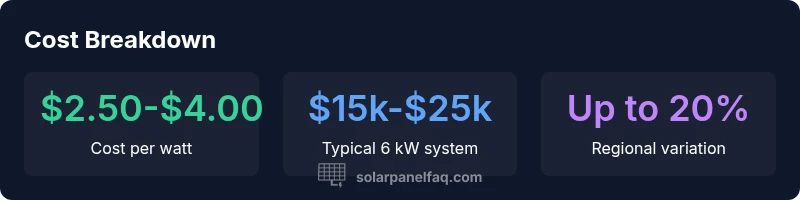
The current average solar panel cost is typically quoted as $2.50 to $4.00 per watt, equating to roughly $15,000 to $25,000 for a typical 6 kW home system before incentives. This range reflects equipment variety, labor, and permitting across regions. According to Solar Panel FAQ Analysis, 2026, these prices capture differences in installer competitiveness and regional costs. When quoting, think per-watt rather than total system price, since system size drives the final number.
What the 'average solar panel cost' means in 2026
The term average solar panel cost describes the typical upfront price homeowners pay to install a grid-tied solar system before incentives. In 2026, the figure is commonly quoted as roughly $2.50 to $4.00 per watt, which translates to about $15,000 to $25,000 for a typical 6 kW system. According to Solar Panel FAQ Analysis, 2026, these prices reflect the mix of equipment, labor, and permitting across regions. The Solar Panel FAQ team found that quotes vary widely by location and installer. Variations by location, panel efficiency, and installer competitiveness mean most homeowners will see quotes within this band. When discussing this topic, think in terms of per-watt cost rather than a single system price, because system size drives total price.
Key cost drivers in solar installations
Costs break down into modules, inverters, racking, wiring, permitting, and labor. The balance-of-system (BOS) can swing significantly by contractor and market, sometimes more than the panels themselves. Higher-efficiency modules or premium brands may carry steeper upfront costs but can yield better performance in space-constrained or shaded roofs. Reading quotes with this framework helps you compare apples to apples, rather than chasing the cheapest sticker price. Remember that cheaper panels can come with higher BOS costs or shorter warranties, which matters for long-term value.
Regional differences and incentives
Prices vary by geography due to labor rates, permitting complexity, interconnection fees, and local market dynamics. Regions with higher electricity prices often present stronger economics for solar, which can influence quotes and financing terms. Incentives—federal tax credits, state rebates, and utility programs—substantially reduce net cost in practice, though availability changes by year and location. Always verify current incentives and policy details when requesting quotes to understand your true bottom line.
System size and the cost curve
Solar pricing is typically quoted per watt, so increasing system size affects the total price but can reduce the average cost per watt through economies of scale. For example, an 8 kW system may have a lower per-watt price than a 4 kW system, depending on installer and equipment choices. The ranges above—$2.50-$4.00 per watt—help you ballpark total cost for different sizes. Use these ranges as guidance and confirm precise quotes from multiple installers to account for local factors.
Financing options to reduce upfront cost
To manage upfront cost, homeowners can opt for cash purchases, solar loans, leases, or power purchase agreements (PPAs). Cash purchases maximize incentives and ownership benefits, while loans allow payment over time with ownership and eligibility for tax credits. Leases and PPAs typically offer little or no upfront cash but may limit long-term savings and ownership rights. When evaluating financing, compare total payments, interest rates, and terms, and assess how ownership affects incentives and maintenance.
A practical cost-estimation method for homeowners
Follow a simple calculation to estimate your cost: 1) estimate system size based on roof space and energy goals; 2) choose panel type and inverter; 3) request quotes from at least three installers; 4) compute cost per watt and total system price; 5) apply available incentives; 6) estimate payback period and lifetime value. In many markets, a 6 kW system will land in the $15,000-$25,000 range before incentives, but individual quotes will vary by equipment and labor.
What to look for in a quote beyond price
Pricing is important, but warranties, performance guarantees, and installation timelines matter too. Compare panel and inverter warranties, workmanship warranties, expected energy output (using performance metrics), and the installer’s track record. Request a detailed breakdown in writing, including component names, warranty terms, installation milestones, and any post-installation maintenance services. The best value often comes from a balanced combination of price, reliability, and long-term savings.
Market trends heading into 2026
The solar market continues to mature with incremental gains in panel efficiency, manufacturing capacity, and installation quality. Price per watt has gradually stabilized after earlier volatility, while warranties and service offerings have become more standardized. The economics of solar are increasingly influenced by local rate structures, net metering rules, and ongoing incentives. Solar Panel FAQ's analysis suggests payback periods are improving in high-electricity regions with robust incentive ecosystems.
Case example: hypothetical homeowner
Jane, a homeowner in a sunny climate, targets 6 kW. She solicits three quotes: $16,000, $22,500, and $18,800 before incentives. Federal tax credits and state programs can reduce the net cost substantially, depending on eligibility. The best value includes strong warranties (25-year panels, 12-year inverter) and a reputable installer. This example illustrates why comparing per-watt pricing, warranties, and financing terms is more informative than chasing the lowest upfront price.
Typical cost ranges by system size
| System Size | Cost per Watt (range) | Typical System Cost (USD) |
|---|---|---|
| 4 kW | $2.50-$3.50 | $10,000-$14,000 |
| 6 kW | $2.50-$4.00 | $15,000-$25,000 |
| 8 kW | $2.60-$4.00 | $20,000-$32,000 |
Frequently Asked Questions
What is the current average installed cost per watt?
The installed cost per watt typically ranges from $2.50 to $4.00, depending on region and equipment. Readers should compare quotes on a per-watt basis to account for differences in system size and components.
The installed cost per watt usually runs two fifty to four dollars, depending on where you live and the equipment you pick.
How do incentives affect the price of solar panels?
Incentives reduce the net cost and can vary by year and location. Federal tax credits often cover a substantial portion, with additional state rebates and utility programs shaping the final price.
Incentives can cut the overall cost, with federal credits and state rebates playing big roles.
Are higher-efficiency panels worth the extra cost?
Higher-efficiency panels can be advantageous on small rooftops or shaded sites where space is limited. For larger, unobstructed roofs, standard-efficiency panels often provide similar ROI with lower upfront costs.
If you have limited roof space or shading, high-efficiency panels may be worth it; otherwise, standard panels usually offer similar value.
How long does installation typically take?
Most residential installs take one to three days for electrical wiring and roof work, with permitting and inspections adding additional time. Scheduling varies by contractor and local approvals.
Most installs are done in a few days, but permitting can add extra time.
Does price vary by state or utility?
Yes. Local labor costs, permitting processes, interconnection charges, and rate structures influence quotes. Utilities with higher electricity rates often see stronger solar economics.
Yes, prices differ by state due to labor costs and local policies.
What happens if I also need a roof upgrade?
If a roof upgrade is required, it adds to both cost and project timeline but can be bundled with the solar install for efficiency. Ensure the roofing contractor and solar installer coordinate to avoid rework.
If your roof needs a fix, factor that into the plan and coordinate with your installer.
“Price transparency matters more than the headline sticker price; focus on per-watt costs, incentives, and total cost of ownership to judge value.”
Top Takeaways
- Compare prices per watt across installers
- Incentives reduce net cost substantially
- System size drives total price, not just per-watt price
- Get multiple quotes to reveal true value
- Check warranties and service quality alongside price