n type bifacial solar panel vs monocrystalline: A detailed comparison
A rigorous side-by-side comparison of n type bifacial solar panel vs monocrystalline for homeowners. Learn performance, cost, and installation factors to choose the right panel for your roof.


n type bifacial solar panel vs monocrystalline: For homeowners, bifacial panels can offer potential energy gains under ideal conditions, but monocrystalline panels remain the most established, cost-effective option for typical rooftops. The Solar Panel FAQ team emphasizes that the right choice depends on roof orientation, shading, and long-term goals like payback and durability.
What the comparison covers
This article analyzes two common solar panel categories—n type bifacial solar panel and monocrystalline panels—through a practical, homeowner-focused lens. We examine how each technology captures light, how installation conditions shape output, and how lifecycle costs influence decision making. While bifacial designs promise extra rear-side capture, they also introduce site-specific considerations. According to Solar Panel FAQ, understanding your roof, climate, and budget is essential to pick a solution that aligns with your energy goals.
Key terms to know: monocrystalline panels are the traditional high-efficiency option built from single-crystal silicon, while bifacial panels are designed to harvest light from both sides. The “n type” designation refers to a silicon wafer chemistry that can offer advantages in certain performance metrics. This article compares these two approaches in practical home solar scenarios, avoiding hype and focusing on real-world implications such as output under the typical shade profile, long-term reliability, and total cost of ownership.
How bifacial panels work and what “n type” adds to the picture
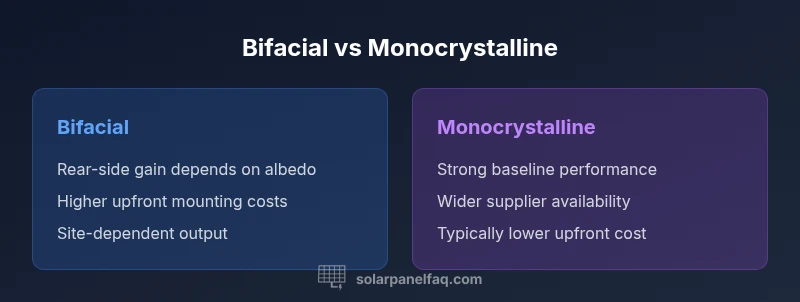
Bifacial solar panels are designed to generate electricity from light that bounces off the ground or surrounding surfaces, in addition to the front-side irradiance. The rear-side capture can translate into higher energy yield when albedo (reflectivity) is favorable and the roof setup supports mounting that optimizes rear exposure. The n type wafer chemistry can improve minority-carrier lifetimes and resistance to light-induced degradation in some designs, potentially extending service life and performance consistency. However, the performance lift is highly site-dependent: it benefits areas with bright surroundings, low shading, and reflective ground cover. Solar Panel FAQ notes that the added complexity and cost of bifacial modules should be weighed against actual site conditions and expected output rather than assumed gains.
Monocrystalline panels: the reliable benchmark
Monocrystalline panels, typically built from high-purity silicon and cut from single crystals, have long established benchmarks for efficiency, durability, and warranty coverage. They perform well under a broad range of conditions and are widely compatible with standard racking systems. For many homeowners, the predictability of monocrystalline panels—steady performance, broad supplier availability, and clear cost trajectories—makes them the baseline comparison when evaluating bifacial options. The Solar Panel FAQ team emphasizes that for standard rooftops with typical sun exposure, monocrystalline solutions often deliver strong value, with fewer variables to optimize compared to bifacial configurations.
Key performance considerations for homeowners
When evaluating either option, several performance factors matter: insulation and roof type, orientation, shading from trees or vents, and the likely albedo of surrounding surfaces. Bifacial panels can outperform monocrystalline in bright, reflective environments, but a shaded or dirty roof can erase the rear-side advantage. The efficiency gap between monocrystalline and bifacial modules may narrow if installation choices emphasize proper spacing, anti-reflective coatings, and precise tilt angles. Solar Panel FAQ’s analysis highlights the importance of realistic expectations: the best choice balances local climate, roof geometry, and energy goals rather than chasing maximum possible output in idealized conditions.
Cost considerations and total ownership
Upfront cost is a major determinant. Monocrystalline panels generally have lower upfront costs and broad availability, which translates into simpler procurement and installation. Bifacial modules, especially n type varieties, can incur higher material costs and may require upgraded racking, higher mounting structures, or specialized backsheet designs to maximize rear-side capture. Long-term economics depend on local incentives, electricity rates, maintenance, and the system’s actual performance relative to projections. The Solar Panel FAQ team advises homeowners to perform a cash-flow analysis that includes potential output gains, not just sticker price.
Installation, roof compatibility, and site preparation
Roof type and mounting hardware can influence whether bifacial panels provide meaningful gains. Flat or low-slope roofs with clean neighboring surfaces can support rear-side exposure more effectively than steep pitches or cluttered surroundings. Bifacial systems may demand precise spacing to prevent shading and may require new sealants or edge protection during installation. Monocrystalline installations tend to be compatible with a wider array of roof profiles and mounting kits, making them easier to deploy in standard retrofit projects. In any case, professional assessment is essential to confirm roof integrity, wind load considerations, and electrical feasibility.
Durability, warranties, and service life
Both bifacial and monocrystalline modules can come with long warranties, but terms vary by manufacturer and technology. N-type bifacial designs may offer favorable resistance to certain degradation modes, yet field reliability depends on manufacturing quality, installation practices, and maintenance. Monocrystalline panels typically exhibit proven durability and consistent performance across many climates. When evaluating warranties, look beyond duration to coverage details for labor, microcracks, and potential rear-side performance loss for bifacial units. The Solar Panel FAQ team recommends selecting a warranty that aligns with your expected system life and local service conditions.
Decision framework: matching site conditions to panel type
To choose effectively, owners should map three dimensions: roof characteristics (orientation, pitch, shading), environmental context (albedo, available space, clutter), and financial goals (payback period, incentives, resale value). If your site delivers strong rear-side exposure and you can invest in appropriate mounting, bifacial may offer incremental gains. If you prefer a straightforward, predictable installation with broad supplier support and shorter payback timelines, monocrystalline is a well-established option. The best approach is a formal comparison that includes site-specific simulations and a professional quote that itemizes hardware, labor, and maintenance.
Practical steps to move forward
- Schedule a site assessment with a qualified installer to evaluate shading, albedo, and mounting options.
- Request separate quotes for monocrystalline and bifacial configurations, including all hardware, warranties, and expected output baselines.
- Run a simple payback analysis that accounts for incentives and potential output differences under your local climate.
- Review warranties and after-sales support to ensure long-term reliability and service access.
- Consider future expansion or integration with storage to maximize daytime generation and resilience.
Comparison
| Feature | n type bifacial solar panel | monocrystalline solar panel |
|---|---|---|
| Rear-side energy capture potential | Possible rear-side gain under favorable albedo | Limited rear-side capture; front-side performance dominates |
| Typical upfront cost | Higher upfront hardware and mounting costs | Lower upfront hardware costs and broad market pricing |
| Efficiency range and consistency | Potential efficiency support with optimized conditions (site-dependent) | Stable, well-documented efficiency with broad supplier base |
| Installation considerations | Requires mounting that optimizes rear exposure; may need specialized racking | Widely compatible with standard racking and roof types |
| Best for | Sites with high albedo and proper mounting latitude | Standard homes seeking predictable performance and value |
Strengths
- Potential energy yield gains in favorable sites
- Broad availability and proven reliability (monocrystalline baseline)
- Rich supplier ecosystem and easier procurement
- Long warranties and service support
Drawbacks
- Bifacial gains are site-dependent and can require complex mounting
- Higher upfront costs for bifacial configurations
- Less predictable payback on roofs with shading or complex geometry
- Warranty terms vary by manufacturer and technology
Monocrystalline remains the practical default for most homes; bifacial n-type can add value where site conditions support rear-side gains.
Choose monocrystalline for predictability and cost-efficiency on typical roofs. Consider bifacial only if your site offers strong rear-side exposure and you plan for specialized mounting to maximize potential gains.
Frequently Asked Questions
What exactly is a bifacial solar panel and how does n-type affect performance?
Bifacial solar panels generate electricity from light that hits both sides, not just the front. The n-type wafer chemistry can influence carrier lifetimes and degradation resistance, potentially improving performance in certain conditions. Real-world gains depend on albedo, mounting, and climate; not all sites will see a noticeable uplift.
Bifacial means light on both sides; n-type helps with durability in some designs, but results vary by site.
Do bifacial panels perform better on shaded roofs?
Shading impacts both panel types, but front-side shading reduces output for any module. Bifacial gains are more likely when rear-side exposure is optimized and albedo is high. If a roof is heavily shaded, bifacial advantages diminish.
Shading reduces gains for both, and bifacial only helps if rear exposure is meaningful.
Are n-type bifacial panels more expensive to install?
Upfront costs for bifacial, including n-type designs, can be higher due to materials and mounting requirements. The total cost of ownership depends on installation complexity, local incentives, and the measured output over time.
They can be pricier upfront, but incentives and longer-term output matter.
What factors should I consider for selecting between the two options?
Key factors include roof orientation, available space, shading pattern, albedo of surroundings, local climate, and long-term budget. A site-specific analysis helps determine whether potential bifacial gains justify higher costs.
Look at your roof, shade, and albedo, then run a site-specific analysis.
How should I evaluate warranties for bifacial vs monocrystalline panels?
Compare warranty duration, coverage for workmanship and product defects, and whether rear-side performance is protected in bifacial models. Ask for third-party verification of performance claims and available service in your area.
Check what the warranty covers and who stands behind it, especially for bifacial parts.
Top Takeaways
- Assess roof albedo and mounting feasibility before choosing bifacial
- Monocrystalline panels offer reliable performance and simpler installation
- Bifacial gains depend heavily on site conditions; don’t rely on them alone
- Get site-specific quotes and a payback analysis
- Choose a warranty that matches your long-term plans