Mono-PERC Solar Panel vs Bifacial: An Objective Homeowner's Guide
An analytical, homeowner-focused comparison of mono-PERC and bifacial solar panels, covering efficiency, cost, installation considerations, and climate-specific performance.


Mono-PERC panels generally balance cost and reliability, while bifacial panels offer extra energy under high-reflectivity conditions. The best choice depends on roof geometry, climate, and budget. See our detailed guide for site-specific recommendations.
Definitions: Mono-PERC and Bifacial Panels
According to Solar Panel FAQ, the topic mono perc solar panel vs bifacial is central to understanding what homeowners install on a typical roof. For homeowners evaluating the topic mono perc solar panel vs bifacial, understanding their definitions is the first step. In simple terms, mono-PERC panels are monocrystalline cells with a passivated emitter and rear contact that improves efficiency by reducing recombination and light losses. They are the industry’s workhorse, offering a predictable combination of efficiency, durability, and cost. Bifacial panels, by contrast, generate electricity from both the front and the rear surfaces. Their total energy yield can increase when there is ample reflected light from the ground or nearby surfaces (albedo). The extra energy is not guaranteed in every installation, but in the right conditions it adds meaningful production over the lifetime of the system. For Solar Panel FAQ readers, the bifacial design often depends on mounting height, tilt, roof reflectivity, and climate. In practice, understanding the physics behind each option helps homeowners weigh output expectations, warranty terms, and long-term value. This block sets the stage for a deeper comparison of performance, cost, and installation considerations.
How the technology differs: cell structure, rear-side generation, and mounting implications
At the cell level, mono-PERC uses a single crystal structure with passivation to reduce recombination and reflectivity losses, delivering consistent performance under most conditions. Bifacial modules use cells similar to mono types but are designed to harvest light from both sides. The rear-side generation depends heavily on albedo and installation geometry; on bright surfaces like white roofs or light-colored gravel, rear-side gain can be substantial. Another difference is the mounting arrangement: bifacial panels often benefit from a gap above the roof line to allow rear illumination, whereas mono-PERC modules can achieve strong performance with standard mounting. Temperature behavior also matters; bifacial gains can help offset some derating on hot days, but the gap between front and rear efficiency narrows in high-temperature climates. In practice, performance results vary by site; Solar Panel FAQ analysis shows that to realize bifacial gains, you need careful layout, shading analysis, and perhaps higher-budget mounting hardware. For homeowners, this means weighing not just module efficiency but the whole system design.
Key performance determinants: efficiency, temperature, shading, and climate
Module efficiency is the headline metric, but real-world energy yield depends on many interacting factors. Mono-PERC modules typically deliver high efficiency in the 18-21% range under standard test conditions, with strong performance across a broad temperature range. Bifacial modules can push total energy yield higher when rear-side light is captured; however the front-side efficiency is still in the same ballpark as mono-PERC, with some products offering slightly higher front-side numbers. Temperature coefficient matters: as panel temperature rises, output falls; bifacial gains can mitigate some losses if rear-side irradiance remains strong (though the net effect depends on installation). Shading, orientation, and tilt determine how much of the roof or ground area contributes to energy production. In mixed climates with frequent cloud cover or diffuse light, bifacial gains may be modest; in arid, bright, reflective environments, the rear-side contribution can be more pronounced. Real-world data show that performance is highly site-specific. Homeowners should model expected annual output using system design software or professional estimates that consider albedo, ground reflectivity, and panel spacing. This section highlights the key physics behind why one solution may outperform the other depending on site characteristics.
Cost and value: up-front cost, installation, and long-term energy savings
Financially, mono-PERC panels typically deliver a lower up-front cost per watt due to broad manufacturing scale and a mature supply chain. Bifacial panels often carry a higher sticker price and may require specialized mounting hardware, taller racking, and reflective ground surfaces to realize gains. When evaluating value, homeowners should contrast the upfront cost with expected energy production over 20-30 years, i.e., the life cycle energy yield. Even when bifacial gains exist, the payback depends on local sunlight, albedo, and incentives. Solar Panel FAQ analysis shows that the cost-per-watt gap between mono-PERC and bifacial has historically narrowed as manufacturing scales grow, but the best overall value still hinges on site-specific energy yield and installation costs. For a typical rooftop with moderate sun and standard mounting, mono-PERC remains the most economical option; bifacial can offer meaningful returns where rear-side gain is reliable, such as high-reflectivity environments or ground-mounted systems oriented toward bright surroundings. Homeowners should obtain site-specific quotes and run a simple sensitivity analysis to understand how much extra energy (and money) bifacial gains would realistically deliver.
Installation considerations and roof suitability
Installation decisions for mono-PERC and bifacial panels share many elements, but bifacial arrays place extra emphasis on mounting height, tilt, and rear exposure. Roof condition and type (gable, hip, flat) influence practical spacing and airflow; bifacial gains often require more height to create a reflective cavity behind the rear side. Ground-mounted or carport installations provide the most opportunity for rear-side energy capture, while typical pitched-roof installations can still perform well if shading is minimized and albedo is favorable. Wiring strategy (string versus microinverters) and inverter sizing are similar across both technologies, but bifacial projects may necessitate slightly larger cables or more robust monitoring to track rear-side output. Permitting, ice and wind load considerations, and warranty terms must be reviewed before committing to a bifacial-heavy design. A careful roof and site assessment can reveal whether the added complexity is worth the potential gains.
Use-case scenarios: when each shines
Mono-PERC shines on standard rooftops with reliable sun exposure and moderate budgets, delivering strong cost-per-watt and broad availability. Bifacial shines in scenarios where rear-side capture is feasible: high-albedo roofs (light-colored surfaces), open ground spaces with reflective surroundings, and installations that allow sufficient height and spacing. In urban canyons with constant shade or overhangs, mono-PERC tends to provide more predictable results. For ground-mounted or carport installations near bright surfaces, bifacial arrays can add meaningful energy yield. Climate also matters: desert environments with bright sun favor rear-side gains, while cloudy, diffuse conditions limit them. Always run a site-specific energy model to quantify potential gains under your conditions.
Maintenance, warranties, and durability
Both technologies share long-term durability and standard warranties; typical modules offer 25- to 30-year manufacturer warranties and 10- to 25-year product warranties, depending on the manufacturer. Cleaning is usually minimal in dry climates, but for bifacial gains to persist, rear-surface cleanliness matters somewhat more than with mono-PERC. Regular inspections, inverter testing, and monitoring are recommended. Seasonal checks for shading from nearby trees, snow cover, and debris help maintain performance. The Solar Panel FAQ team notes that warranty terms and service networks can be a decisive factor in project viability, especially for bifacial installations that may involve more complex mounting.
Real-world data and caveats: region matters for gains
Real-world data show that bifacial gains are highly site-specific and often modest in many residential installations. Regions with high ground reflectivity or snow cover can see noticeable rear-side contributions, whereas dense urban rooftops may suppress rear-side irradiation. The reliability of mono-PERC remains high across climates, making it a safer default for most homeowners. The Solar Panel FAQ team emphasizes using performance modeling tools and a professional assessment to translate lab efficiency into site-specific energy yields, while accounting for local incentives, permitting timelines, and maintenance costs. Always compare quotes that include albedo-related design considerations.
Practical decision checklist for homeowners
- Define roof geometry: tilt, orientation, shading, and available space.
- Measure ground reflectivity and albedo potential around the installation site.
- Run a site-specific energy yield estimate for mono-PERC and bifacial options.
- Compare total installed cost, financing, and incentives; evaluate payback potential.
- Check warranties, service options, and expected degradation rates.
- Decide on mounting approach (standard roof, elevated racks, or ground-mounted) and inverter strategy.
- Obtain multiple quotes and run a sensitivity analysis for rear-side gains.
- Make a final decision based on site physics, not just upfront price.
Authority sources
This article references authoritative sources to provide independent context for the mono-PERC vs bifacial comparison.
- National Renewable Energy Laboratory (NREL): https://www.nrel.gov/pv/
- U.S. Department of Energy – Office of Energy Efficiency & Renewable Energy (EERE): https://www.energy.gov/eere/solar
- U.S. Energy Information Administration (EIA): https://www.eia.gov/solar/
Comparison
| Feature | mono-PERC solar panel | bifacial solar panel |
|---|---|---|
| Typical front-side efficiency range | 18-21% | 18-22% |
| Rear-side energy capture potential | Minimal to moderate | Moderate to significant under favorable albedo |
| Cost range (installed, per watt ballpark) | Lower upfront cost | Higher upfront cost |
| Best use-case | Standard rooftops with good sun | High-albedo sites or ground-mounted with space |
| Maintenance & warranty complexity | Typical warranties; straightforward maintenance | Similar warranties; may require more precise mounting |
Strengths
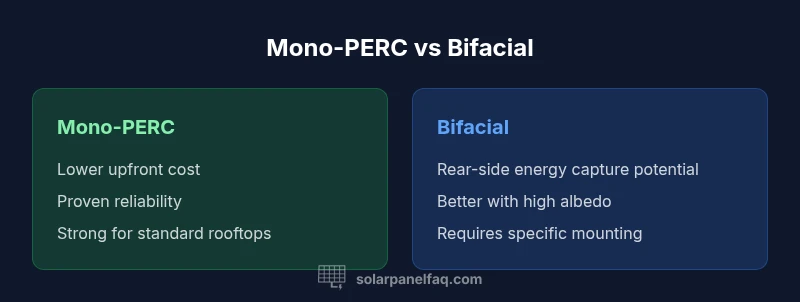
- Lower upfront cost on average for mono-PERC
- Proven reliability and broad availability
- Easier to source and install due to mature supply chain
- Predictable performance on typical rooftops
Drawbacks
- Lower potential energy yield in some environments
- Bifacial requires reflective surfaces and specialized mounting
- Higher upfront costs and design considerations for bifacial
- Output gains are site-specific and not guaranteed
Mono-PERC panels are generally the safer default for most homes; bifacial panels offer incremental gains when rear-side capture is reliable.
For typical roofs, mono-PERC provides the best balance of cost and predictable output. Bifacial can add value where albedo and mounting height enable rear-side gains, but only with thoughtful installation and site conditions. The Solar Panel FAQ team's perspective emphasizes modeling site-specific yield before committing.
Frequently Asked Questions
What is the main difference between mono-PERC and bifacial solar panels?
Mono-PERC panels use a single crystal with rear-contact enhancements for efficiency, while bifacial panels harvest light from both sides. The rear-side gain depends on reflectivity and installation geometry.
Mono-PERC are the common, reliable choice; bifacial can add extra energy when the site reflects light well.
Are bifacial panels worth it for typical rooftops?
For most homes, mono-PERC offers the best value. Bifacial panels can pay off where there is strong rear-side irradiance, such as high-reflectivity roofs or open ground near bright surfaces.
They can be worth it if your site supports rear-side gains.
Do bifacial panels require reflective roofs?
Bifacial gains increase with higher rear-side irradiance, which is more likely on reflective surfaces, but they do not require them to function. Gains are site-dependent.
Not strictly required, but helpful for more energy.
How does shading affect each type?
Shading reduces energy for both types, but bifacial gains can compensate if rear-side light remains available. Overall, shading impact is highly site-specific.
Shade hurts both, but bifacial can be more sensitive to rear-side shading.
What about payback period differences?
Payback varies by region, climate, incentives, and installation costs. In many cases, mono-PERC offers shorter payback, while bifacial may improve return where rear-side gains are reliable.
The payoff varies; model your site to see real numbers.
Which is better for small rooftops or condos?
Mono-PERC is typically safer for smaller spaces due to proven performance and cost. Bifacial could be considered if the site allows rear-side generation and there is adequate clearance.
Mono-PERC is usually easier for small spaces.
Top Takeaways
- Choose mono-PERC for cost-efficiency and reliability
- Bifacial adds rear-side gains where albedo conditions are favorable
- Model site-specific energy yield before deciding
- Consider mounting height and reflective surroundings for bifacial
- Check warranties and service networks as part of the decision