Amorphous solar panel vs monocrystalline: A Homeowner’s Guide
Compare amorphous thin-film vs monocrystalline solar panels to decide what fits your home: efficiency, cost, installation, and long-term value examined for homeowners.


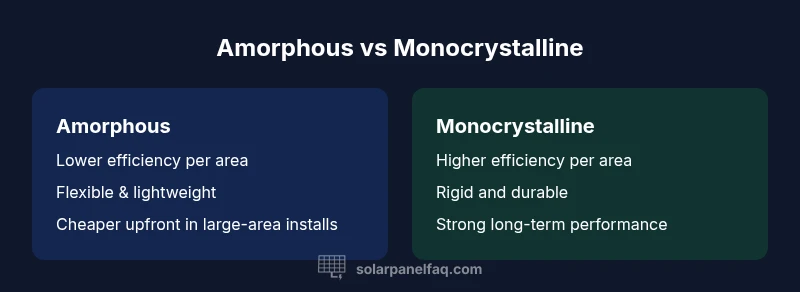
Monocrystalline panels typically offer higher efficiency and space efficiency on standard rooftops, while amorphous thin-film panels are cheaper upfront and can excel on large-area surfaces or non-traditional installations. For most homes, mono wins for performance and roof fit; amorphous may be attractive for budget-first projects or flexible surfaces. The choice hinges on roof geometry, climate, and long-term value.
Amorphous solar panel vs monocrystalline: Core differences
According to Solar Panel FAQ, the choice between amorphous solar panel vs monocrystalline often hinges on efficiency, installation context, and budget. In residential settings, monocrystalline panels are typically favored for their higher output per square meter, which translates to more energy from a smaller roof area. Amorphous, or thin-film, panels excel in situations where space is less constrained or where surfaces are uneven or flexible. This section outlines the core distinctions to help homeowners understand what drives the decision.
- Materials and manufacturing: Monocrystalline cells are grown from single silicon crystals, yielding higher efficiency; amorphous cells are deposited as thin film, enabling flexibility.
- Performance envelope: Mono panels maintain strong performance under standard conditions, while amorphous can perform comparatively better in diffuse light and high-temperature environments.
- Physical attributes: Mono panels are rigid and heavy; amorphous panels are lighter and can be more flexible or adaptable to non-traditional surfaces.
From a practical standpoint, the amorphous solar panel vs monocrystalline comparison shows that there is no one-size-fits-all answer; the right choice depends on roof layout, climate, and budget. The Solar Panel FAQ framework highlights trade-offs between upfront cost, land-area requirements, and long-term performance.
Key performance differences between amorphous solar panel vs monocrystalline
Understanding the performance gap is essential for a decision that matches your home, climate, and goals. Monocrystalline panels are known for higher efficiency and better output per area, which means you can generate more electricity from a smaller roof. Amorphous panels, by contrast, offer advantages in certain real-world conditions, particularly where light is diffuse or where surfaces differ from flat, rigid rooftops.
- Efficiency and space: Monocrystalline generally provides higher efficiency per square foot, making it well-suited for tight roof footprints. Amorphous panels deliver lower efficiency per area but can cover irregular shapes more easily.
- Shade and diffuse light: In real-world conditions with shade or diffuse daylight, amorphous panels often maintain more usable output than traditional crystalline panels, though this depends on how the system is designed and mounted.
- Temperature effects: Temperature changes influence performance; amorphous thin-film panels often show resilience in hot conditions, while crystalline panels can experience more pronounced drops in very hot climates.
- Weight and installation geometry: Amorphous panels tend to be lighter and more flexible, enabling installation on curved surfaces or atypical frames where rigid crystalline panels would struggle.
When evaluating amorphous solar panel vs monocrystalline, consider your roof geometry, local climate, and how you value space efficiency versus outright peak output. This choice will shape your system sizing, mounting requirements, and overall value proposition over time.
Durability, warranty, and degradation patterns
Durability and warranty expectations differ across panel technologies, and those differences can influence long-term cost and satisfaction. Monocrystalline panels have a well-established track record in many markets, supported by lengthy warranties and robust post-installation performance data. Amorphous panels vary more by manufacturer, with some models emphasizing durability and others focusing on cost containment. Degradation rates and warranty terms can impact long-term energy production and replacement costs.
- Degradation trajectory: Crystalline panels generally exhibit predictable, slower degradation over time, whereas amorphous panels may show different long-term behavior depending on the film composition and environmental exposure.
- Warranty coverage: Warranties for monocrystalline modules are typically found across main markets with standardized terms, while amorphous warranties may vary more by supplier or installation context.
- Field performance: Real-world performance depends on installation quality, mounting angle, cleaning regimes, and shading; a well-installed system can outperform expectations for either technology.
In all cases, verify manufacturer warranties, service options, and warranty transferability before purchasing to avoid surprises later.
Cost considerations and life-cycle value
Cost considerations extend beyond upfront price. Both amorphous and monocrystalline panels have different life-cycle value drivers, including installation costs, space requirements, energy yield, and maintenance. Amorphous panels may offer lower upfront cost in certain large-area deployments, particularly where surface area is abundant and roof geometry is challenging for rigid panels. Monocrystalline panels typically command higher upfront costs but can deliver higher energy output per square meter, which may reduce longer-term installation costs or the need for supplementary panels.
- Upfront vs long-term costs: Amorphous panels might reduce initial capital outlay in specific projects, but you should account for the larger area required to reach the same energy production as mono.
- System sizing implications: With lower per-area efficiency, more mounting space may be needed in the amorphous option to achieve your target energy production, affecting roof assessment and racking.
- Maintenance and access: Heavier or less flexible formats may influence access for cleaning and maintenance, impacting ongoing performance.
To arrive at a fair comparison, model both options against your roof area, climate profile, and budget horizon, using the same system sizing parameters.
Installation and roof-fit considerations
Roof geometry and mounting considerations strongly influence the practical choice between amorphous solar panel vs monocrystalline. Amorphous panels’ lighter weight and flexibility often make them attractive for curved roofs, skylights, carport covers, or non-traditional surfaces where rigid modules would be difficult to install. Monocrystalline panels, while heavier and rigid, tend to offer easier long-term performance and a smaller physical footprint for the same electrical output in conventional rooftop installations.
- Surface compatibility: If you have a curved or irregular surface, amorphous could be a feasible option where traditional panels are impractical.
- Racking and mounting: Racking setups for amorphous systems may be simpler for certain shapes, but ensure weatherproofing and wind load calculations are accurate.
- Aesthetics and resale value: Monocrystalline modules present a uniform, recognizable appearance that many homeowners prefer for resale value, though aesthetics are subjective.
The takeaway is to consult with a qualified installer who can model output, wind resistance, and shading for your exact roof geometry, then compare the costs and performance projections for each technology.
Environmental impact and recycling considerations
Environmental impact is a growing consideration for solar panels, from material sourcing to end-of-life recycling. Amorphous thin-film panels have different manufacturing footprints and recycling pathways compared with crystalline modules. Some consumers prioritize broader environmental benefits, including energy payback periods and facility efficiency, while others focus on the longevity and recyclability of the panel type. When assessing amorphous solar panel vs monocrystalline, examine the supplier’s sustainability disclosures, regional recycling options, and local environmental regulations.
- Material life-cycle: Each technology has distinct material footprints; consider the end-of-life processing options and recycling availability.
- Energy payback: Take into account the energy required to manufacture and transport panels relative to lifetime energy output, especially in climates where energy generation is lower for longer periods.
- Waste considerations: Ensure proper disposal pathways for decommissioned panels to minimize environmental impact and meet regulatory requirements.
Real-world scenarios: when amorphous wins vs when mono wins
To illustrate how the amorphous solar panel vs monocrystalline decision plays out in real homes, consider two common scenarios. In a large, shallow-roof project with ample area and budget constraints, amorphous panels can deliver a cost-effective, scalable solution. In a compact urban rooftop with strong sun exposure and a premium on roof space, monocrystalline modules typically maximize energy output and provide quicker payback and higher resale value.
- Scenario A (large area, mixed orientation): Amorphous panels may help cover surface area efficiently and reduce installation complexity, especially if a curved or complex roof is involved.
- Scenario B (small roof, high sun): Monocrystalline panels are usually the preferred choice due to higher efficiency and space efficiency.
- Scenario C (shade-tied sites): Evaluate system design for shading; amorphous panels can perform comparatively better in diffused light, but the overall system sizing remains critical.
Each scenario demonstrates that the amorphous solar panel vs monocrystalline decision must be rooted in site-specific constraints and goals.
How to evaluate a panel: a step-by-step approach
Evaluating whether amorphous or monocrystalline makes sense for your home involves a clear, repeatable process. Start with your roof geometry and available space, then consider climate, shading, and your budget horizon. Gather panel datasheets and warranty terms from multiple manufacturers and request performance simulations from installers. Finally, compare total installed cost and projected energy yield based on your location.
- Define targets: annual energy needs, available roof area, and budget. 2. Collect specs: efficiency, temperature coefficient, and warranty. 3. Run local shading analysis and system sizing. 4. Compare lifetime value: energy yield, maintenance, and end-of-life costs. 5. Factor in intangible considerations: aesthetics, brand reliability, and local support.
Comparison
| Feature | amorphous solar panel | monocrystalline solar panel |
|---|---|---|
| Typical efficiency range | lower efficiency per area | higher efficiency per area |
| Best use-case characteristics | Budget-focused large-area or curved surfaces | Space-constrained roofs with high energy needs |
| Shade and diffuse light performance | Better under diffuse light (amorphous) | More sensitive to shade (monocrystalline) |
| Temperature stability | Amorphous: resilient in heat | Mono: more temperature dependent |
| Weight and flexibility | Lighter, flexible formats | Rigid, heavier modules |
| Durability and warranty patterns | Variable warranties by maker | Established warranties for crystalline |
| Cost and space efficiency | Lower upfront cost per large area | Higher efficiency per area, less space |
Strengths
- Lighter weight and flexible formats suitable for non-traditional surfaces
- Potentially lower upfront costs in large-area deployments
- Better performance under diffuse light in some climates
- Easier installation on curved roofs or unusual geometries
Drawbacks
- Lower efficiency per unit area requiring more roof space
- Warranty variability and potentially less mature data for some manufacturers
- Long-term performance may vary with climate and maintenance
- Higher total area requirements can increase mounting complexity
Monocrystalline panels generally offer better efficiency and space efficiency for typical home roofs.
The Solar Panel FAQ team recommends prioritizing efficiency and roof fit when choosing panels. The majority of homes will benefit from monocrystalline performance, while amorphous may suit large-area or budget-focused projects under specific site conditions.
Frequently Asked Questions
What is the key difference between amorphous solar panels and monocrystalline panels?
The main difference is material and efficiency. Amorphous panels use thin-film technology and typically have lower efficiency per area but can be more versatile on non-traditional surfaces. Monocrystalline panels are crystalline and generally offer higher efficiency and better performance in standard rooftop installations.
Amorphous panels are thin-film and flexible, while mono panels are crystalline and more efficient on rooftops.
Are amorphous panels flexible or curved-friendly?
Yes, amorphous panels can be lighter and more adaptable to curved or irregular surfaces compared to rigid monocrystalline panels. This makes them useful in non-traditional installations, though you’ll trade off energy density.
Amorphous panels can bend and fit curved surfaces, unlike standard rigid mono panels.
Which lasts longer, amorphous or monocrystalline panels?
Durability depends on construction and environment. Monocrystalline installations have a long track record with strong warranties in many markets. Amorphous panels vary more by manufacturer and may have different degradation patterns.
Mono panels tend to have a longer, more predictable track record, but check the warranty for amorphous models.
Do amorphous panels perform well in hot climates?
Amorphous thin-film modules can exhibit favorable performance in high temperatures due to different material properties, but overall energy output depends on many factors including area and shading. Consider local climate and system design.
They can do well in heat, but design matters for total output.
Is amorphous better for shading than mono?
Amorphous panels often handle diffuse light better than some crystalline modules, making them a potential choice for shaded sites. However, actual performance depends on system layout and balance of components.
Amorphous may perform relatively better in shade, but plan the system carefully.
What should homeowners consider when choosing between amorphous and mono?
Focus on roof space, climate, shade patterns, and long-term cost. Obtain multiple quotes that include performance simulations and warranty terms to compare total value.
Look at roof space, climate, and warranties before deciding.
Top Takeaways
- Compare roof space to energy needs before choosing
- Assess shading conditions to gauge performance impact
- Prioritize efficiency for compact roofs and high-sun climates
- Consider amorphous options for large-area, curved, or budget-conscious installs
- Verify warranties and local support before purchase