Bifacial Solar Panel vs Monofacial: Which Is Right for Your Roof?
Learn how bifacial vs monofacial solar panels compare in energy yield, cost, mounting options, and climate performance to decide the best fit for your roof and budget.


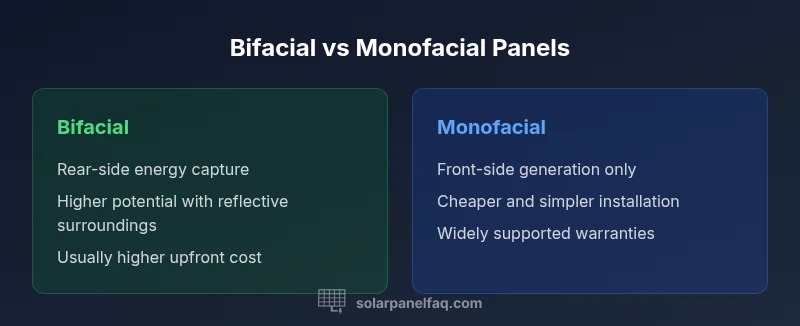
Bifacial solar panel vs monofacial: bifacial modules can generate energy from both sides when rear irradiance is available, potentially boosting output in the right mounting conditions. Monofacial panels stay simpler and typically cheaper upfront, making them the default choice for most homes. The choice hinges on roof space, mounting geometry, and local climate; this comparison weighs the trade-offs.
What Are Bifacial and Monofacial Panels?
In the context of solar technology, bifacial solar panel vs monofacial describes two families of modules designed to harvest light differently. Bifacial panels are built to collect sunlight from both the front and rear surfaces when light reflects off surrounding surfaces such as a white roof or snow. This rear-side capture can increase total energy production under favorable conditions. Monofacial panels, by contrast, capture most of their energy from the front surface with little to no rear input. The Solar Panel FAQ team notes that the decision often hinges on mounting geometry, surface albedo, roof orientation, and local sun exposure. homeowners should weigh whether their site provides sufficient rear irradiance and reflective surfaces to justify the added complexity. For many residences, the simplicity and lower upfront cost of monofacial panels remain appealing, but bifacial technology can offer meaningful gains in the right setup.
How Bifacial Panels Work Differently
Bifacial panels use thin, transparent back sheets or glass backs and specialized frame designs to harvest light from the rear side. Rear-side cells are not shadowed by the frame in all installations, and the electrical path is designed to collect energy that enters from behind the panel. The key is rear irradiance, which depends on mounting height, tilt, and nearby reflective surfaces. When sunlight strikes the front face and reflected light returning from the ground or nearby materials hits the back, the module can generate additional current. Monofacial panels, with conventional construction and framing, rely entirely on front-side absorption. In most residential setups, the rear contribution is modest unless the installation is optimized for rear-side capture.
Key Performance Factors
Performance depends on several interrelated factors. First, albedo or surface reflectivity matters: bright white roofs, concrete, or snow can enhance rear-side irradiance for bifacial panels. Second, mounting geometry matters: elevated, gap-filled racking and clean rear airflow reduce shading and allow rear exposure. Third, tilt and orientation influence the amount of rear light reaching the back surface. Fourth, system design, including bypass diodes and electrical configuration, affects how rear-side energy is integrated into total output. In general, bifacial panels excel when the installation can consistently expose the rear to reflected light, while monofacial panels perform reliably with standard roof-slope installations and typical sun exposure. The precise gains depend on site conditions, making a professional site assessment essential. When approaching bifacial vs monofacial choices, compare expected rear irradiance, mounting options, and local climate to quantify potential advantages.
Site and Mounting Considerations
The practical viability of bifacial panels hinges on site conditions beyond the panel itself. Rooftop installations with adequate height and clear rear area can reduce shading and encourage rear light capture. Ground-mounted systems with highly reflective surfaces or white ballast can also boost rear irradiance, especially when mounted away from tall obstructions. For residential roofs, traditional mounting remains straightforward and cost-effective, while bifacial setups may require specialized rails, wider frames, or edge clearance to avoid shading. In all cases, cleaning and maintenance should account for both faces if accessible, and professionals should verify structural compatibility and wind load ratings. If rear irradiance is uncertain, a pilot assessment or a small-scale test installation can help quantify potential gains before committing to a full bifacial deployment.
Cost and Value Considerations
Pricing for bifacial vs monofacial panels reflects more than the price tag of the modules themselves. Bifacial technology often carries a higher upfront cost due to dual-sided design, specialized mounting requirements, and potential need for higher-quality reflective surfaces. On the other hand, the potential for higher energy yield in suitable installations can translate into greater long-term value, especially where space is limited or where a rooftop faces abundant rear-light opportunities. When evaluating cost, consider installation labor, mounting hardware, potential racking adjustments, and any permitting or warranty implications. Solar Panel FAQ analysis shows that the residential ROI for bifacial systems relies heavily on site-specific rear irradiance and albedo; where those conditions are favorable, bifacial panels can improve overall system economics.
Climate and Environment Impacts
Climate and environment influence how much rear-side energy bifacial panels can harvest. In snowy or highly reflective climates, rear irradiance can be more significant as snow reflects sunlight onto the back surface. In hot, shaded, or urban environments with lower albedo, the rear contribution may be smaller. Temperature plays a role as well: bifacial cells behave similarly to monofacial cells under heat, but the slight difference in thermal coefficients may affect overall performance. For homeowners in milder climates with highly reflective surroundings (light-colored roofs, light ground cover), bifacial panels may provide more noticeable gains. Always model performance under typical seasonal conditions to estimate potential benefits accurately.
Durability, Warranties, and Maintenance
Durability for bifacial panels is generally on par with monofacial panels, but warranty coverage and maintenance practices can differ. Some manufacturers offer warranties specifically covering rear-side performance, while others provide standard product and power warranties. Maintenance considerations include cleaning both faces where accessible; however, rear-side cleaning can be challenging in tightly spaced roof lines. When evaluating warranties, check depth of coverage for environmental stressors, potential backsheet degradation, and any requirements for professional inspection. A well-chosen bifacial system should align warranty terms with local climate and mounting configuration to ensure long-term reliability.
Practical Scenarios: When to Choose Each
- Choose bifacial panels when rear irradiance is reliably available: elevated or ground-mounted systems with reflective surroundings, snow, or white roofing can maximize rear-side gains. - Opt for monofacial panels when installation simplicity, cost, and proven performance are priorities: typical residential rooftops with standard sun exposure and minimal rear irradiance still deliver solid returns. - Consider site-specific modeling: a professional assessment using shading analysis, albedo measurements, and tilt optimization will clarify whether bifacial gains justify the added complexity. - Evaluate long-term goals: if you anticipate expanding the system or reconfiguring the site later, bifacial installations may offer flexibility with modular mounting and grid interconnection, but ensure compatibility with local codes and warranties.
Common Misconceptions
- Misconception: Bifacial panels always produce more energy. Reality: Gains depend on rear irradiance and albedo; in some sites, monofacial panels perform just as well. - Misconception: Bifacial panels require a high-cost roof replacement. Reality: Many installations work with existing roofs if mounting and spacing allow rear exposure. - Misconception: Bifacial technology is only for commercial-scale projects. Reality: Residential bifacial installations are feasible, though less common, and can be cost-effective in the right conditions.
You Should Do Next: Site Assessment Checklist
- Confirm rear irradiance potential: assess reflective surfaces around the installation site. - Check roof height and clearance to ensure rear exposure is not blocked by obstructions. - Obtain a professional shading and albedo analysis to estimate possible gains. - Verify warranty terms and mounting compatibility for bifacial options. - Run a simple ROI calculation that accounts for installation costs, maintenance, and potential energy yield under realistic seasonal conditions.
Comparison
| Feature | Bifacial solar panel | Monofacial solar panel |
|---|---|---|
| Energy yield potential | Potentially higher with rear irradiance | Front-side yield only |
| Installation complexity | Higher due to rear-side considerations and mounting | Lower; standard mounting suffices |
| Initial cost | Higher upfront cost due to dual-sided design | Lower upfront cost typical |
| Space efficiency | Better use of space in reflective setups | Conventional space usage |
| Best use case | Rooftops/ground with high rear irradiance or reflective surroundings | Typical residential rooftops with standard sun exposure |
| Maintenance considerations | Rear-side cleaning can be more challenging | Easier maintenance on front-only surface |
Strengths
- Potential for higher total energy output in suitable installations
- Space-efficient mounting and better use of limited roof area
- Improved performance in diffuse light and partial shading
- Future-ready technology with growing industry support
Drawbacks
- Higher upfront cost and more complex installation
- Requires site-specific analysis of rear irradiance and albedo
- Warranty and maintenance considerations can be more complex
Bifacial panels offer higher potential energy yield in the right conditions, but monofacial panels remain the safer, cost-effective default for most homes.
Choose bifacial if your site provides strong rear irradiance and reflective surroundings. Otherwise, monofacial panels are typically more straightforward and cost-efficient for standard residential installations.
Frequently Asked Questions
What is the difference between bifacial and monofacial solar panels?
Bifacial panels harvest light from both the front and rear sides when rear irradiance is available, potentially increasing energy yield. Monofacial panels collect light primarily from the front. The choice depends on mounting, albedo, and climate conditions.
Bifacial panels capture light from the back when conditions allow, possibly boosting output. Monofacial panels only use the front side. Site conditions determine the benefit.
Do bifacial panels require a special mounting?
Yes, bifacial installations often require higher clearance and sturdy mounting to maximize rear exposure. The mounting must minimize shading on the back surface and allow airflow for cooling.
They usually need higher clearance and sturdy mounting to let the back face catch light, so plan for specialized hardware.
Are bifacial panels more expensive?
Bifacial panels typically cost more upfront due to dual-sided design and mounting needs. Long-term value depends on site conditions and energy gains, which may offset the higher initial investment.
They usually cost more at first, but gains depend on your site’s rear irradiance.
Can bifacial panels be used on existing roofs?
They can be used on existing roofs if the mounting system can provide adequate rear exposure. It may require retrofits or reinforced racking to maintain clearance and airflow.
Yes, but you may need special mounting to ensure rear-side exposure.
How should I estimate potential gains with bifacial panels?
Work with a professional to model rear irradiance based on albedo, mounting height, and tilt. Compare with a baseline monofacial design to estimate potential gains under typical seasonal conditions.
Have a professional model rear irradiance and compare to a standard design.
What about warranties for bifacial panels?
Warranty terms vary by manufacturer. Some cover rear-side performance specifically, while others apply standard power and product warranties. Verify coverage for environmental exposure and rear-side degradation.
Warranties differ by maker—check if rear performance is covered.
Top Takeaways
- Assess rear irradiance and albedo before choosing bifacial tech
- Weigh installation complexity against potential energy gains
- Consider roof or ground reflectivity and mounting options
- Factor in warranties and maintenance when comparing costs
- Model ROI with site-specific conditions to avoid overpaying